
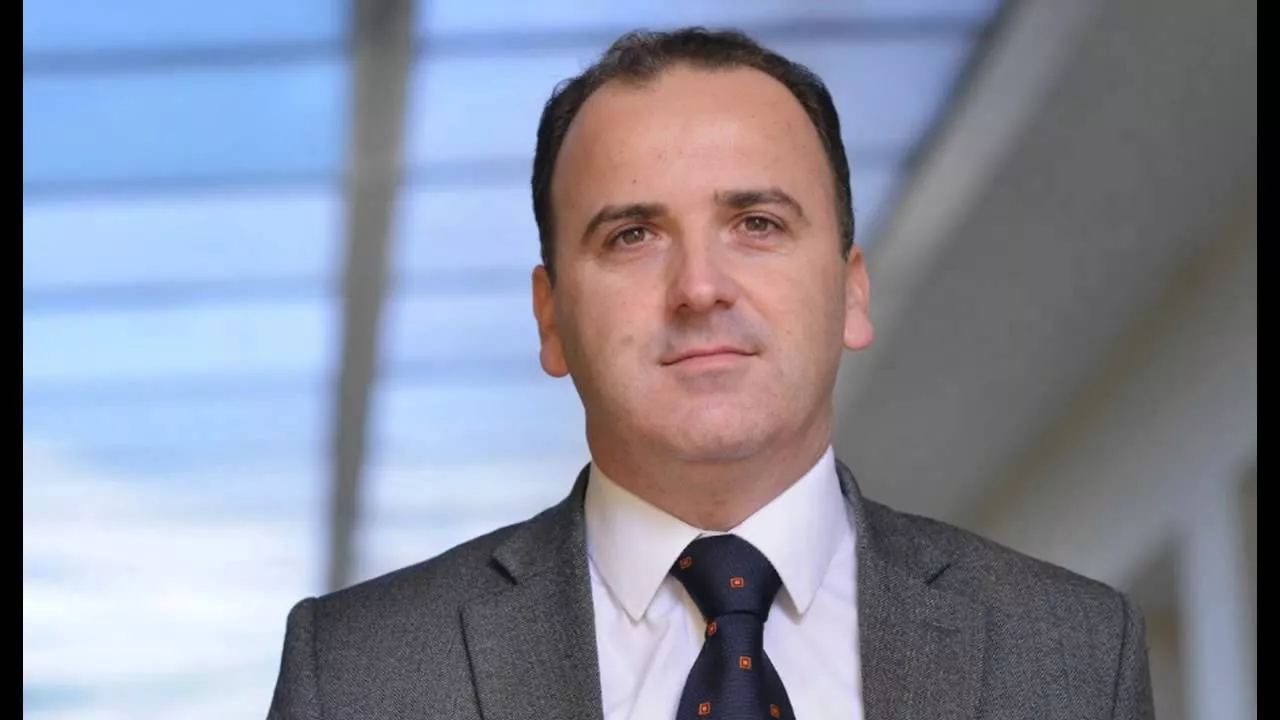
Prof. Dr. Dženan Đonlagić, full professor at the Finance Department of the Faculty of Economics, University of Sarajevo and DF representative in the Parliament of BiH, said that the most important strategic goal of the entire federal Law on Mitigating Negative Economic Consequences (the so-called „Corona Law“) in the real sector must now be TO STOP THE TREND OF LAYING OFF WORKERS.
„Let us repeat, urgently stop the growing number of layoffs! The focus now must be to preserve as many jobs as possible in the real sector of the economy and nothing else in this short term. And those jobs in sectors whose operations are negatively affected, i.e., caused by the spread of the COVID-19 infection. Financial support should now go only to those affected by the coronavirus. The law, with part of its measures, should also take into account the population of independent workers who are in the category of so-called „freelancers“, because they are probably also affected by reduced demand for their intellectual services, or even job loss“, Đonlagić states.
How to determine whose business is specifically a consequence of this?
„By summing up the realized revenues for January and February 2020, determining their average, and then for someone to be eligible for support, they must have revenue in, say, April that is 20% or more lower compared to the average revenue from the first two months of the current year. And so on for each subsequent month! This will make it very clear which activities and their economic decline are a consequence of the spread of the infection caused by the coronavirus, and only those, which is also fair, should receive a financial injection.
According to the text of the Draft Law adopted by the Government of the Federation of BiH and which is now publicly available, it seems to me that the above-mentioned goal is not fully maximized, i.e., it is only partially achieved. The proposal envisions subsidizing, but what? Only that part of personal income (salary) that relates to the corresponding contributions for mandatory insurance (pension, health, and unemployment insurance). Here, public funds from the Budget of the Federation of BiH will only be redistributed through contributions and returned to the state treasury as such. However, to maximize the aforementioned strategic goal, it is necessary to invest a little more effort to reach a solution to implement the following measure, which is subsidizing minimum wages and corresponding contributions for all workers in the real sector“, Đonlagić emphasizes.
So, in this short term, for example, the next three to four months, the Budget of the Federation of BiH, and even cantonal budgets (let them make rebalances for 2020), should jointly cover both the minimum wage and the corresponding contributions with their financial resources.
„If the Government of the Federation of BiH is ready to subsidize contributions in the amount of 244.85 KM monthly per employee (according to its own Proposal), then let it also subsidize the amount of the minimum wage of about 406.00 KM from the announced „Stabilization Fund“.
Well, just by rebalancing the federal budget for 2020, it has been announced that 250 million KM can be injected into the mentioned Fund, and this amount could cover the entire support package for the economy: both the minimum wage and contributions.
There is no sense in financing benefits from the „Stabilization Fund“ for the unemployed who, due to layoffs, will end up on the records of cantonal Employment Services (so-called Employment Bureaus). Isn't it better to subsidize their minimum wage with all contributions so that workers do not get laid off in the coming hours, days, and months? Otherwise, an avalanche of new layoffs could follow with much greater intensity compared to the previous few weeks. In parallel with this Law, it is necessary to develop a strategy of medium-term economic measures whose focus must primarily be on stopping the decline in consumption, i.e., injecting fresh money into the economy to stimulate new consumption“, adds Đonlagić.
Komentari (0)
Prijavite se za komentiranje
PrijavaJos nema komentara. Budite prvi!
Minuta
Sve →Iz drugih kategorija

High Representative Not Elected: Germans, French and British Against Americans, New Attempt at End of June

ČOVIĆ WITHOUT MERCY: How Those Who Brought Ademović to Office Created a Political Hell for Him



Sunny Saturday, quite warm



Tragedy in Albanian resort: Two minors drown












