
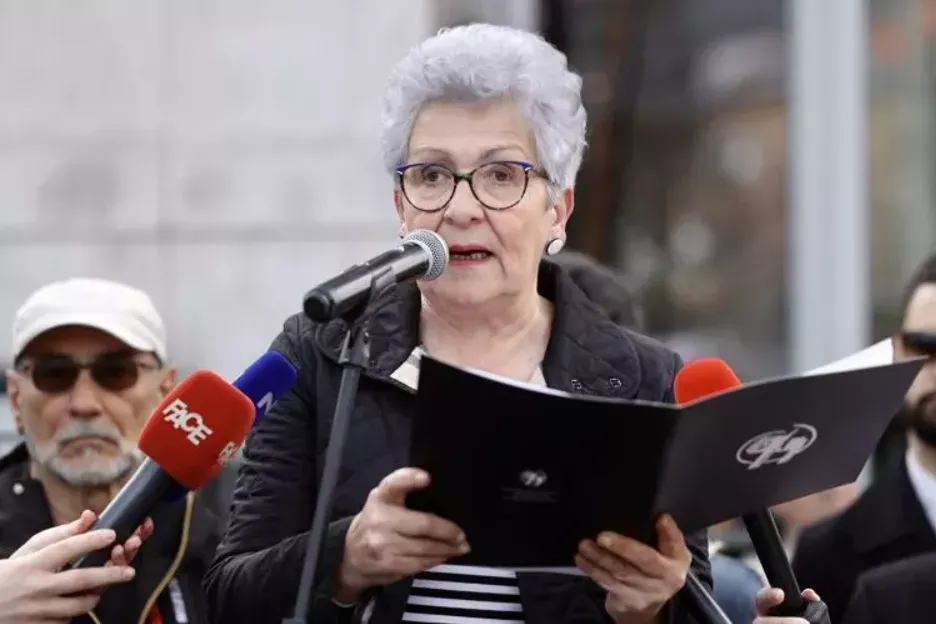
(Patria) - Next month marks 10 years since the final judgment in the Azra Zornić v. Bosnia and Herzegovina case, which has never been implemented. In addition to this judgment, the European Court of Human Rights has issued five other judgments ('Sejdić-Finci', 'Šlaku', 'Pilav', 'Pudarić'), while the proceedings in the 'Slaven Kovačević' case have not yet been finalized.
In a letter prepared for the panel "Bosnia and the West: Implications of the European Court of Human Rights Judgments" within the conference "Biden Administration's Policy in BiH: 30 Years of the Federation of BiH", organized by the American-European Alliance and the International University of Sarajevo (IUS), Zornić, unable to attend, posed the question of how long she would have to wait for the implementation of her judgment.
We present her address below:
"Annex IV of the Dayton Peace Agreement, reached in 1995, constitutes the Constitution of Bosnia and Herzegovina. Since then, final judgments have been delivered in six cases before the European Court of Human Rights, and another case, 'Kovačević', is ongoing to determine discrimination and violations of fundamental human rights guaranteed by the European Convention on Human Rights and Fundamental Freedoms, which, I remind you, is an integral part of the Constitution of Bosnia and Herzegovina.
As individuals, we are denied the right to run for office due to our Bosnian nationality, (non)ethnic affiliation, or place of residence. The Constitution of Bosnia and Herzegovina discriminates against all its citizens through the 'constituent peoples': Serbs, Croats, and Bosniaks, because only constituent peoples can be elected as members of the Presidency, the House of Peoples, judges of the Constitutional Court of BiH, etc. It is unacceptable that the category of 'others' still exists in the Constitution, thereby denying citizens any rights in the electoral process. There is no constitution in the world that categorizes its citizens as 'others'.
What does it mean to be an 'other' in your own country, in your hometown? Six of us initiated court proceedings in our names, and thus in the name of all citizens whose fundamental rights and freedoms are denied (over 400,000 throughout Bosnia and Herzegovina). Ten years after my judgment – nothing has happened. The category 'others' still exists in the Constitution of Bosnia and Herzegovina. I cannot run for the Presidency of Bosnia and Herzegovina and the House of Peoples in the same way that Bosniaks and Croats from the Republika Srpska entity cannot run for the Bosniak and Croat member of the Presidency, respectively, nor Serbs from the Federation of BiH entity as the Serb member. The right to vote is only permitted within 'one's own' entity and one's own ethnicity.
The state of Bosnia and Herzegovina has not removed discrimination and implemented the judgments. It is evident that the parties in power lack the political will to do so. I note that the actual implementation of judgments is not a change of residence or adherence to a corrupt ethnic principle, which is the foundation of our constitution. The process of constitutional changes has actually never even begun where it should take place – in the Parliamentary Assembly of Bosnia and Herzegovina. Support for the delusion that Bosnia and Herzegovina can join the European Union without amending constitutional provisions that violate the European Convention on Human Rights serves to push the state's obligation to implement the judgments into the most uncertain future possible. The postponement of implementation and the politicization of constitutional discrimination by focusing on resolving other, essentially ephemeral, current political 'issues', accompanied by constant and open threats of obstruction in decision-making and conflicts, has become the only way to discuss constitutional amendments in Bosnia and Herzegovina, while elections are held in which citizens of Bosnia and Herzegovina are deprived of fundamental human rights.
Contrary to the recommendations of the EU, the resolutions of the Council of Europe, the opinions of the Venice Commission, the primacy of the European Convention on Human Rights and the European Court of Human Rights, the existing political system in Bosnia and Herzegovina has been used for ten years to incite and deepen mistrust among peoples, which halts all progress of the country on its democratic path towards full membership in the European Union. As a result, society is held hostage in a state of collective intolerance and a lack of organized force to lead and win the fight for the implementation of decisions. Nothing is happening in reality; it should be noted that, on the one hand, the ruling political oligarchies obstruct implementation, while, on the other hand, some political options offer, but still only verbal, support for this implementation.
However, none of them have taken any steps towards implementation. The issue of constitutional discrimination has been used as an instrument of political manipulation for over a decade. Therefore, the issue of implementing the judgments of the European Court of Human Rights, i.e., removing discrimination in the electoral process, should be separated from all other politically manipulated issues of constitutional reform, and the Constitution of Bosnia and Herzegovina should be amended through a legal procedure in accordance with the judgments of the European Court of Human Rights.
First and foremost, I express my gratitude to the United States of America for the crucial role it played in ending the war and bloodshed in our country and in creating the Dayton Peace Agreement, which has maintained peace in Bosnia and Herzegovina to this day. Now, twenty-nine years after the signing of the Dayton Peace Agreement, the hard-won peace is under threat. Ironically, it is the structures of the Dayton Peace Agreement that have become an obstacle to Bosnia's political survival.
The mantra repeated by numerous international officials, that Bosnia consists of two entities and three constituent peoples, has led to a deep existential crisis. Due to the lack of international intervention, especially after 2006, the Dayton structures have shifted to ethno-nationalist rhetoric of division and threats of secession that destabilize Bosnia and the region.
The leader of Bosnian Serbs, Milorad Dodik, threatens secession and consistently speaks of Bosnia as a failed state. He uses hate speech towards Bosniaks and denies the Srebrenica genocide without any consequences. The leader of the Bosnian Croat party, Dragan Čović, constantly threatens to form a third entity. Both of these separatist leaders have exploited the concept of 'constituent peoples' to create further divisions and hatred. These separatist agendas have found the most pronounced support from the Russian Federation, whose embassy in Sarajevo insisted in April 2021 that Bosnia, in principle, consists of two entities and is not a unified state.
Therefore, it is clear that the time has come for a fundamental revision of the Constitution of Bosnia and Herzegovina so that our country can meet the conditions for accession to NATO and the European Union. I sincerely hope and wish to believe that the United States of America, i.e., the Biden administration, will make a turn in its foreign policy towards Bosnia by initiating the process of amending Annex IV of the DPA, in accordance with the judgments of the European Court of Human Rights.
We need sincere and effective support from the US to help Bosnia transition from a system that prioritizes constituent peoples and ethnic divisions to a nation of citizens with equal rights and dignity. So far, diplomatic efforts by special envoys Palmer, Escobar, and others have aimed to appease the HDZ, an ethno-nationalist political party that intends to ensure one of its members is elected to the Presidency – the so-called legitimate representative of Bosnian Croats.
However, such a result would only further deepen ethnic divisions and create a situation where two out of three members of the Presidency would seek ways to undermine BiH's sovereignty. With international interference in Bosnia's internal affairs from Croatia, Serbia, and the Russian Federation, and with the worsening of social divisions within Bosnia, through increasingly pronounced hate speech, denial of genocide, and glorification of convicted war criminals, as long as threats of secession and the creation of a third entity persist, there will be no peace or progress for BiH.
The first step in the process of reforming the Constitution and Election Law should be the actual implementation of all judgments of the European Court of Human Rights: 'Sejdić-Finci', 'Zornić', 'Pilav', 'Šlaku', 'Pudarić', and 'Kovačević', and the abolition of the ethnicity-based electoral model in BiH in favor of a model where the citizen of Bosnia and Herzegovina is at the forefront and center of the electoral process guided by the principle of 'one citizen, one vote'.
A person's ethno-national identity must not be the sole determinant in the governance process. The implementation of these judgments of the European Court of Human Rights is of key importance for the future of BiH. Indeed, it was expected by the Court of Human Rights that the contested category of 'constituent peoples' and any discrimination based on ethnic principles would be removed from the Constitution of Bosnia and Herzegovina. In Article 43 of the Court's judgment in the case of 'Zornić v. Bosnia and Herzegovina' (application 3681/06), the European Court calls for the establishment of equality among the citizens of Bosnia and Herzegovina and the abolition of 'constituent peoples' as an outdated concept rooted only in the cessation of hostilities by an agreement signed to stop genocide and ethnic cleansing:
"The nature of that conflict was such that it was necessary to agree on 'constituent peoples' in order to ensure peace (ibid.). However, now, more than eighteen years after the end of the tragic conflict, there can be no reason for the contested constitutional provisions to remain in force. The Court expects a democratic order to be established without further delay."
The phrase 'constituent peoples' is part of the Dayton Peace Agreement, but the way this term has evolved does not correspond to the spirit of this agreement. Furthermore, citizens and others are also clearly mentioned in the Constitution, which opens the door for the reform and evolution that the Court mentions in the above-mentioned paragraph.
Without a fundamental restructuring of the Constitution, as established in Dayton, change for Bosnia and Herzegovina will not be possible. Therefore, we, the citizens and non-resident citizens of Bosnia and Herzegovina, together with allies, dear friends, and a few non-governmental organizations from abroad, urge the US to initiate and support the process of creating a completely new social contract for the 21st century in Bosnia and Herzegovina.
Instead of a complicated and extremely expensive governance system, which includes a state government (Council of Ministers), two entities, and ten cantons, support a comprehensive constitutional and electoral reform that would ensure a sustainable democratic political structure in Bosnia and Herzegovina.
To conclude, the judgments of the European Court of Human Rights should not be mere anniversaries of non-implementation as a reminder of the inequality of citizens of Bosnia and Herzegovina," Azra Zornić stated in her letter.
Komentari (0)
Prijavite se za komentiranje
PrijavaJos nema komentara. Budite prvi!
Minuta
Sve →Iz drugih kategorija

High Representative Not Elected: Germans, French and British Against Americans, New Attempt at End of June

ČOVIĆ WITHOUT MERCY: How Those Who Brought Ademović to Office Created a Political Hell for Him



Sunny Saturday, quite warm



Tragedy in Albanian resort: Two minors drown












