
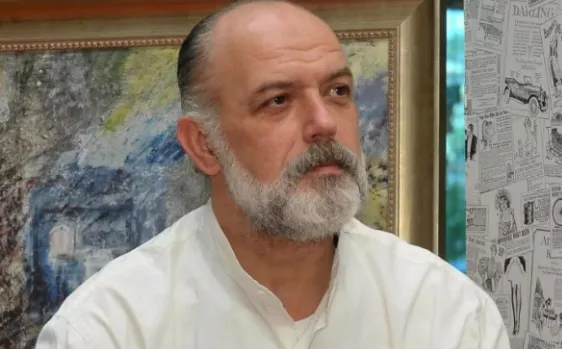
By Edin Urjan Kukavica
Islam, by its nature, eludes all (attempts) at secular definition and integration into (human) patterns and matrices, while at the same time encompassing and containing them all, defining them, contextualizing them, and conceptualizing them... placing an unimaginably large pressure and stress on the personality, role, and function of the ruler (the order is not important) insisting on his positive human values and qualities / virtues as a personality, his relationship towards his subjects entrusted to him, and the manner of performing / carrying out the authority (function / functions). The religious and moral-ethical essence of Islam transcends and will transcend all specific political forms... which is clearly evidenced by the fact that the social manifestations of Islam have differed through epochs, spaces, and cultures through all the national, cultural, and linguistic heterogeneities of Islam, whereby all forms of these social manifestations have perished, proving their secondary and temporary nature, while Islam has survived, proving its permanence and superiority.
Bosnian Muslims are a specific Islamic community even in the Balkans, where there are several other Islamic communities or, rather, communities of Muslims, and it is therefore normal for us to attract enormous social and scientific attention and interest. Much has been written about Bosnian Muslims in a political and religious sense, from the aspect of religious spirituality, both in the country and in the region, as well as in the world, of which we are almost entirely unaware. This Muslim minority in the Balkans, when viewed within the framework of Muslim minorities in the former Yugoslavia, Bulgaria, Romania, Hungary, along with all the political processes in Turkey, and in the context of the tragic events in the Middle East... is something that is scientifically interesting, and our independence contributes to this interest, not only in terms of statehood and state-building but also in terms of the independence of the Islamic Community as an institution.
However, we have this psychological and/or psychosocial tendency towards conspiracy theories, which is most clearly manifested in the understanding and interpretation of the relationship between the West and Islam, and Islam and the West. People here, even serious people, including some intellectuals, believe that someone hates us because we are Muslims. Although this is likely – even certainly – true in individual cases or in cases of smaller or larger groups, it is fundamentally absolutely untrue and does not hold. We must necessarily and urgently free ourselves from these and similar theories, and even from the way of thinking, and this is the task of normal people, normal intellectuals, the new intellectual elite. Especially the Muslim one...
If we are, as we should be, Muslims... and intelligent people with common sense and open eyes, then we should know that the image that Islam and Muslims currently enjoy in the world is largely a product of their internal state and external behavior. The scenes broadcast from the Muslim, not to say Islamic, world generally, to the greatest extent, confirm and justify the fear and apprehension of the rest of the world towards Muslims because Muslims today project an image of themselves to the world that they have never projected before. It is a completely different matter that this image, or what it depicts, has nothing to do with Islam, and to whom such an image of Islam and Muslims in the 21st century truly belongs and suits. (paraphrased, Filandra, 2016).
Bosniak ethno-national romanticism associates the presence of Muslims in the Balkans, especially in Bosnia and Herzegovina, with the first official arrival of the Ottoman Sultan Mehmed II al-Fatih in 1463, although serious historiography even documents the presence of Muslims in the Balkans and in Bosnia and Herzegovina significantly earlier, as early as the 8th century, and in indications even earlier, 36 years after the Hijra or 658 AD when the first three Muslims (documented) landed in the Dalmatian port of Ragusa. For the appearance of Serbs and Croats, some other data apply, significantly, centuries later, but that is less important for the story about current generalization.
Hasn't that, as well as accepting (even insisting) on the Ottoman-Turkish origin and principle of Islam in the Balkans, along with insufficiently supported insistence on the thousand-year historicity of Bosnian (and Herzegovinian) statehood, put us in a predicament that cannot be easily and simply resolved: did Bosnian Muslims come to the Balkans and to Bosnia and Herzegovina with the Ottomans, or are we Muslims (only) from the Ottoman era onwards, or are we converted medieval Bosnian Christians who are a special story in all of this)?
In any case, we are now a legitimate part of the contemporary Islamic world, where there is, let's say, an official structure and there is something that is outside the system. In that sense, we are part of the global Islamic world. So, here in Bosnia, we have something called (Bosnian) Islam and something that is not called that, which has largely – until recently – been an extra-institutional form of organizing Muslims, which has been increasingly institutionalized in recent times, appearing in an increasingly organized form (and outside the official institutions of the system) and taking on a form that should concern the Islamic Community – if it hasn't already. Why? Because everything outside the system's institutions always carries a negative political context, threatening to grow into a serious problem. The fact that this extra-institutional phenomenon has its extensions and/or continuations within institutions, including the Islamic Community and national associations, that they are well-funded and financially independent... indicates the need to pay much more attention to this situation than has been done so far.
Furthermore, two evident facts support caution: first, that "non-Bosnian Muslims" are increasingly appearing as religious police (not to say inquisition) presenting themselves as the only form of correct religious practice, and second, paradoxically, that they are increasingly taking over institutions with a national prefix or of national importance, presenting themselves as the (only) defenders, protectors, and guardians of Bosniak tradition and Bosniak national interests. In this sense, we can speak today in Bosnia of a model process emerging, which is characteristic of most Muslim nations, having an official and traditional Islam that is close to the state nomenklatura and something that is outside that institution, which can be named in various ways, but which is extra-institutional, which is called an Islamic movement in scientific literature, and which is becoming increasingly institutionalized and increasingly close to political and religious structures, threatening to become the loudest, if not dominant, form. This situation is being ignored, but, in my opinion, the problem is incomparably more serious than how it is being approached by existing institutions, religious, political, and security...
Of course, it is a private, legal, human right to practice one's faith as one wishes and considers best, but it is not right to impose one's own worldview and religious views as the exclusive and only correct form of anything. This is what is happening here, and it is viewed with leniency because it concerns "Muslims," and these are phenomena that deserve serious observation and analysis of the existing, official institutional structure: how much has its method of work (or lack thereof) contributed to a certain dissatisfaction that something has emerged outside its structure, how much is it part of imported things that come with certain financial contributions, demands, and propaganda from the Islamic world, which has also been present here. But, it is also a phenomenon that deserves serious attention from our side, especially considering the fact that it attracts incredible attention from people in the West and greatly contributes to and fuels the aforementioned resultant "conspiracy theory" that the world hates us because we are Muslims.
The problem is that we are a small Islamic community and that these processes negatively affect the spiritual constitution of Bosnian Islam and Bosnian Muslims.
Admittedly, we are a small and few, but by no means insignificant, Muslim community in the Balkans, which, due to the aforementioned and numerous unmentioned specificities, is the subject of numerous observations for various reasons. The fact is that for the last two centuries, we have been on a downward trajectory, which, theoretically, is largely a result of our model of relating to ourselves and to others, which, especially in the last hundred years, has not yielded positive results. Others are not to blame for this, or at least not solely others, but primarily and above all ourselves and our proverbial way of thinking – that we blame others for all our weaknesses, failures, and sufferings. The problem is never (only) in the strength of the other, but in one's own weakness, in one's own mistakes.
It should have been clear to us that the devil – pardon, Satan – has had his fun and that things have definitively gone downhill the moment the Islamic Community had no other way to broadcast the adhan on its radio at the precise time except with the help and support of the local meat industry.
(To be continued)
Komentari (0)
Prijavite se za komentiranje
PrijavaJos nema komentara. Budite prvi!
Minuta
Sve →Iz drugih kategorija

High Representative Not Elected: Germans, French and British Against Americans, New Attempt at End of June

ČOVIĆ WITHOUT MERCY: How Those Who Brought Ademović to Office Created a Political Hell for Him



Sunny Saturday, quite warm



Tragedy in Albanian resort: Two minors drown












