
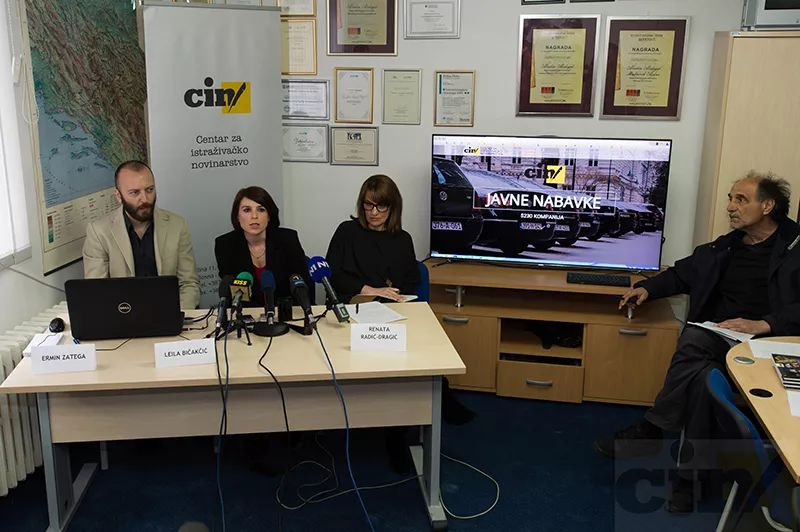
The Center for Investigative Journalism (CIN) has created a unique online database of public procurement to make public spending easier for citizens to understand and to offer information on how and from whom institutions and public companies purchase goods, services, or enter into public works contracts, reports the Patria News Agency.
The database contains data on 39,178 contracts, which 828 institutions and public companies have entered into with 5,230 companies. The value of the contracts is at least 6.2 billion convertible marks.
At a press conference held today in Sarajevo, CIN Director Leila Bičakčić stated that public procurement is an area that deserves full attention, both due to the amount of money spent and the frequent complaints about corruption and lack of transparency. She said that the database will serve for broader research into public procurement, which CIN will continue to focus on in the future.
-CIN has decided to analyze the processes, procedures, and actors in this sector, and through a series of investigative stories, inform the public about what is really happening – how open procurement is, how fair tenders are, whether political suitability is decisive, and what citizens of Bosnia and Herzegovina are paying for – quality or political games," said Bičakčić.
CIN's Editor-in-Chief Renata Radić-Dragić said that entering the data into the database took about half a year and that the entire editorial team worked on it:
"We entered the names of the institutions and companies that entered into the contract, the method by which the contract was awarded, the subject of the contract, and its value."
Ermin Zatega, one of the CIN journalists who worked on the database, said that the most money was spent in the energy and health sectors in the past four years.
"Three public power companies and all their affiliated companies spent nearly 2.1 billion KM on mining machinery, fuel, and electricity, or about a third of the total amount recorded in our database. After that, medicines, medical equipment, and materials cost citizens more than a billion convertible marks," Zatega said at the conference.
He added that companies from Sarajevo received the most money, around 1.4 billion KM, either on their own or in a consortium with other companies. Companies from Banja Luka earned more than a billion KM, while companies from Mostar received contracts worth 534 million KM.
Journalists noted that among the contract winners were companies owned or co-owned by politicians. Their companies received 295 contracts worth more than 103.8 million KM for the procurement of vehicles, fuel, medicines, hotel accommodation, and construction and forestry works.
The database is available on the CIN website: www.cin.ba/javnenabavke, it is completely free and adapted for mobile devices.
Komentari (0)
Prijavite se za komentiranje
PrijavaJos nema komentara. Budite prvi!
Minuta
Sve →Iz drugih kategorija

High Representative Not Elected: Germans, French and British Against Americans, New Attempt at End of June

ČOVIĆ WITHOUT MERCY: How Those Who Brought Ademović to Office Created a Political Hell for Him



Sunny Saturday, quite warm



Tragedy in Albanian resort: Two minors drown












