
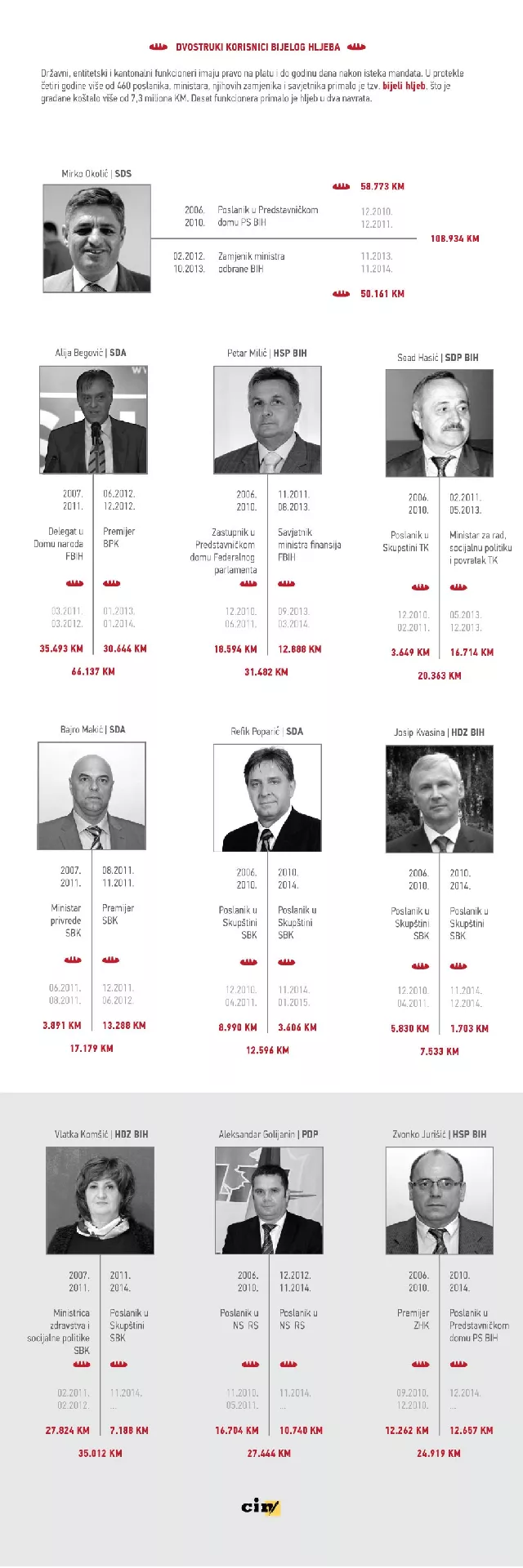
Citizens of BiH paid at least 7.3 million KM for "white bread" used by at least 460 officials over four years. Ten of them took this right to salary without work twice.
Although he did nothing for two years, former Deputy Minister of Defense of Bosnia and Herzegovina (BiH) Mirko Okolić received almost five thousand marks every month. He was entitled to this because he was a politician in power. And he is not an isolated case.
Presidents, prime ministers, ministers, their deputies and advisors, as well as MPs and heads of some state institutions, can receive a salary for up to a year after the end of their term. This right was given to them by laws they themselves wrote and adopted at the state, entity, and cantonal levels of government.
They can receive a salary until they find another job or retire. Officials receive "white bread" even if they are dismissed or if they spend at least one day in office. There is no limit to how many times the same person can use this right.
State and federal officials can enjoy the right to "white bread" for a year. All officials in the Republika Srpska (RS), West Herzegovina Canton (ZHK), and advisors in the Federation of BiH are approved payments for a maximum of half a year.
According to data collected by the Center for Investigative Journalism (CIN), in the past four years, 435 officials received at least 7.1 million marks for "white bread," while ten of them were on "white bread" twice.
Besides Okolić, another official enjoyed this privilege for a full two years. Citizens paid 175 thousand KM for these two alone.
Two years of work – four years of salary
Mirko Okolić, a member of the Serb Democratic Party (SDS), failed to renew his mandate in the Parliamentary Assembly of BiH in the 2010 elections. Around 10,000 citizens voted for him then – a third less than in previous elections. A month after he learned he would no longer be a state MP, Okolić began receiving a salary without working.
According to the Law on Salaries and Allowances in BiH Institutions, Okolić was approved to receive a monthly allowance equal to his last salary for the next year, which was 4,833 KM. He would lose this right if he found employment or retired in the meantime, which did not happen.
"Nothing contrary to the law was done, and it is not the only case, nor is it an isolated case. Everyone did it that way," Okolić told CIN.
According to the property statement he filled out before the elections, Okolić had about 145,000 KM in private accounts at that time, an apartment, and a car, which he valued at a total of 210,000 KM. He had a loan of about 11,000 KM at the time.
"Look, if you have a legal option and if you expect to get something that was agreed upon, then it simply happens like that," says Okolić.
He remained on "white bread" until December 2011, and at the beginning of February 2012, he became the Deputy Minister of Defense.
He was dismissed from that position in October 2013, and a month later he again requested the same allowance. He exercised this right. Until November 2014, he received 4,180 KM every month.
"Simply, by inertia, that's how it went. Regulated by law, there was nothing controversial," says Okolić.
He did not wait long for a new job – in mid-December, he got a new job – he became acting head of the newly formed Civil Protection Department of the City of Doboj. His privilege of salary without work cost citizens 109 thousand marks.
Adis Arapović, project manager at the Centers for Civil Initiatives (CCI), says that "white bread" is an instrument invented by political parties to secure jobs for their party members after their mandates expire. He believes this is one of the worst examples of politicians setting their own compensation.
"White bread" for doctors in politics
Similar to Okolić, the record holder for the time spent on "white bread" is the former Prime Minister of Bosanskopodrinjski Canton (BPK), Alija Begović.
Begović was previously the Minister of Health in the BPK Government, and then the cantonal governor. After that, he was an MP in the BPK Assembly and a delegate in the House of Peoples of the FBiH Parliament.
In the 2010 elections, he did not get a new mandate for the cantonal assembly – he won 183 votes, which is almost ten times less than in the previous elections. He then decided to switch to "white bread" of 2,957 KM per month, which was his salary in the federal parliament. Like his colleague Okolić, he also believes that he only used a legal social privilege.
"I think the law should have been regulated so that a person could return to their workplace, regardless of when they entered politics. If that were the case, I would have no problems, nor would I need "white bread"," says Begović.
Begović entered politics 18 years ago from the position of director of the Goražde hospital.
According to the Labor Law of FBiH, appointed and elected officials can retain their previous job for a maximum of four years, which is the duration of the mandate. If they extend their mandate, they no longer have the right to return to their old job.
Begović received "white bread" until March 2012, and three months later he found a new job. The Party of Democratic Action (SDA) appointed him Prime Minister of BPK, but he managed this canton for only five and a half months before being dismissed.
Although he lost his job, he did not lose his salary. He again requested "white bread" and continued to receive a salary of 2,553 KM.
In the meantime, Begović appealed to the Constitutional Court of FBiH because he believed he was illegally dismissed from the prime minister's position. "The court waited for three to four months, and I, of course, waited because I calculated that they would return me to the position of prime minister since it was done completely illegally," Begović told CIN.
After the Court determined that it did not have jurisdiction over his lawsuit, Begović began looking for a job in his medical profession. In March 2014, he became the director of the Ustikolina Health Center.
His colleague from Kiseljak, Vlatka Komšić, former MP in the Assembly of Srednjobosanski Canton, also spent almost half of the last four years receiving a salary without working.
However, this politician from the Croatian Democratic Union of BiH (HDZBiH) is the only one who received "white bread" even before 2010. In eight and a half years, she used the right to an allowance three times and has taken 52,000 KM in this way to date.
She first enjoyed the benefit of a monthly amount of about 2,250 KM after her mandate in the state parliament at the end of 2006.
After that, she was the Minister of Health and Social Policy of SBK for four years, and after the end of that mandate, she maximally exercised her right to an allowance, receiving a salary of 2,320 KM for the entire year 2011.
However, this was not her only income from the budget during that period. In the meantime, she also won a mandate as an MP in the SBK Assembly. She gave up her full salary and professional status to receive "white bread" in addition to per diems and MP allowances. Thus, she earned a total of 2,900 KM per month.
"I didn't have to receive "white bread". (...) I could have become a professional immediately, so it didn't matter – whether I used it or was a professional," Komšić told CIN.
But it did matter. If she had become a professional MP and given up "white bread," she would have earned almost 500 KM less per month, which was the average salary of workers in industry, construction, trade, and hospitality in SBK at the time.
In November last year, her mandate in the SBK Assembly ended, and as a former MP, she began receiving an allowance for the third time. If Komšić does not find permanent employment in the meantime, she will receive 1,797 KM until November.
"I am a legalist. (...) I operate within the framework of the law that allowed me to have "white bread" for this year. I don't think it's the worst solution," she told CIN.
Komšić says she lives with her mother, who has a minimum pension, and her child volunteers, so she needs some income.
Adis Arapović from CCI says that all politicians took this allowance because the laws they pass allow them to do so.
"But, lo and behold, parties change, but the policy hasn't changed. So, whoever had the opportunity to take this "white bread" took it. A few people refused to take it or took it and directed it to some humanitarian purposes. 95 percent of people took it without question, without asking themselves if it was normal, ethical, acceptable, and rational in this time of complete budget collapse," says Arapović.
Most double allowances for officials from SBK
From this canton, besides Vlatka Komšić, there are three other officials who used the allowance twice – former cantonal MPs Refik Poparić (SDA) and Josip Kvasina (HDZBiH), and former Prime Minister Bajro Makić (SDA). They used "white bread" for shorter periods because they found new jobs faster – from four to seven months in total. The average monthly salary was between 1,450 KM and 2,250 KM.
Like their colleague Komšić, Kvasina and Poparić also received MP allowances and per diems along with "white bread," so their monthly income from December 2010 to April 2011 was 2,230 KM and 3,012 KM, respectively.
Sead Hasić (SDPBiH), former cantonal minister from Tuzla, used the allowance for a total of 11 months – three months as an MP in the Tuzla Canton (TK) Assembly at the beginning of 2011, and then eight months during 2013 as the Minister of Labor, Social Policy, and Returnees of TK. During this time, he received slightly more than 20,000 KM from the budget.
Petar Milić from the Croatian Party of Rights (HSP) BiH also enjoyed the privilege of salary without work twice in the past four years. He first tasted "white bread" as a federal MP during the first half of 2011, receiving a total of 18,594 KM, and then from September 2013, when he ceased to be an advisor to the federal Minister of Finance, Ante Krajina. He cost the citizens of the Federation of BiH 31,481 KM.
His party colleague, the president of HSP BiH, Zvonko Jurišić, is currently receiving this allowance. As a former state MP, he has been receiving 3,164 KM per month since the end of November last year. Before that, he received "white bread" as the Prime Minister of ZHK in 2010, when he received 12,262 KM for three months.
Aleksandar Golijanin, former MP of the Party of Democratic Progress (PDP) in the National Assembly of Republika Srpska, is the only official in this entity who received "white bread" twice, both times as an MP. First, at the end of his mandate in 2010, he exercised his full right to a six-month allowance, thus receiving 16,704 KM. He did the same at the end of last year, since when he has had a monthly salary of 2,685 KM to which he is entitled until May.
"White bread" has existed for years as one of the rights of officials. This was not widely discussed in public until February 2014, when its abolition was one of the main demands of citizens in protests against the inefficient government in BiH. So far, three cantons have abolished the right to "white bread": Sarajevo, Tuzla, and Unsko-sanski. The procedure for abolition has also been initiated at the state level.
Adis Arapović from CCI says that before the protests, such a thing was not possible because there was no political interest, nor citizen pressure.
"Only after the February protests last year and after these concluded elections did we witness that a rapid change can indeed be made in a very short period to the extent that "white bread" is completely abolished," says Arapović.
(CIN)
Komentari (0)
Prijavite se za komentiranje
PrijavaJos nema komentara. Budite prvi!
Minuta
Sve →Iz drugih kategorija

High Representative Not Elected: Germans, French and British Against Americans, New Attempt at End of June

ČOVIĆ WITHOUT MERCY: How Those Who Brought Ademović to Office Created a Political Hell for Him



Sunny Saturday, quite warm



Tragedy in Albanian resort: Two minors drown












