
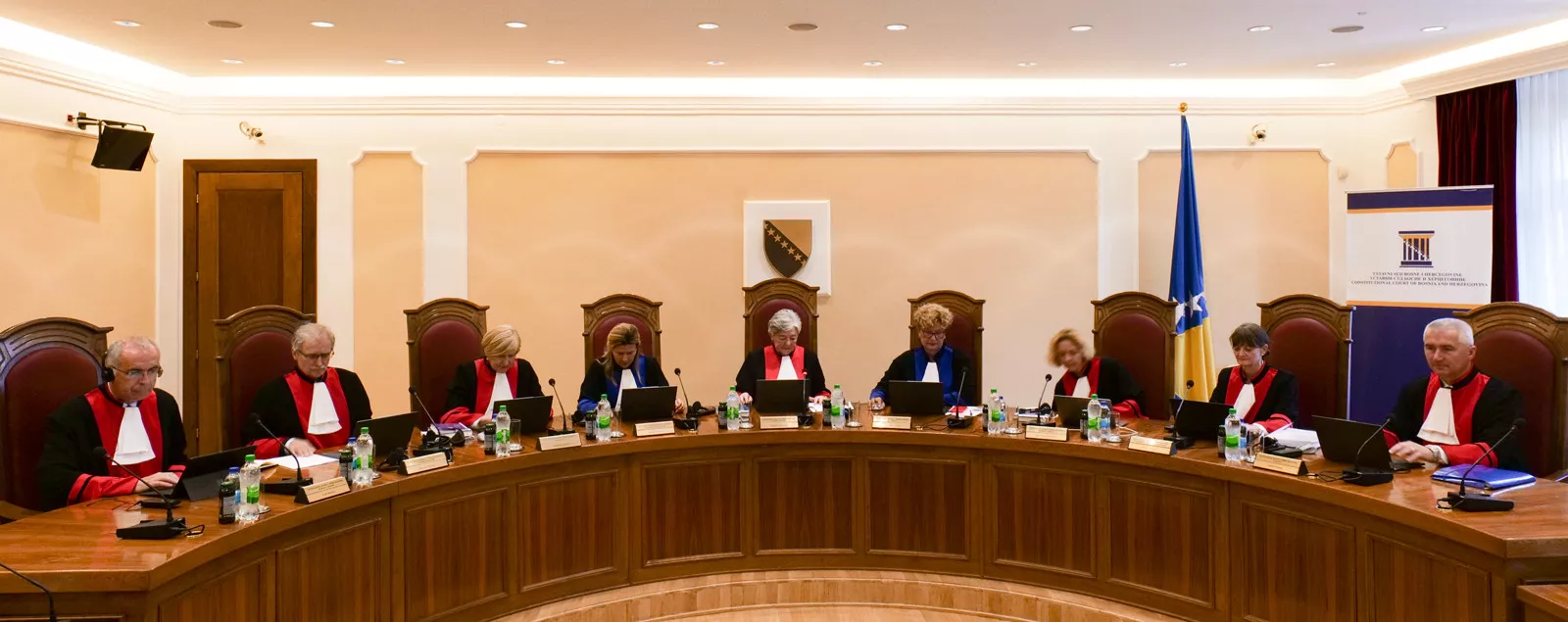
(Patria) - Today, the full text of the decision of the Constitutional Court of Bosnia and Herzegovina in the 'Respirators' case was published.
The separate opinion of Judge Mirsad Ćeman was also published, which we present in full:
"The Constitutional Court of Bosnia and Herzegovina, by Decision number AP-667/24 of 14 November 2024 (four cases joined), upheld the appeal of F. H. and 'F. H. Srebrena malina' d.o.o. and found a violation of the rights of F. H. and 'F. H. Srebrena malina' d.o.o. in the part of the Judgment of the Court of Bosnia and Herzegovina number S1 2 K 039029 23 Kž
3 of 2 November 2023, which decided on the appellants' objection that they 'did not know what they were being charged with', thereby violating their right to a fair trial under Article II/3.e) of the Constitution of Bosnia and Herzegovina and Article 6, paragraph 3, point a) of the European Convention for the Protection of Human Rights and Fundamental Freedoms, and in that part 'annulled the said judgment in respect of F. H. and 'F. H. Srebrena malina' d.o.o.'.
The Constitutional Court decided that, in respect of them, the case be returned to the Court of Bosnia and Herzegovina, which is obliged, in an urgent procedure, in Case number AP-667/24 87 Decision on Admissibility and Merits, to render a new decision in accordance with the 'right to a fair trial' established by the Constitution of BiH and the European Convention, and ordered the Court of Bosnia and Herzegovina to inform the Constitutional Court, in accordance with the Rules of the Constitutional Court, of the measures taken with a view to executing that decision.
By the same decision, the appeals of F. S. and F. N. were partially upheld and a violation of Article II/3.e) of the Constitution of BiH and Article 6, paragraph 2 of the European Convention was found in the process of determining the 'criminal charge' against the appellants in connection with statements by certain public officials (before and during the proceedings before the regular courts) by which the 'right to the presumption of innocence' of F. S. and F. N., i.e., the second appellant and the fourth appellant, was violated. At the same time, their appeals were dismissed as unfounded in respect of the other allegations of violation of the right to a fair trial under Article II/3.e) of the Constitution of BiH and Article 6, paragraphs 1 and 3 of the European Convention.
Unlike the decision relating to F. H. and 'F. H. Srebrena malina' d.o.o., i.e., the first appellant and the third appellant, by which the Constitutional Court decided to return the case in one part to the Court of Bosnia and Herzegovina for re-adjudication, the Constitutional Court decided, in respect of the appellants F. S. and F. N., i.e., the second appellant and the fourth appellant, that only a 'declaratory decision' was sufficient satisfaction for them.
Given that during the proceedings before the Constitutional Court, the proposal for the decision as a whole was discussed and voted on, although I agree with certain parts of the operative part/decision and reasoning (e.g., regarding the established violation of the rights of the first appellant and the third appellant, regarding the establishment of the jurisdiction of the Court of BiH in that case, regarding the publication of the judgment and the written copy of the judgment, etc.), nevertheless, for reasons I will briefly explain, I could not support the decision.
First of all, and this is indeed the reason for my disagreement with the majority decision, I wish to emphasize that I am largely closer to the approach, legal logic and argumentation presented and explained by the appellants and the president of the first-instance trial panel in his separate opinion on the first-instance decision, both in the appeals and during the proceedings before the regular court (first-instance and second-instance panels). In doing so, I am thinking, among other things, of (as key reasons and circumstances that should have been taken into account) the overall extraordinary circumstances, i.e., the 'state of emergency', as the Government of the Federation of BiH called them (panic, fear, collective and individual psychosis, etc., not only in the Federation of BiH but throughout Bosnia and Herzegovina, and even globally), caused by the coronavirus pandemic (COVID-19), in which, according to the indictment and judgments, the acts of execution with which the appellants were charged occurred, and which circumstances decisively influenced the actions or behavior of the accused, especially the second accused and the fourth accused as public officials; then the subjective and objective identity of the indictment; the volitional
element, i.e., the existence or non-existence of the intent of the accused to commit the criminal offense(s); the fact that the indictment and the evidence presented did not, especially in respect of some of the appellants, meet the 'beyond a reasonable doubt' standard (which the appellants explained in detail); the extensive use of circumstantial evidence as a basis for
concluding the alleged guilt of some appellants and the evidence supporting it; the application of the principle of in dubio pro reo, etc.
Furthermore, it is unclear why neither the regular court in both trial panels nor the majority in the Constitutional Court (in the context of the right to a fair trial) paid any attention at all (?!) to the claim made in the separate opinion (reasonably concluded also during the trial) by the president of the first-instance trial panel of the Court of BiH that the fourth appellant F. N., as Prime Minister of the Government of the Federation of BiH, requested that 'large, registered companies' be included in the respirator procurement procedure, and that, as the president of the first-instance panel claims, only the owner of the company 'Violeta' Grude responded, who eventually withdrew due to complicated 'administrative procedures' and the like. Thus, even the majority in the Constitutional Court did not find this relevant, although, in my opinion, not only the qualification of the offense depended on the correct determination of facts in connection with this, but only depending on the answer to that question can a reliable judgment be made as to whether F. H., i.e., his company 'Srebrena malina', were allegedly illegally privileged and, consequently, whether there was possibly room for the application of Article 10 of the Law on Public Procurement during the procurement of the disputed respirators or not.
I therefore do not consider it necessary to list or explain in detail, actually repeat, the argumentation extensively presented and explained in the appeal and other submissions of the appellants, i.e., in the separate opinion of the president of the first-instance trial panel. After all, the factual substrate, legal logic and argumentation, both for the upholding and the dismissing part of the appeals, are correctly stated and explained in the decision of the Constitutional Court (see, e.g., chapters III, IV and V).
However, it is impossible not to notice that the initial, almost key incrimination on which the Prosecutor's Office based and further developed the concept of charging all appellants, namely 'associating for the purpose of committing criminal offenses' prescribed by the criminal law of Bosnia and Herzegovina, the Federation of Bosnia and Herzegovina
and the Republika Srpska (by organizing or agreeing to be a member of a group), was not proven for any of the appellants. It was precisely this initial incrimination that significantly, if not decisively, influenced the construction of the indictment and further, regardless of the fact that it was ultimately dismissed as unproven, it can still be concluded, quite certainly, that it created the atmosphere during the trial and determined the judicial decision at both instances of the regular court, and even the decision of the Constitutional Court.
Also, although the fifth accused J. M., as Minister of Finance in the Government of the Federation of BiH and head of the Federal Civil Protection Headquarters, was involved and signed payment orders by which budget funds were engaged for the procurement of the disputed respirators and other equipment and supplies, she was fully acquitted of the charge (the prosecution charged her with committing the criminal offense of negligent work in
office). I agree with the acquittal.
However, when everything is taken into account, i.e., the overall context, and especially the competencies and responsibilities, and the actions and procedures of the fourth appellant, the second appellant and the fifth accused, a serious question arises as to whether this nevertheless constitutes unequal treatment of the fourth appellant and the second appellant in relation to the fifth accused, or vice versa.
Due to the above, the judgment should have been overturned due to violation of the right to a fair trial and returned for retrial not only in respect of the first appellant and the third appellant, as the Constitutional Court decided, but also in respect of the second appellant and the fourth appellant, and in that sense, it should be reconsidered whether, given the overall
circumstances, especially in the initial phase of the coronavirus pandemic, there are elements for criminal liability of any of the accused, i.e., the appellants".
Komentari (0)
Prijavite se za komentiranje
PrijavaJos nema komentara. Budite prvi!
Minuta
Sve →Iz drugih kategorija

High Representative Not Elected: Germans, French and British Against Americans, New Attempt at End of June

ČOVIĆ WITHOUT MERCY: How Those Who Brought Ademović to Office Created a Political Hell for Him



Sunny Saturday, quite warm



Tragedy in Albanian resort: Two minors drown












