
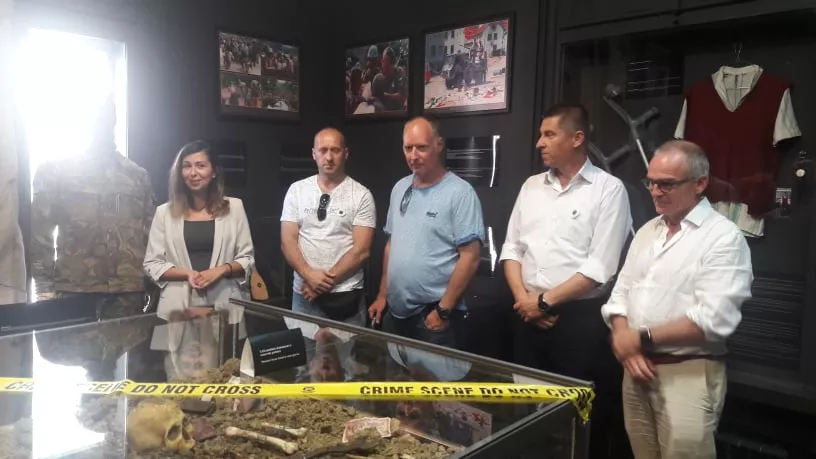
SARAJEVO, (Patria) - Former member of the Dutch UN battalion in Srebrenica Serge Janssen, who has been regularly visiting the Museum of Crimes Against Humanity and Genocide since 2017, today donated a video camera that recorded footage from wartime Srebrenica in 1994.
Every July, Serge Janssen comes to Bosnia and Herzegovina and Srebrenica, bringing his friends and family. He is the first member of the Dutch battalion to donate his personal belongings to the Museum.
"He donated his military uniform and boots in which he entered Bosnia and Herzegovina and first set foot on the soil of Srebrenica," explains Suada Nožić, director of the Museum. She emphasizes that Janssen voluntarily donated the items to the Museum and that he always returns.
Today at the Museum, Serge was joined by Osman Avdić, who survived the genocide in Srebrenica. Their acquaintance dates back to 1994 when Osman was 16 years old. After nearly 18 years, they re-established contact and have been friends ever since, with Janssen visiting him. It was Osman's idea for Serge to donate items to the Museum.
Serge explained that in 1994, soldiers used the video camera to film wartime Srebrenica for the needs of media in the Netherlands, as well as video messages for their families and the children of Srebrenica, among whom was Osman.
"The camera was with my friend, and he had no objection when I suggested bringing it to the Museum. The footage we made with the camera and sent to our families was the only way for them to know what we were doing in Bosnia and Herzegovina because there were no mobile phones back then. What I remember most are the conversations with the children," said Janssen.
Serge was not in Srebrenica in 1995, and he has participated in the Peace March several times. This year, he also visited Srebrenica and the Potočari Memorial Center.
Jasmin Mešković, founder of the Museum and president of the Association of Concentration Camp Prisoners of Bosnia and Herzegovina, said it is good that former members of peacekeeping forces who were in Bosnia and Herzegovina return and talk about what happened in the country.
"This year, a large number of members of various international forces who were in Bosnia and Herzegovina are coming to both the Genocide Museum in Sarajevo and in Mostar. They bring their items, their testimonies, and bring friends and family. They experience this Museum in different ways. Some come and stay for two or three hours, viewing everything and reading, while there are also different situations where they need psychological preparation to enter the Museum," said Mešković.
He emphasized that the Genocide Museum faces a problem of lack of space and cannot display all the items they have in storage.
"The story of crimes against humanity, genocide, and the war in Bosnia and Herzegovina will never be finished, never be told as it really was. I think museums tell it in the most correct way. Those who should support this museum and push it forward, I believe their attitude is incorrect," said Mešković.
Visits to Bosnia and Herzegovina, Srebrenica, and the Museum are part of the therapeutic process that Serge undergoes to confront his past as a soldier.
Komentari (0)
Prijavite se za komentiranje
PrijavaJos nema komentara. Budite prvi!
Minuta
Sve →Iz drugih kategorija

High Representative Not Elected: Germans, French and British Against Americans, New Attempt at End of June

ČOVIĆ WITHOUT MERCY: How Those Who Brought Ademović to Office Created a Political Hell for Him



Sunny Saturday, quite warm



Tragedy in Albanian resort: Two minors drown












