
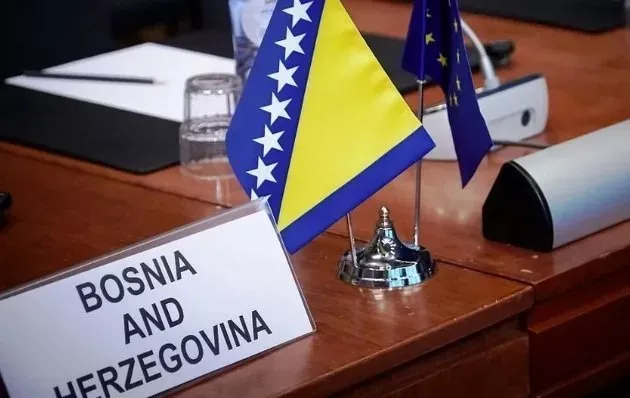
The debate in the House of Lords of the Parliament of the United Kingdom about Bosnia and Herzegovina undoubtedly deserves attention. It is no small matter when former NATO generals, diplomats, ministers and parliamentarians almost unanimously warn that Bosnia and Herzegovina is facing the most serious political crisis since the end of the war.
The messages heard in London are not new. Warnings about secessionist policies, Russian influence, the weakness of state institutions and the lack of a unified international response have been present for years. Perhaps the only novelty is the intensity with which this is being discussed.
Baroness Arminka Helić openly warned about the project of dismantling state institutions and the danger of destabilising the entire region. Former NATO Secretary General George Robertson reminded that the Balkans have repeatedly shown how local crises can escalate into European ones.
So, all already seen and heard.
Stuart Peach, who served for years as the UK's Special Envoy for the Western Balkans, spoke back in 2021 about ethnic tensions and Russian influence, but without visible results showing that his mandate produced any significant political shift on the ground.
These are all serious warnings. However, it is equally important to ask why they are being uttered with such intensity today.
The world is in the midst of the greatest geopolitical realignment since the end of the Cold War. The war in Ukraine, conflicts in the Middle East, the worsening of relations between the West, Russia and China, as well as growing uncertainty within the European Union itself, have led to the Western Balkans reappearing on the radar of great powers.
In such circumstances, Bosnia and Herzegovina easily becomes a space where broader geopolitical interests intersect. Therefore, it is not difficult to get the impression that in recent months there has been increasing talk about security threats, possible conflicts and the need for military guarantees. The earlier ones, provided by Denis Bećirović, have expired!
At the same time, the international community is sending contradictory messages. While British parliamentarians warn of dangers, the Peace Implementation Council (PIC) fails to reach agreement even on the issue of the future High Representative. At a time when the biggest crisis since Dayton is being discussed, international actors show their own divisions.
This raises a legitimate question: is Bosnia and Herzegovina truly a priority of international politics, or is its crisis being used as an argument in broader global competitions?
Of course, the greatest responsibility for the state of the country remains with domestic politicians. They are the ones who block institutions, produce political conflicts and for years have offered no solutions to citizens' problems. However, they are not the ones who decide on the appointment of the High Representative, the composition of the PIC, or the strategic relations of the great powers.
Therefore, it is important to distinguish internal political problems from geopolitical processes taking place above Bosnia and Herzegovina.
What is particularly concerning is the increasingly frequent imposition of a logic of alignment in the public sphere. As if Bosnia and Herzegovina is expected to be part of someone's sphere of influence or an instrument in the confrontation of great powers. The history of this country shows how dangerous such divisions can be. However, current political actors seem unwilling to see this, or are simply not capable of doing so.
Therefore, the wisest response from Bosnian-Herzegovinian politics would be, while preserving the European path and international obligations, to avoid turning the country into a playground for geopolitical rivalries, if we are not already too late.
Today, Bosnia and Herzegovina needs stability, functional institutions and economic development much more than participation in global conflicts of interest.
The messages from London should be taken seriously, but also carefully analysed. Because between justified warnings about the political crisis and attempts by great powers to demonstrate their own influence, there is sometimes a very thin line.
In a time when the world is increasingly dividing into blocs, Bosnia and Herzegovina must not become anyone's geopolitical trophy. Its strength must lie in preserving peace, internal dialogue and the greatest possible neutrality, where the interests of the state of Bosnia and Herzegovina are placed first, not those of foreign powers, whoever they may be.
Komentari (0)
Prijavite se za komentiranje
PrijavaJos nema komentara. Budite prvi!
Minuta
Sve →Iz drugih kategorija

High Representative Not Elected: Germans, French and British Against Americans, New Attempt at End of June

ČOVIĆ WITHOUT MERCY: How Those Who Brought Ademović to Office Created a Political Hell for Him



Sunny Saturday, quite warm



Tragedy in Albanian resort: Two minors drown












