
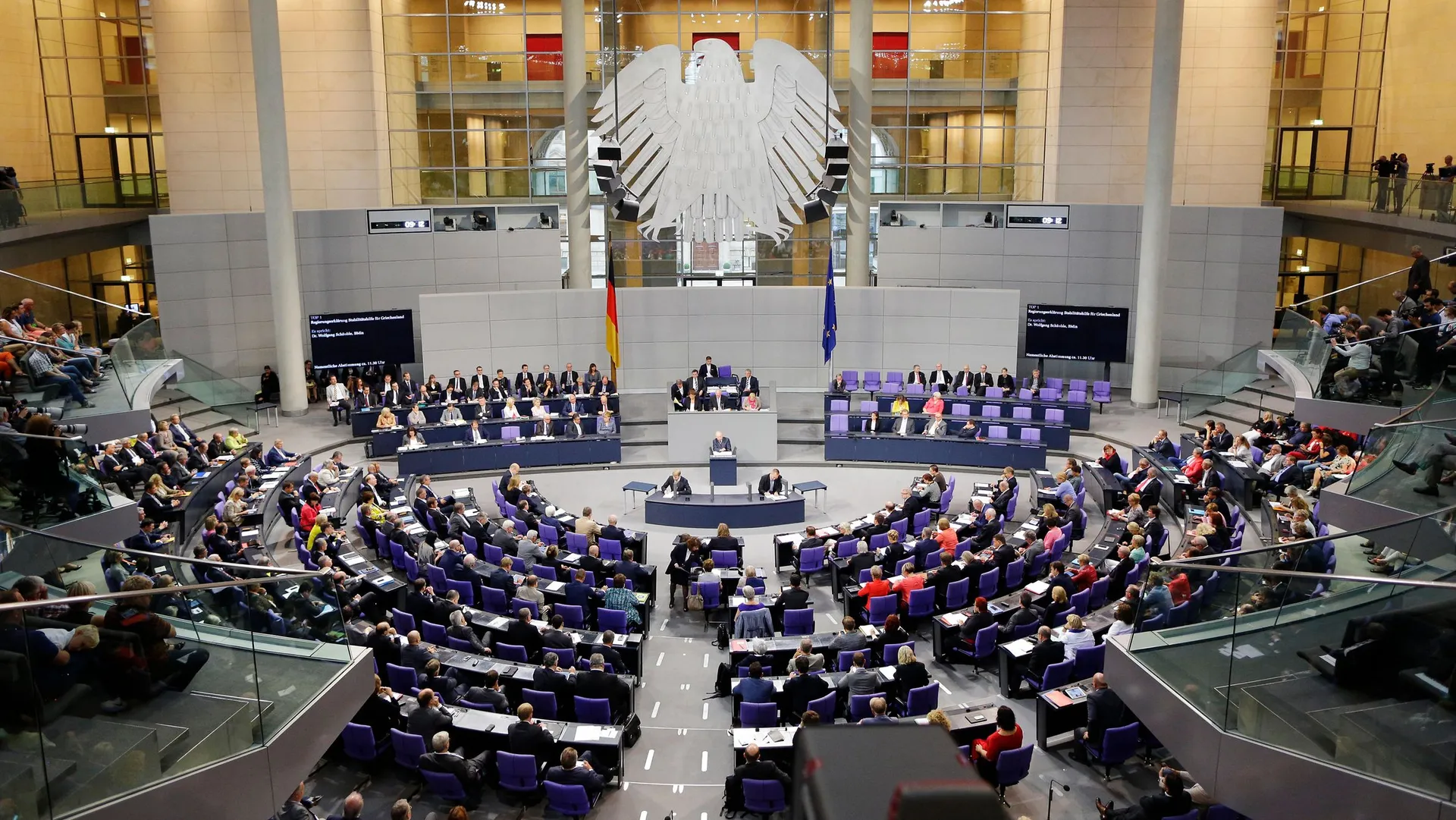
(Patria) - The German Bundestag discussed the extension of the Bundeswehr's participation in the EUFOR Althea mission in Bosnia and Herzegovina today.
Representatives of the German government and most parliamentary parties presented Bosnia and Herzegovina as an important security area for Europe.
The AfD and Die Linke (The Left) opposed the continuation of the mandate, but for completely different reasons, reports N1.
State Minister in the Federal Foreign Office Florian Hahn opened the debate by recalling Srebrenica and the war in Bosnia and Herzegovina.
He said that many still remember the "harrowing images and reports" from that period - separated families, mass executions, and soldiers who could not intervene because they lacked clear authorization and the necessary equipment.
- We are convinced that such a war must not happen again - Hahn stated, explaining why the Bundestag is discussing the continuation of German participation in EUFOR Althea.
According to him, the primary task of the mission remains to support the implementation of the Dayton Peace Agreement, which ended the war in Bosnia and Herzegovina in 1995.
Hahn stated that there are currently no open hostilities in the country and that the security situation is stable, but warned that the political situation remains fragile.
He particularly emphasized that Bosnia and Herzegovina, due to its location in the EU's immediate neighborhood, its European perspective, and its vulnerability to Russian influence, "remains a political priority" for Germany.
A stable Western Balkans, he added, is in Berlin's direct interest.
Parliamentary State Secretary in the Federal Ministry of Defence Sebastian Hartmann also supported the continuation of the mandate.
He recalled that more than 100,000 people were killed in the war in Bosnia and Herzegovina, while more than two million were displaced or expelled.
- Since the Dayton Agreement in 1995, no major armed conflict of a similar kind has broken out. This is connected to the continuous presence of the international community - Hartmann emphasized.
He warned that secessionist tendencies and rhetoric, particularly in the BiH entity of Republika Srpska, continue to undermine the integrity of the state of BiH and increase vulnerability to external influences.
He stressed that this carries the risk of short-term destabilization.
Green Party MP Niklas Wagener spoke about his recent visit to Sarajevo and Vlasenica, where he visited Bundeswehr members as part of the mission.
He specifically described a visit to a crime scene where, as he said, there is still no memorial today.
- Without confronting the past, there will be no reconciliation, and without reconciliation, conflicts will erupt again and again - said Wagener.
He assessed that Bosnia and Herzegovina is caught between Russian influence, the uncertainty caused by the Trump administration, and the lack of prospects for young people, which leads to mass emigration.
Peter Beyer from the CDU/CSU stated that EUFOR Althea is an important expression of cooperation between the European Union and NATO.
He noted that the Dayton Agreement is not without flaws, but that it stopped the war and that there is still broad support for Bosnia and Herzegovina's European path.
Beyer warned that the political system of Bosnia and Herzegovina, where reforms can be blocked by veto, often serves to protect particular interests.
- If Germany and Europe do not stand up for their interests in Bosnia and Herzegovina, space is opened for the destabilizing influence of anti-Western actors - Beyer stated.
The AfD, on the other hand, rejects the continuation of the mission. Tobias Teich and Jörg Zelbers claim that EUFOR Althea has transformed from a temporary security instrument into a permanent state without a clear objective or exit strategy.
- A mission that was conceived as a transitional solution has become a permanent state - Teich stated.
Zelbers added that the mission has been ongoing for 22 years, not counting earlier mandates like SFOR, and that discussions are about "decades," not a time-limited task.
The AfD believes that long-term military presence cannot replace the political responsibility of domestic actors and that German resources should be directed towards its own defense capabilities.
Die Linke is also against the extension. MP Gökay Akbulut assessed that BiH is today a "dysfunctional state" where institutions are blocked, and ethnic vetoes weaken democracy.
She particularly criticized the role of High Representative Christian Schmidt.
- Democracy cannot be governed from the outside - said Akbulut, stating that BiH does not need the Bundeswehr, but rather a fight against corruption, investment in education, peace projects, and trauma work.
The debate showed a clear majority for the continuation of German participation in the EUFOR Althea mission, but also a deep political difference in the interpretation of Bosnia and Herzegovina.
For the government and most parties, it is Europe's security front, while for the opponents of the mandate, it is proof of the failure of long-term international governance.
The current mandate, approved by the Bundestag in June 2025, expires on June 30, 2026, so an extension should be voted on before that deadline.
Komentari (0)
Prijavite se za komentiranje
PrijavaJos nema komentara. Budite prvi!
Minuta
Sve →Iz drugih kategorija

High Representative Not Elected: Germans, French and British Against Americans, New Attempt at End of June

ČOVIĆ WITHOUT MERCY: How Those Who Brought Ademović to Office Created a Political Hell for Him



Sunny Saturday, quite warm



Tragedy in Albanian resort: Two minors drown












