
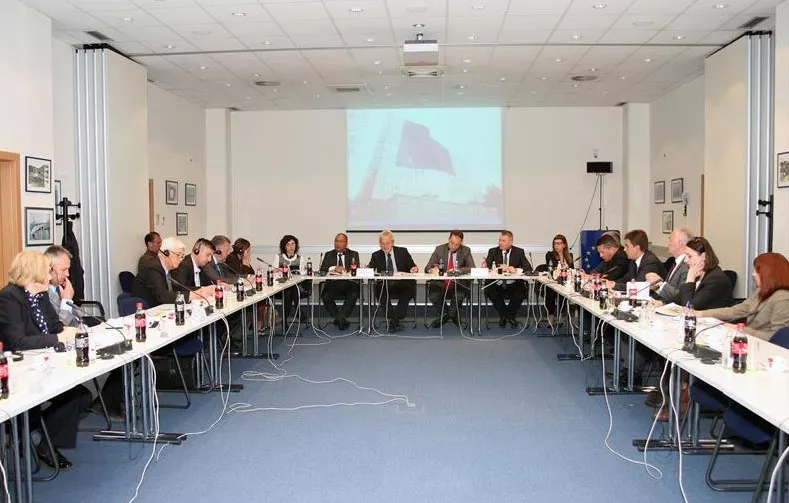
The European Union plans to invest one billion euros over the next five years in the development and connectivity of transport and energy infrastructure in the Western Balkan region, leading to further integration with EU member states, stated the Chargé d'Affaires of the European Union Delegation to Bosnia and Herzegovina, Dr. Renzo Daviddi, at a meeting with the Minister of Communications and Transport of BiH Slavko Matanović, the Minister of Transport and Communications of RS Neđo Trninić, and representatives of the Council of Ministers of BiH, the Ministry of Foreign Trade and Economic Relations of BiH, the Ministry of Transport and Communications of FBiH, and the Ministry of Energy, Mining and Industry of FBiH, reports the Patria News Agency.
At the meeting held at the headquarters of the European Union Delegation in Sarajevo, Dr. Daviddi reminded that in recent years, the European Union has given greater importance to connecting citizens and businesses across Europe in order to promote sustainable economic growth.
He added that the Western Balkans Summit, held in August last year in Berlin, further strengthened efforts to improve connectivity with the Western Balkan countries.
As announced by Commissioner Hahn in Pristina, on March 25, 2015, the first step involves more than 100 million euros in funds under IPA II, which will be available to all countries, along with loans for financing from European financial institutions. To access these funds, countries in the region must first agree on the core transport infrastructure network for the region.
A preliminary agreement was reached at the meeting of ministers in Pristina, which needs to be formally confirmed by the prime ministers from the region on April 21 in Brussels. The next step is to agree on specific priorities for investments in the transport and energy sectors.
Each country, including Bosnia and Herzegovina, will have to carefully select priorities and explore all possible funding sources. In this context, it is necessary to establish a functional Investment Committee at the state level, bringing together representatives of all relevant ministries and financial partners. The Investment Committee will have to establish a sectoral project management mechanism, i.e., a comprehensive planning and financing mechanism, which includes the most important investment projects for financing in the country. Credible sectoral strategies and a sectoral project management mechanism, as well as a regulatory framework in line with EU requirements, are key and, as such, represent a prerequisite for accessing EU funds.
"This represents a real opportunity for BiH to significantly improve its transport and energy sectors. Significant EU assistance must be accompanied by a strong priority given to efforts in BiH, which can lead to strengthening overall competitiveness, economic growth, job creation, and a genuine improvement in the lives of citizens in BiH. As such, the Connectivity Agenda is fully complementary to the Agreement for Growth and Employment, the implementation of which the authorities have committed to," emphasized Dr. Daviddi, concluding:
"It is now up to BiH to fulfill the conditions without delay to ensure access to EU funds."
Komentari (0)
Prijavite se za komentiranje
PrijavaJos nema komentara. Budite prvi!
Minuta
Sve →Iz drugih kategorija

High Representative Not Elected: Germans, French and British Sabotaged Americans, New Attempt at End of June

ČOVIĆ WITHOUT MERCY: How Those Who Brought Ademović to Office Created a Political Hell for Him



Sunny Saturday, quite warm



Tragedy in Albanian resort: Two minors drown












