
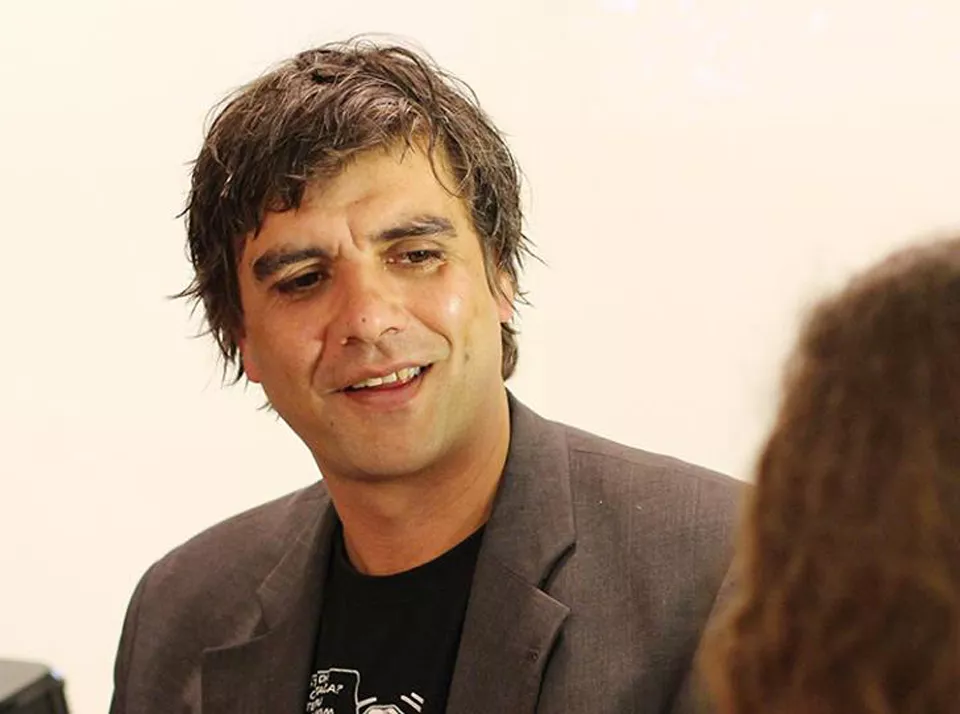
For Patria, Bekim Sejranović, an exceptional literary figure, speaks. Just like his literature, his interviews are particularly interesting and intriguing, full of sincere wit. When you read anything by Bekim, you enjoy it.
Interview by: Armin Aljović
You were born in Brčko and lived there until you were 13, you also lived in Rijeka for another eight years, and since you were 21, you've been in Norway. What are you more, a person from Brčko, Rijeka, or Norway? And are you more of any of these?
Today, I am a bit of everything, although each city or country has its time, period of the year, or part of life. Brčko is childhood, Rijeka is very important for formative teenage years, while I have officially lived the longest in Norway, although I have spent a lot of time outside of that, let's say, my second homeland.
Today, I have developed a nomadic lifestyle system, I have friends and family members all over the world, I have two daughters, one in Oslo and the other in Ljubljana, and I visit them as often as I can. In recent years, after getting tired of traveling the world, I embarked on what has been the most important journey of my life so far, sailing down the Sava and Danube rivers towards the Black Sea.
That's how I discovered that I don't need land, but water. In the summer, I sail the Sava, and in the winter, I go to Oslo for a while to earn a few kroner to survive. Sometimes I write something, I read a lot. Now I've been in Zagreb for over half a year, or rather, in a small village near Zagreb, and I'm trying to create a home for myself here, some kind of base. Ljubljana and my younger daughter are close by, which is most important to me, but so are the Sava and Brčko, and also the sea and Rijeka. Perhaps my life seems chaotic to someone, but believe me, that nomadic life also has its routine, just a little different from the usual one. And like most people, I'm just trying to stay afloat. The river carries you, and you go a little left, a little right, you sink a little, then you resurface, and that's all.
As my poet friend Marko Tomaš would say: "Life is a joke." Don't take it too seriously. Enjoy it when you can, it will pass quickly. And when things are tough, grit your teeth and wait for it to pass, because everything passes. I know it sounds simple, but it's not quite like that. We all have bad days and good days.
Here in Bosnia and Herzegovina, people wonder why you are not a member of the Association of Writers of BiH? Why are you only a member of the Croatian Association? We also read your works here and enjoy your success. You are increasingly resembling Andrić and Meša. Are you also being skillfully "taken away" from Bosnia?
No one is taking me away, it's not like that. I am not a member of BiH because I am too lazy to send an application, but I will do it, I just don't know how. Just send me the form to fill out, and I'll gladly be a member. I am a member of the Croatian Association, but I have never paid membership fees, nor have I attended any meetings. I am also a member of the Norwegian Society of Writers, I even paid them membership fees, I don't know why myself. I don't socialize much with writers either, maybe with a couple of them, with whom I would socialize even if I didn't write. I don't think anyone "took" Meša or Andrić either; they are simply writers who have multiple identities, which is a fact for many artists and not just them. Things shouldn't be framed as "either-or," but as "both-and."
When you belong to multiple places, you see things from different perspectives, often completely opposite ones, you understand some things, you learn to observe the world without all that designed packaging, you see through the "colorful lies," you realize that there is no recipe for life, no rules, you don't know what something is good for or not.
People can simultaneously belong to multiple cultures, and even multiple languages. I consider myself a Bosnian, Croatian, Norwegian, (post)-Yugoslav, European, and world writer. It doesn't matter. Whoever reads my book, and if they think a little about what I want to say, they are mine.
To your question, I can also answer with a counter-question: Will anything in my life change or get better if I become a member of the Association of Writers of Bosnia and Herzegovina? Will I become a better writer? A bigger Bosnian? A better Bosniak? Will anyone be happy if I say no, I am not a Croatian writer, I refuse to be one, I want to be only and exclusively Bosnian, and even more exclusively Bosniak? Or Norwegian? I am fighting to raise my children and to live as freely and independently as possible. There is no complete freedom anymore, if there ever was. I am not a materialist; everything I own fits in one bag. Give me a joint, a good book, a small boat to sail, and I am a happy man.
Judging by the stories and novels you write, you are mostly from "nowhere and from nowhere." A cosmopolitan. However, what has defined you the most is that you grew up on the soil of Brčko. You cannot change that. Scientists say that our character, mentally and physically, is formed in the first seven years of life, as the core and essence of a human being is formed then.
Yes, but I wasn't only in Brčko in the first seven years. I visited my father in several different places and cities, and I visited my mother in Rijeka. My grandfather and grandmother raised me, but I also spent time in other places. But I agree, in the end, I returned to the Sava in Brčko, at least in the summer.
I am currently in Oslo, and next year I am traveling to America if everything goes well and my first novel is published in the USA in English.
I don't have any plan, actually. I have as many dreams and fantasies as you want. But we'll see what happens next.
It's true what you say, that a person cannot escape their roots, but for a tree to survive, roots are not enough; it must also have a crown, it must bear fruit to reproduce. If I had stayed in Brčko, I probably would never have become a writer. Maybe I wouldn't even be alive. But that's the story of what would have happened if...
Your family is all over the world. A typical Bosnian family. How do you manage to stay together through connections and networks?
Well, we see each other as much as we can, we help if we can, we talk via Skype, although not very often. I saw my grandparents the most while they were still alive; they were my priority. But I also have good relationships with my half-sisters and my half-brother, thirty years younger, on my father's side. And I wouldn't say we are a "typical" family. My father married and divorced four times, and I have three times. I never felt like I had a family. I always felt like I was alone. I have been living alone since I was thirteen.
Is "Your Son Huckleberry Finn" an autobiographical novel? Does it align with your family's diaspora? Do you think the fate of the Bosniak refugees is one of the most tragic of the last century?
It is tragic, yes. That there are many more tragic, even worse stories, that's also true. There's always worse. People have always moved, migrated, and will continue to do so as long as they exist, for one reason or another. It's true we've scattered across the world, but at the same time, we are now everywhere; we have marked every country on the planet. One would think there are a hundred million of us. Wherever I went, for example, to India or Brazil, I ran into someone from Bosnia. As for the autobiographical aspect of the novel, I believe everything is autobiographical, even when you tell something you've made up, because that is also yours, your imagination and dreams are autobiographical. The novel is not called "My" son, but "Your son..." and on a symbolic level, it is a letter to my father.
Many things in the novel have happened, and some are yet to happen. I try to erase the line between literature and reality, because otherwise, art has no meaning, or rather, it is not art but a craft. The difference between art and craft is that craft does not tolerate mistakes in form, while the greatest art arises precisely when you break established frameworks, given forms, and create something original, even if, from a "craftsman's" perspective, that new thing is of lesser quality.
It's bad enough that fate scattered you all over the place and broke your life into three parts, but you are still going on journeys. You recently organized a Sava river convoy to Belgrade. Do you think the Yugoslav peoples can remain together in some form?
I did not organize any convoy; you probably mean my voyage down the Sava and Danube towards the Black Sea. The Yugoslav peoples are simply interdependent, and we will always have special, neighborly relations. Sometimes good, sometimes bad, as it goes with neighbors. My books are read in Belgrade and Sarajevo and Ljubljana and Skopje. It's similar with other artists, or with any other people; we are all still connected. True, we have fought each other many times, but in most cases, we fought for the interests of others. I don't know what official relations the post-Yugoslav countries will have in the future, but I assume something like the Scandinavian countries. We understand each other; our languages are actually the same, although there are several different literary standards, it is still, linguistically speaking, the same language, even though we call it by different names. I will, if you insist, always feel the space from the Vardar to Triglav as my own. I was born in Yugoslavia, I was a Tito's pioneer, and I don't regret it, although there was a lot of indoctrination, of course. But believe me, there is indoctrination everywhere; every country raises children and fills their brains with slogans.
For example, it's funny to me today that when I travel by train from Ljubljana to Sarajevo, they change the locomotive four times. First, the train is pulled by a Slovenian locomotive, then a Croatian one, then a locomotive from Republika Srpska, and finally a "federal" one. It's pure Monty Python, as if someone is messing around. If someone had told me what all this would look like, I wouldn't have believed them. Just as today, my friends in Brčko, twenty years younger than me, don't believe that we used to swim across the Sava five times a day to bathe on the Slavonian side where the beach was. They say, "What about your passport? Where did you put your passport?" What passport, man, there were no borders. And so, today, my Sava is again a border between two worlds.
You have a Japanese friend, a director, with whom you made a documentary film in 2011. The Japanese man appears in "Huckleberry." Where does this unusual "Japanese connection" of yours come from?
We filmed the movie back in 2007. We met by chance through a friend of mine from Rijeka who lives in Berlin. I had bought a small boat and wanted to sail from Brčko to the Black Sea, and he is a film director, and that sounded like a great idea to him, although he had never even heard of the Balkans before, let alone Sava and Brčko. Anyway, he liked it here, and he has been coming here often ever since.
You are definitely the most popular young writer in the region. I recently read on Facebook: "The best, most handsome, and most interesting writer." People are convinced that your literary star will achieve great success. How do you handle this great popularity?
Thank you for the "young" part, because if we're being honest, I'm approaching fifty. And when you hear "most handsome," the first thing that comes to mind is, what are the others like? (laughs) Honestly, all this fuss is tiresome. It's one thing to write books, and another to play the clown and entertainer. The latter is not for me. I am withdrawn and quite shy. It was okay when I was ten years younger and still a little less known. Now I feel tired, and I'm tired of people asking me the same things, tired of talking about myself. I get happy when I meet someone who has never read my books or heard my name.
I get nothing concrete out of this popularity, or maybe I don't know how to use it, who knows?
Now I just want to write in peace, read books, sail, and spend as much time as possible with my daughters.
Komentari (0)
Prijavite se za komentiranje
PrijavaJos nema komentara. Budite prvi!
Minuta
Sve →Iz drugih kategorija

High Representative Not Elected: Germans, French and British Sabotaged Americans, New Attempt at End of June

ČOVIĆ WITHOUT MERCY: How Those Who Brought Ademović to Office Created a Political Hell for Him



Sunny Saturday, quite warm



Tragedy in Albanian resort: Two minors drown












