
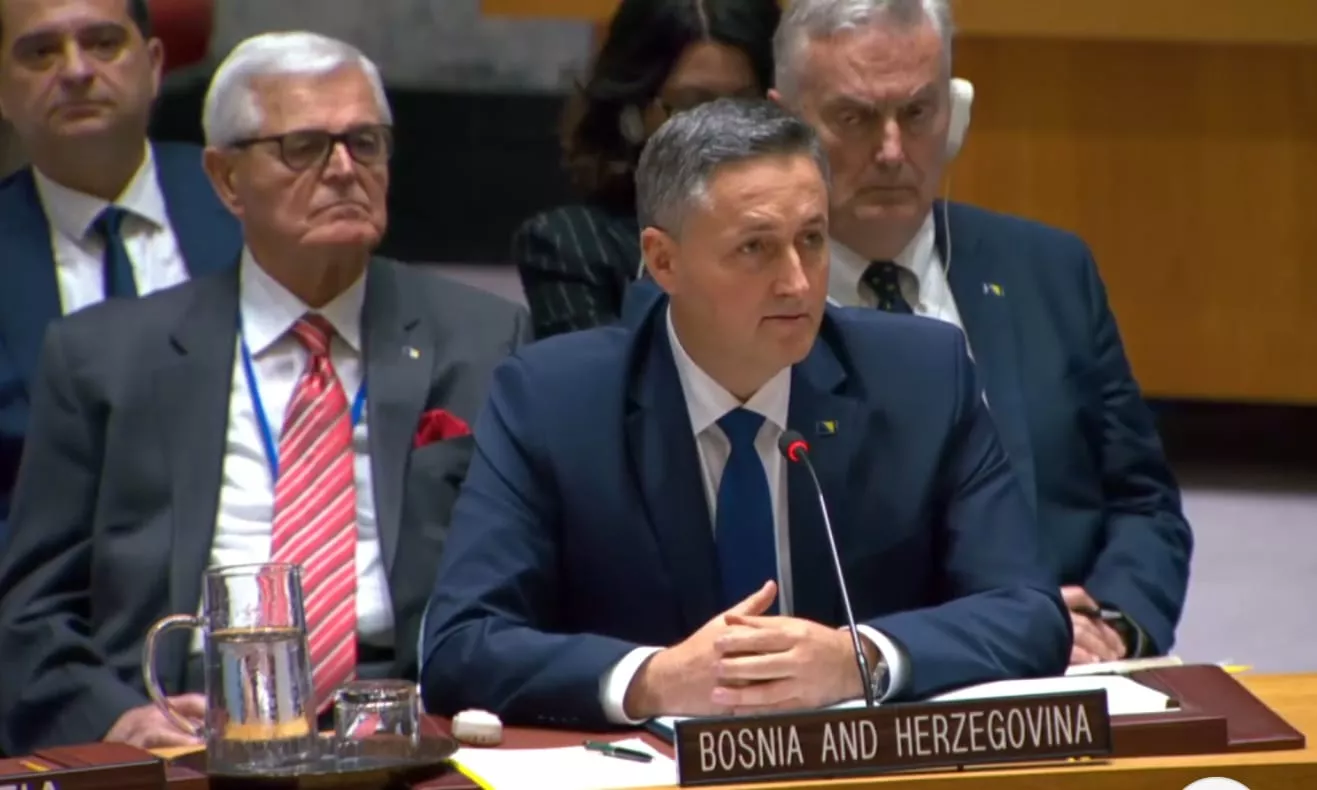
(Patria) - At a session of the United Nations Security Council, the Chair of the Presidency of Bosnia and Herzegovina, Denis Bećirović, presented key foreign policy positions of his country and warned of threats to peace and stability in the region.
Our foreign policy goals are NATO and EU membership. Bosnia and Herzegovina has successfully covered a large part of the path towards Euro-Atlantic and European integration. Had it not been for obstructions and blockades initiated from outside our country's borders, our results would have been even better. All wars in the long history of Bosnia and Herzegovina were caused by aggressions from other states.
That was the case from 1992 to the end of 1995 as well. This has also been confirmed by UN courts. Therefore, the essential problem of Bosnia and Herzegovina is external attempts to weaken, divide, and ultimately destroy our country.
In May of this year, the UN General Assembly adopted the Resolution on the International Day of Remembrance and Commemoration of the Genocide Committed in Srebrenica in 1995. Following the final and binding verdicts of the highest UN courts on the genocide against Bosniaks, it is very important that the UN General Assembly also adopted this resolution. We must not forget, the genocide against Bosniaks was the culmination of the aggression against Bosnia and Herzegovina.
Unfortunately, the leadership of the Republic of Serbia does not respect the verdicts of UN courts and the Resolution of the UN General Assembly. I remind you, Serbia is the only country in the world that has violated the UN Convention on the Prevention and Punishment of the Crime of Genocide. The destructive policy of the Serbian leadership is followed by the authorities of the entity Republika Srpska. They recently introduced content into primary school curricula that glorifies convicted war criminals Radovan Karadžić and Ratko Mladić.
They are not heroes. They are convicted war criminals, found guilty of genocide, crimes against humanity, and other war crimes. The authorities of the entity Republika Srpska dangerously undermine the foundations of the Dayton Peace Agreement. They publicly advocate for:
unilateral destruction of the Dayton Agreement;
restoration of the criminal project of a Greater Serbia;
destruction of the state of Bosnia and Herzegovina;
and violation of international and national law.
These are not just my personal observations.
The Steering Board of the Peace Implementation Council unanimously concluded on 20 June 2024 that the ruling coalition in the entity Republika Srpska:
carries out flagrant attacks on the General Framework Agreement for Peace;
attacks the constitutional and legal order of Bosnia and Herzegovina;
attacks the sovereignty and territorial integrity of Bosnia and Herzegovina;
undermines the state, its authorities, and its multi-ethnic character.
Witnesses to the Dayton Agreement, who are actively engaged in the Peace Implementation Council and the UN, should sound the red alarm due to threats to peace and stability in Bosnia and Herzegovina and the region.
It is very important that the Steering Board of the Peace Implementation Council adopted a clear interpretation of three important elements for ensuring peace and stability.
Sovereignty belongs to Bosnia and Herzegovina, as a single state whose territorial integrity is guaranteed, among other things, by the General Framework Agreement for Peace.
The entities within Bosnia and Herzegovina are not states; they exist solely on the basis of the BiH Constitution and have no sovereignty of their own. The international community retains the necessary instruments to ensure the implementation of the General Framework Agreement for Peace.
The leadership of the Republic of Serbia aggressively interferes in the internal affairs of Bosnia and Herzegovina, as well as some other countries in the region. One piece of evidence for this claim of mine is the adopted Declaration of the so-called All-Serbian Assembly in Belgrade, on 8 June of this year. Besides at the so-called All-Serbian Assembly, the Declaration was adopted in the Assembly of Serbia and the Assembly of the entity Republika Srpska.
The so-called All-Serbian Assembly cannot be superior to the state authorities of Bosnia and Herzegovina and declare the military neutrality of Bosnia and Herzegovina. One of the Deputy Prime Ministers of the Republic of Serbia recently openly admitted that "the unification of Serbia and Republika Srpska has begun." This is dangerous and absolutely unacceptable. It is time to tell the truth here, in the UN Security Council, about Serbia's real intention. The essential goal of the Serbian leadership is the gradual Anschluss of the entity Republika Srpska into Serbia.
It is trying to achieve this goal by abusing parallel ties. I remind you, the Constitution of BiH clearly states that parallel relations with neighboring states can be established "in accordance with the sovereignty and territorial integrity of Bosnia and Herzegovina." The Declaration of the so-called All-Serbian Assembly is contrary to the Dayton Agreement and the Constitution of BiH.
For these and numerous other reasons, the High Representative was obliged to annul this anti-Dayton declaration. It is not just a declaratory act, but a dangerous, great-state programmatic document.
Unfortunately, the High Representative has not yet done so. I call on the international community, especially the EU, to clearly condemn the reactivation of the Greater Serbia project.
This concerns not only Bosnia and Herzegovina but the whole of Europe. Let us stop the revival of the dangerous concept of "one nation, one assembly" in time.
It is particularly unacceptable that the Serbian leadership does not respect international law, nor the final and binding decisions of the Constitutional Court of BiH on state property of Bosnia and Herzegovina.
State property constitutes an inseparable part of the territorial integrity and sovereignty of Bosnia and Herzegovina.
The notorious President of Serbia, Slobodan Milošević, tried to divide state property between the entities in Dayton. Milošević did not achieve this goal during the aggression against Bosnia and Herzegovina, nor during the negotiations in Dayton. The international community must not allow this war goal to be achieved in peacetime.
I consider it important that the UN Security Council adopted the Decision on extending the mandate of EUFOR/Althea. The presence of EUFOR is important for preserving peace and stability in Bosnia and Herzegovina, as well as in the region.
Also, NATO's message that it will not allow a security vacuum in Bosnia and Herzegovina is very important. Let us not forget, NATO's mandate in Bosnia and Herzegovina is precisely defined by Annex 1-A of the Dayton Agreement.
The future of Bosnia and Herzegovina is linked to the implementation of the judgments of the European Court of Human Rights in Strasbourg. Bosnia and Herzegovina has an obligation to ensure the individual rights of citizens, not just the collective rights of constituent peoples. It is time for retrograde forces to stop obstructing the implementation of the judgments of the European Court of Human Rights.
Pressure on the European Court of Human Rights regarding the latest judgment in the case of Slaven Kovačević is unacceptable. We must eliminate every form of discrimination against citizens, including discrimination based on ethnic and territorial grounds.
It is our obligation to harmonize the Constitution of BiH with international law and generally accepted democratic principles and practices. In this process, it is necessary to strengthen the democratic and multi-ethnic state of Bosnia and Herzegovina.
Bosnia and Herzegovina accepted the European Convention for the Protection of Human Rights and Fundamental Freedoms as part of its international obligations within the Dayton Agreement, thereby assuming responsibility for the protection of human rights according to the highest European standards.
Bosnia and Herzegovina does not need selective application of this Convention. The Constitution of BiH prescribes the direct application of the European Convention for the Protection of Human Rights and Fundamental Freedoms, as well as the priority of this Convention over any other law.
Bosnia and Herzegovina needs democratic solutions to overcome current challenges. In this regard, I believe we should focus on:
consistent and comprehensive implementation of all aspects of the Dayton Agreement;
harmonization of the Constitution of BiH, in accordance with the requirements of the European Court of Human Rights;
acceptance of the EU acquis.
My country needs a political system that will ensure equal rights and a better future for all citizens.
At the end of my address to the UN Security Council, I wish to particularly emphasize that for my homeland, Bosnia and Herzegovina, it is very important to ensure the necessary preconditions that will guarantee the security of all citizens.
Unfortunately, in the neighborhood, we are witnessing enormous arming with offensive weapons. After the genocide, crimes against humanity, and joint criminal enterprises of the 1990s, Bosnia and Herzegovina must be enabled to have the necessary defense capacities, in accordance with international and national law. This is a joint obligation of Bosnia and Herzegovina and the international community," Bećirović's speech concluded.
Komentari (0)
Prijavite se za komentiranje
PrijavaJos nema komentara. Budite prvi!
Minuta
Sve →Iz drugih kategorija

High Representative Not Elected: Germans, French and British Against Americans, New Attempt at End of June

ČOVIĆ WITHOUT MERCY: How Those Who Brought Ademović to Office Created a Political Hell for Him



Sunny Saturday, quite warm



Tragedy in Albanian resort: Two minors drown












