
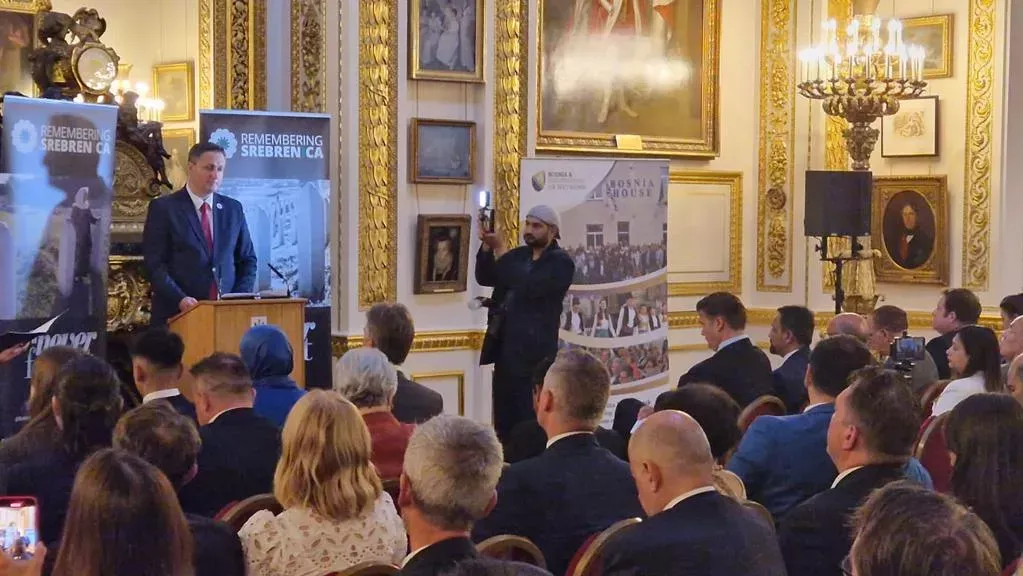
(Patria) - BiH Presidency member Denis Bećirović addressed the commemoration of the 28th anniversary of the genocide against Bosniaks in the "UN Safe Zone of Srebrenica" at Lancaster House in London.
We present Bećirović's speech in its entirety, without intervention:
Distinguished representatives of His Majesty's Parliament and Government,
Ladies and Gentlemen,
Dear Friends,
First and foremost, I wish to express, on my own behalf and on behalf of the vast majority of citizens of Bosnia and Herzegovina, my gratitude to the Government and Parliament of the United Kingdom of Great Britain and Northern Ireland (United Kingdom) for their principled fight to preserve the truth about the committed genocide against Bosniaks.
I extend my sincere thanks to the Chairman of the "Remembering Srebrenica" foundation, Waqar Azmi, and esteemed friends from this foundation. I also wish to pay my respects to Prime Minister Margaret Thatcher and Lord Paddy Ashdown, who are no longer with us, but who, even during the aggression against the internationally recognized state of the Republic of Bosnia and Herzegovina, called for just action from the international community.
Lord Paddy Ashdown, as the High Representative of the international community in Bosnia and Herzegovina, will forever be inscribed in the history of Bosnia and Herzegovina and Europe as a man who persistently and strongly fought to overcome the consequences of aggression and genocide. This diplomat and humanist will be remembered with great distinction in the history of our two countries.
I also express my gratitude to the Government of the United Kingdom for its contribution to the implementation of the Dayton Peace Agreement and its support for Bosnia and Herzegovina's Euro-Atlantic path. The citizens of Bosnia and Herzegovina highly value the engagement of the United Kingdom, which in 2015 proposed Resolution S/2015/508 on Srebrenica to the United Nations Security Council (UN). Although the adoption of the resolution text was halted by the Russian Federation's use of its veto power, we perceived the resolution as an important civilizational step forward in the fight for truth and justice.
We are convinced that this resolution is equally important for the world as it is for Bosnia and Herzegovina, as it unequivocally expresses, on a global level, condemnation of genocide and support for the victims.
The highest courts of the UN have proven what happened in Bosnia and Herzegovina from 1992 to 1995. It was not a civil war in our country, as some wished to portray it. It was an international armed conflict. The internationally recognized state, the Republic of Bosnia and Herzegovina, was subjected to brutal aggression. Joint criminal enterprises were carried out against our country, during which genocide was committed against Bosniaks. These are facts that cannot be erased. These are permanent condemnations of criminal Greater-state projects aimed at dismembering Bosnia and Herzegovina.
The judgments of the International Court of Justice and the Hague Tribunal do not exist to be archived. They must be thoroughly analyzed and implemented. Numerous final judgments by international and national courts have proven that the only genocide in Europe after World War II was committed by the army and police units of the so-called Republika Srpska. During July 1995, in a brazen operation of killing, with clear intent, organized and according to a precisely established plan and pattern, over 8,000 Bosniaks were tragically liquidated. Among the killed were over 800 children. In and around Srebrenica, thousands of captured Bosniaks were brutally liquidated and buried in mass graves. Hundreds of them were buried alive. Children were separated from their mothers and killed before their eyes. Mass and individual liquidations, forced displacement of residents, committed acts of rape, forced separation of families, conscious and targeted destruction of property and civilian facilities, and imposed severe existential living conditions were consciously committed with the intent to physically or biologically destroy Bosniaks as an ethnic group.
There is abundant evidence of everything committed in and around Srebrenica in July 1995, including mass graves – primary, secondary, and tertiary. The political and military authorities of the so-called Republika Srpska planned the crime of genocide, its execution, provided logistical support, and then participated in covering up the crime through the exhumation and concealment of mass graves, which, I emphasize, has been confirmed by the decisions of the International Criminal Tribunal for the former Yugoslavia.
For the crime of genocide against Bosniaks in and around Srebrenica, the Hague Tribunal sentenced the first president of the self-proclaimed Republika Srpska, Radovan Karadžić, to life imprisonment, as well as other top political and military officials of this para-state. They have been finally convicted, but their policy is not dead.
Unfortunately, the current president of the Republika Srpska entity, Milorad Dodik, has not learned from the judgments of international courts. On the contrary, similar to the criminal Radovan Karadžić, Dodik denies the committed genocide, insults the victims and their families, and takes actions that pose a serious threat to the preservation of peace and security in Bosnia and Herzegovina and the region.
For the investigation of the genocide committed against Bosniaks in and around Srebrenica, the judgment of the International Court of Justice is of particular importance, in terms of Serbia's responsibility for the failure to prevent genocide. According to the judgment, Serbia is the only country in Europe that has violated the UN Convention on the Prevention and Punishment of the Crime of Genocide. The genocide against Bosniaks in Srebrenica was not a spontaneous act. In addition to the perpetrators of the genocide, we must fully shed light on the role of intellectuals, media, and other structures that conceived, organized, and supported the execution of the genocide. The United Nations and the democratic countries of the world have acknowledged the mistakes made towards Bosnia and Herzegovina.
United Nations Secretary-General Kofi Annan acknowledged the guilt of the international community, stating that "Srebrenica represents the greatest shame in the history of the United Nations." The mistakes made can no longer be corrected, but new ones can be prevented. Therefore, the pro-Russian president of the Republika Srpska entity must be stopped urgently and decisively before he destabilizes Bosnia and Herzegovina and the Western Balkans.
It is time for the European Union to join the sanctions imposed by the United Kingdom and the United States of America against deniers of genocide and destroyers of the Dayton Peace Agreement. The world and Europe must learn from Srebrenica.
Since the July days of 1995, the word Srebrenica has echoed across our planet as a symbol of the only genocide in Europe after World War II. Any evil that we do not stop at its beginning becomes much greater and more dangerous as it continues. Together, let us stop the new evil that once again threatens peace in Bosnia and Herzegovina.
The brutal Russian aggression against Ukraine should be a warning of what happens when dangerous policies are tolerated and ignored. The democratic and free part of humanity must clearly distinguish between democrats and autocrats, victims and perpetrators. Direct or indirect equating of victims and perpetrators leads to the complete collapse of morality and our civilization. In Europe, Bosnia and Herzegovina, and the world, we must build a culture of remembrance of genocide.
The genocide against Bosniaks in the heart of Europe must not be forgotten, marginalized, or denied. We must not allow it for the sake of humanity's future. A culture of remembrance is not a culture of revenge. It is a culture of educating about the policies and ideologies that bring evil and violence. The purpose of a culture of remembrance is not to create division and hatred, but to prevent evil and crime. Through a culture of remembrance, we fight for democracy and human rights.
By remembering, we also preserve the dignity of those who are no longer with us. By remembering, we also fight for a secure future for new generations. Thank you to the United Kingdom for preserving the truth about Srebrenica and giving hope for a more just future.
Komentari (0)
Prijavite se za komentiranje
PrijavaJos nema komentara. Budite prvi!
Minuta
Sve →Iz drugih kategorija

High Representative Not Elected: Germans, French and British Against Americans, New Attempt at End of June

ČOVIĆ WITHOUT MERCY: How Those Who Brought Ademović to Office Created a Political Hell for Him



Sunny Saturday, quite warm



Tragedy in Albanian resort: Two minors drown












