
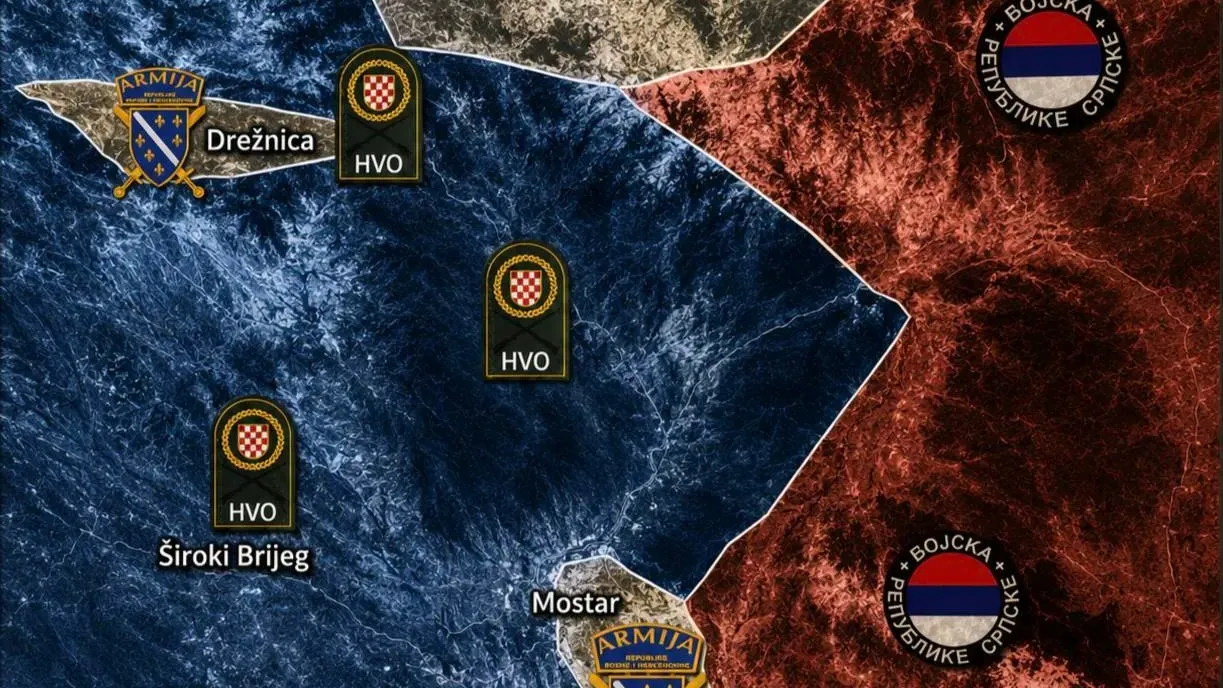
(Patria) - On this day in 1993, as part of the general attack by the forces of the Croatian Defence Council (HVO) and the Croatian Army (HV) on Mostar, Drežnica was also attacked.
- Fighters of the Army of the Republic of Bosnia and Herzegovina and members of the Ministry of Internal Affairs of the Republic of Bosnia and Herzegovina put up a heroic resistance, stopped the aggressor, defended Mostar and Drežnica, and created preconditions for the de-blockade of the city.
That day marked the beginning of one of the bloodiest sieges of Mostar in its history. A large number of civilians from Mostar, as well as displaced persons from all over Herzegovina, found themselves in complete encirclement - stated the Memorial Center Drežnica.
They added that after the HVO forcibly took over positions in the Ravni and Ledenice area on April 9th, intelligence work detected constant reconnaissance and preparations for an attack on the positions of the 4th Battalion in Drežnica, near the Bijela bridge, Jasenjani, and Drežnica itself, which the command of the 41st Motorized Brigade "Slavne" was also informed about.
- The parish office, as well as other facilities within the "Svi sveti" church complex in Donja Drežnica, served as the command post, communication center, and logistics base for the Independent Company of the HVO Drežnica (Drežnica, Grabovica, and Vrdi), which numbered more than 160 armed and equipped combatants.
In mid-April 1993, there was a significant relocation of assets from the church complex towards Grabovica and Vrdi, organized by parish priest Jozo (Marko) Blažević, known as Joko, an active member of the Independent Company of the HVO Drežnica, while a smaller number of combatants remained present in that area.
From April 16th, Drežnica was under complete hermetic blockade. Traffic on the main road towards Mostar and Jablanica was completely impossible due to HVO checkpoints in Salakovac and Grabovica, as well as previously established checkpoints towards Goranci and Posušje.
All communication, except for radio communication, with the brigade command was cut off, so the Drežnica battalion remained the only unit of the 4th Corps physically separated from other units - the Memorial Center Drežnica reminds.
The goal was to break through the defense lines of the Army of the Republic of Bosnia and Herzegovina
On April 17th, the HVO attacked the villages of Sovići and Doljani near Jablanica, where horrific crimes and the persecution of the Bosniak population were committed. The situation in Mostar became increasingly complex day by day, which is why the battalion command also undertook preparations for a possible attack on Drežnica.
By order of Ilija Vrljić number 02-1458/93 dated April 16, 1993, in the early morning of May 9th, forces of the 2nd Brigade of the HVO, in coordination with other units, attempting to achieve their political and military goals, launched a strong artillery and infantry attack on the defense lines of the 4th Battalion and populated areas in Drežnica.
The entire 2nd Brigade of the HVO was engaged to carry out this task: from the direction of Vrdi, the 3rd Battalion operated, and from the direction of Bijelo Polje, the 1st and 5th Battalions, with the support of artillery and armored units.
- The objective of the attack was to break through the defense lines of the Army of the Republic of Bosnia and Herzegovina stationed in Drežnica, to gain control of the M-17 road communication, to bring the entire area of Donja Drežnica under control, and to encircle Gornja Drežnica, after which, in coordination with forces from Posušje, that area would be brought under control.
It was planned to neutralize everyone who resisted, disarm and expel the rest, connect with HVO forces in Grabovica, and continue the advance towards Jablanica.
Simultaneously, positions of the battalion in the Ušće and Tramošnik area, the position near the Bijela bridge, and positions at Jasenjani were also attacked - state the Memorial Center Drežnica.
HVO forces did not achieve their main objective
Intense infantry fighting took place all day in Donja Drežnica. Fighters of the Drežnica battalion offered fierce resistance, broke through HVO sabotage groups, and neutralized the spearheads of the attack, including the commander of the 3rd Company of the 3rd Battalion (Vinske), Marin Marić, known as Dasa.
On that day, combatants attempted to break through the defense lines in Tramošnik and the Ušće area multiple times, but without success and with heavy losses in personnel, after which they were forced to withdraw.
More than 100 fighters from Gornja Drežnica arrived as reinforcements in Donja Drežnica.
- The attacks were successfully repelled, the defense lines consolidated, and the fighters were ready to continue the fight and defend Drežnica. About ten of our fighters at the position near the Bijela bridge could not resist the much stronger HVO forces, which attacked from three directions with full intensity and all available means. Our units at Jasenjani, under a strong artillery attack, withdrew to Gornja Sela and established a defense line there. HVO forces occupied positions at Bijela and Jasenjani, but did not achieve their main objective – the capture of Drežnica and the link-up with their company in Grabovica.
Drežnica was defended, but it remained completely blocked and surrounded by HVO forces from the directions of Mostar, Grabovica, Goranci, and Posušje. During the night of May 9th, the battalion command received a message: "The falcon lands on the water at 3:00 AM, wait with 50 fighters at the agreed location."
This was a message for the execution of a previously agreed plan with the Special Unit of the Main Staff of the Army of RBiH "Zulfikar" for the liberation of a strong and extreme HVO stronghold in Grabovica, which administratively belongs to the Local Community of Drežnica - they recall.
A group of 50 fighters from the Drežnica battalion prepared for the attack and liberation of the area north of the Drežnica bridge towards Jablanica.
In the early morning of May 10th, an HVO transporter from the direction of Mostar, with a larger group of combatants from Bijelo Polje, approached the bridge in Drežnica and opened fire on our positions in the Ušće area.
Grabovica Hydroelectric Power Plant Liberated
- Our fighters returned fire fiercely. Precise 60 mm mortar shells, fired from the Greben positions, stopped their advance, after which the combatants were forced to withdraw.
The Special Unit for Special Purposes "Zulfikar" attacked the strong and extreme HVO stronghold in Grabovica that morning. Fighters from Drežnica also joined the attack. HVO forces in Grabovica were defeated and routed. A transporter with an anti-aircraft machine gun, an anti-aircraft machine gun, as well as significant quantities of infantry weapons and materiel were captured. A large group of combatants was also captured, including the commander of the HVO Drežnica company, Karlo Marić.
Several combatants were killed during the fighting, including Sergeant Franjo Zadro, former secretary of the Drežnica Local Community.
The Grabovica Hydroelectric Power Plant was liberated, as well as the settlements of Sjenčine, Ominje, Ćopi, Donja Grabovica, and Grabovica, i.e., the entire territory from Drežnica to Jablanica. Fierce infantry and artillery attacks on the battalion's positions at the mouth of the Drežanka into the Neretva continued in the following days, but the defenders of Drežnica did not retreat.
Aware that they had not achieved their objectives in Mostar, that they had not captured Drežnica nor linked up with forces in Grabovica, and fearing attacks by ARBiH units from the direction of Jablanica and Konjic, HVO forces withdrew to Bijelo Polje, established the Ravni-Salakovac line, and destroyed the Jasen and Bijela bridges.
Mostar was defended. Drežnica was defended. Grabovica was liberated.
Contact and communication were established, and coordination with units from the direction of Jablanica was enabled, thereby creating preconditions for the de-blockade of Mostar, which would follow at the end of June.
The final defense of Drežnica would have been almost impossible without the liberation of Grabovica, just as the de-blockade of Mostar would have been significantly more difficult if the HVO had captured Drežnica on May 9, 1993, and linked up with its forces in Grabovica and continued its advance towards Jablanica - stated the Memorial Center Drežnica.
Komentari (0)
Prijavite se za komentiranje
PrijavaJos nema komentara. Budite prvi!
Minuta
Sve →Iz drugih kategorija

High Representative Not Elected: Germans, French and British Against Americans, New Attempt at End of June

ČOVIĆ WITHOUT MERCY: How Those Who Brought Ademović to Office Created a Political Hell for Him



Sunny Saturday, quite warm



Tragedy in Albanian resort: Two minors drown












