
By Armin Sijamić
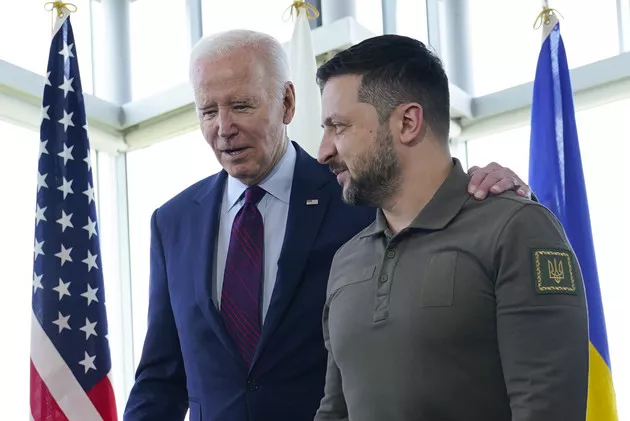
Yesterday will be remembered as one of the more important days for the final outcome of the war in Eastern Europe. US President Joe Biden and his Ukrainian counterpart Volodymyr Zelensky signed a security agreement in Italy yesterday, on the sidelines of the G7 summit, which guarantees important aid to Kyiv. The day before, NATO announced that the organization would coordinate the delivery of aid to Ukraine.
Yesterday once again showed that the West does not intend to lose the war in Eastern Europe, committing its credibility that Russia will not break the Ukrainian army. In just a few days, the United States and its allies, from Europe to Asia, have imposed new sanctions on Russia, signed agreements with Kyiv on providing aid, decided that NATO will be further engaged, and told Russian President Vladimir Putin that he was mistaken when he calculated that the West would stop helping Kyiv.
Things have escalated to the point where Russia, with Belarus, conducted exercises with tactical nuclear weapons, and former President Dmitry Medvedev, as well as some other Russian officials, even threatened the West with nuclear weapons. Putin then softened these statements but threatened that Russia would supply weapons to countries with which the West has poor relations, after Kyiv received permission to use Western weapons to strike deep into Russian territory.
"Unprecedented" Agreement
The agreement signed by Biden and Zelensky is historic, as is its ten-year duration. Zelensky described it as an "unprecedented" agreement, and Biden had previously said that the agreement would give Ukraine similar guarantees from the United States as Israel enjoys.
The agreement provides for American military and economic assistance, the possibility of joint arms production, the exchange of intelligence and all other data between the two armies and states, joint troop training and experience exchange, and consultations between the two sides in case of an attack by third countries.
However, this agreement does not mean that the US will defend Ukraine, as it is obligated to defend NATO members, but it is an important guarantee for Kyiv if an agreement with Moscow is reached. In that case, the American guarantees from the agreement could be an additional security factor for Kyiv. For example, if a ceasefire were reached in Ukraine and then American and allied forces were deployed in the country, it would be a significant deterrent against any new attack. Therefore, it is not surprising that Zelensky sees the agreement as "our bridge to Ukraine's membership in NATO".
Kyiv has already signed similar agreements with fifteen Western countries, including the United Kingdom, Germany, France, Italy, Spain, Sweden, Norway, Finland... All these countries will provide Kyiv with money, weapons, and other forms of assistance.
Biden said that the signed agreement would make Ukraine "strong, sustainable, and resilient" and stated that "Putin will not divide us, and we will be with Ukraine until they win this war".
After that, he announced new sanctions against Russia, its banks, and all those who do business with them, the seizure of profits from Russian assets in the G7 member states, and their transfer to Kyiv. Initially, the profit from Russian assets that Kyiv will have available amounts to fifty billion dollars. It is estimated that Kyiv could receive up to three hundred billion dollars through loans in this way.
Biden's National Security Advisor Jake Sullivan, likely one of the most important officials in the current US administration, said the agreement sends a "signal of our resolve" and added that "if Vladimir Putin thinks he can outlast the coalition supporting Ukraine, he is wrong. He simply cannot wait that long.".
Sullivan is referring to Western sanctions and the economic exhaustion of Russia, as it is difficult to believe that the Russian economy, in confrontation with the most developed countries in the world in a long-term conflict, can remain untouched. The long-term agreements with Ukraine are a message to Moscow that the West does not intend to give up.
NATO Plays with Open Cards
But this was not the end of the good news for Kyiv. The day before Biden's signature on the agreement with Kyiv, NATO Secretary General Jens Stoltenberg said that the alliance is ready to take over the coordination of arms deliveries to Kyiv and the training of its troops, and that this decision will be made quickly.
This practically means that the world's largest military alliance will replace the US at the head of a coalition of about fifty countries, also known as the "Ramstein format," that are helping Ukraine. This contact group relied on American leadership, but Stoltenberg assessed that Donald Trump's potential return to the White House could complicate matters. That is why he decided to propose that NATO take the lead and that a fund of one hundred billion dollars be created in parallel to finance Ukraine.
Stoltenberg has visited some NATO member states in the past period, likely preparing this decision for which he received support. As early as April, Stoltenberg announced this. "Allies have agreed today to move forward with planning for a greater NATO role in coordinating security assistance and training," Stoltenberg said at the time, signaling further aid to Ukraine, after the American military aid package enabled Kyiv to survive another Russian offensive.
Zelensky understands that NATO's involvement in the arms delivery process will be important. At the signing of the agreement with Biden, he said he expects F-16 fighter jets to arrive in Ukraine and that the signed agreement provides for this. It should be recalled that the Netherlands, Denmark, Norway, and Belgium had previously promised these aircraft to Kyiv, and Ukrainian pilots have already undergone training.
War of Attrition and NATO's Eastern Flank
When Russia launched its aggression against Ukraine, one of the main points in Moscow's plans was likely the disunity of the West, i.e., the possibility that one or more countries would stop aid to Kyiv. After that, the Kremlin calculated that there would be fatigue in the West and thus disunity among allies. This scenario has played out to a lesser extent within the European Union, where some countries, primarily Hungary and Slovakia, were against sending aid.
NATO does not have such problems for now, as it is managed by Washington, which stands firmly behind Kyiv. However, there are periodic fears in the West that Western plans will be changed by Donald Trump if he returns to the White House, although more and more people do not believe this. One of them is Putin, who said last week that he sees no difference between Biden and Trump when it comes to Ukraine.
Nevertheless, Western countries are also preparing for a scenario where American military presence in Europe decreases, as the world's largest power wants to focus on containing China, which Trump also did. Therefore, in recent months, efforts have been made to strengthen NATO's eastern flank, from Finland, through the Baltic states, to Romania, with an emphasis on Poland, which is a growing military power on the border of Russia and Belarus.
All these countries are doing what Trump demanded during his term – allocating funds for defense in accordance with NATO standards. The countries on NATO's eastern flank have done this part of the job excellently. Poland, as the strongest military power on NATO's eastern flank, even proposes investing more than that.
All this supports the thesis that the West is building an increasingly large wall against Russia, while economic, financial, and energy ties with Moscow have been severed over the past two years. Thus, the outcome of the war in Ukraine and the answer to the question of where part of this wall will be erected and in what state Russia will be at the moment when the war ends with the defeat of one side or some temporary or permanent peace agreement.
Komentari (0)
Prijavite se za komentiranje
PrijavaJos nema komentara. Budite prvi!
Minuta
Sve →Iz drugih kategorija

High Representative Not Elected: Germans, French and British Sabotaged Americans, New Attempt at End of June

ČOVIĆ WITHOUT MERCY: How Those Who Brought Ademović to Office Created a Political Hell for Him



Sunny Saturday, quite warm



Tragedy in Albanian resort: Two minors drown












