
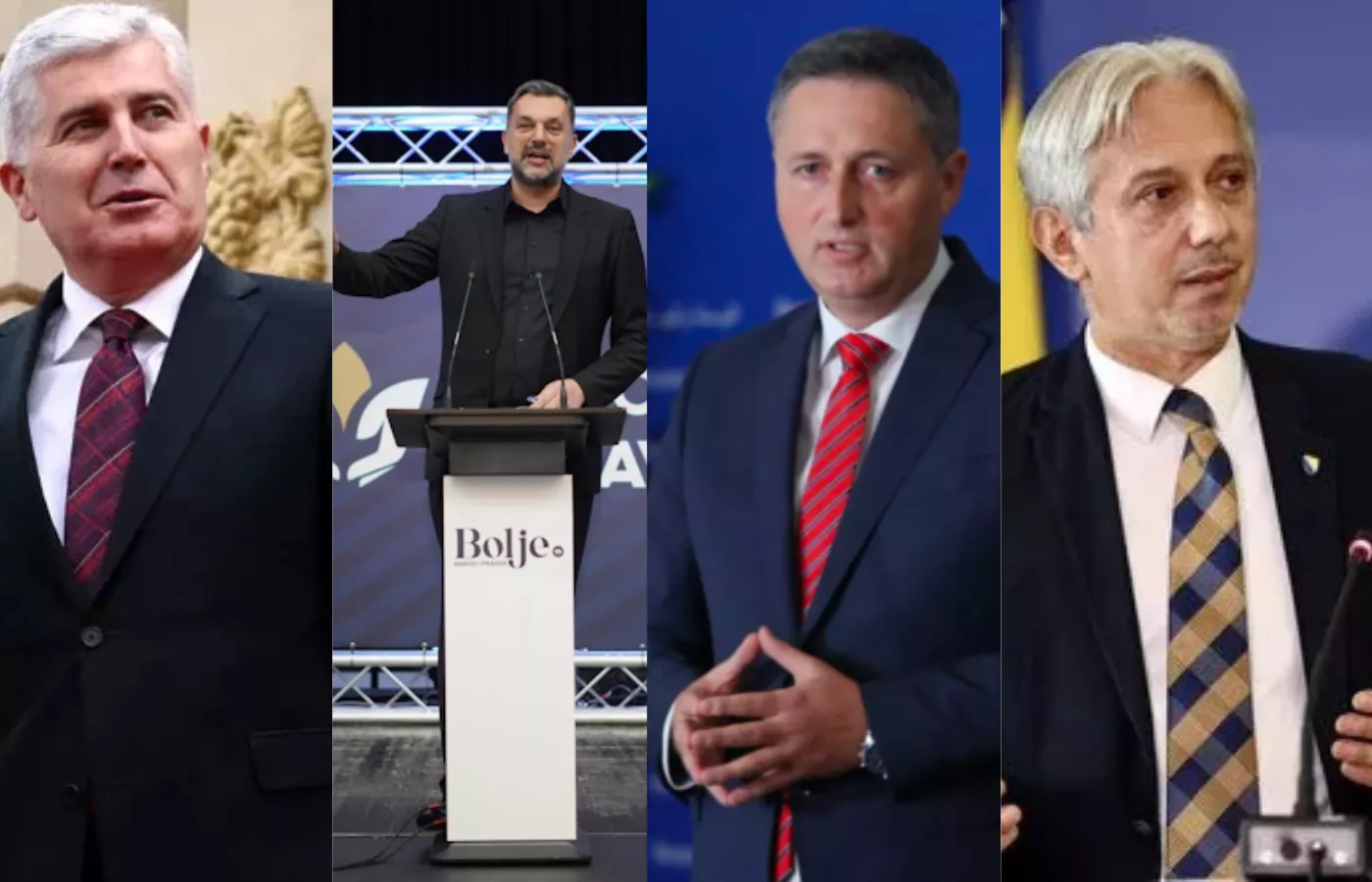
(Patria) - In the last month, officials of the Sarajevo "Trojka", including their leaders, have increasingly directed the edge of their criticism towards HDZ BiH. The only exception in this regard is the "Trojka" member of the BiH Presidency from the Bosniak people, Denis Bećirović, who still does not dare to criticize HDZ's policies.
Although the "Trojka" and HDZ coalition government functions flawlessly at the Federation of BiH level, given that the "Trojka" diligently fulfills all conditions of the HDZ's political dictate, and there is complete harmony in this regard, especially when it comes to the work of public companies where nepotism and corruption flourish, things at the state level and in the general political relations between HDZ and "Trojka" do not function so idyllically.
The divergence began with the unsuccessful "bager campaign" to remove SNSD from state government, undertaken by the "Trojka", which HDZ did not support. Previously, the "Trojka" had pleaded with HDZ to join them in an attempt to oust SNSD from power, to which HDZ, as usual, turned a deaf ear, leaving the "Trojka" in the lurch.
On this occasion, it was quite unpleasant to listen to the odious laments about Dragan Čović being an obstacle to the European path and someone who supports the Russian submarine in the form of Milorad Dodik, as the "Trojka" was presenting the political arguments of the current opposition, which have been present in the public sphere for ten years, and which the "Trojka" until yesterday, when it came to the policies of HDZ and SNSD, did not even want to hear about.
Things became even more bizarre when it turned out that HDZ is blocking the southern interconnector project, which is in the mutual state interest of the United States of America and Bosnia and Herzegovina. The "Trojka's" shock that HDZ is conditioning the project on changes to the election law seemed completely amateurish, given that the HDZ's blockade mechanism has long been known to everyone.
The "Trojka" is now unable to deliver the southern interconnector project to its American partners due to the destructive policies of HDZ. This is the same destructive policy of HDZ that, at the height of the pandemic, blocked and conditioned the procurement of vaccines, for which the "Trojka" applauded them, as such an attitude by HDZ created enormous problems for the then pro-Bosnian government representatives in Sarajevo, who could not find a solution for that blockade. Now, HDZ's insolence is backfiring on the "Trojka".
Certainly, neither HDZ's lenient attitude towards SNSD nor the blocking of the southern interconnector project are the only reasons why the "Trojka" is now turning its criticism towards SNSD. Daily political dynamics constantly bring to the surface other reasons for the forced shift in the "Trojka's" rhetoric.
One of the better examples is the reaction of "Trojka" officials, especially Elmedin Konaković, to the statements of Croatian MEP Tomislav Sokol, and earlier to the statements of Željana Zovko, who threaten the alleged formation of a "third entity".
Reacting on behalf of the "Trojka" to Sokol's statements about the "third entity" and the claims that European officials support the formation of a "third entity", Konaković recently stated in his TV appearances that this is not only untrue but that he was also told by European officials that HDZ's proposals for amending the election law are completely contrary to European standards.
Of course, there is nothing new in the information that Konaković is now conveying in an attempt to improve his own and the "Trojka's" ratings, as it has long been known that the nature of HDZ's demands is precisely that. What is problematic is the fact that the "Trojka" and Konaković spent years whitewashing these proposals and attacking anyone who dared to criticize them.
Now that it is becoming increasingly clear that the "Trojka" is losing ground, it is turning to the truth about HDZ's policies and quietly abandoning the self-deceptions about them, with which they had been burdening the public in previous years in an effort to please the policies of Dragan Čović and Andrej Plenković.
However, the question arises: if HDZ's policies are now a problem for the "Trojka", and they finally reluctantly admit that they are, why do they even dislike those who consistently oppose such policies and those who are trying to curb its influence? Why, then, is Elmedin Konaković bothered by the candidacy of Slaven Kovačević for the BiH Presidency member from the Croatian people, if, and it is, the problem for Bosnia and Herzegovina is the policy of HDZ BiH?
In the logic of the NiP leader, it might be possible, but in social reality, claims that HDZ's policies are a problem for Bosnia and Herzegovina cannot coexist with the claim that the candidacy of a candidate who is not a representative of HDZ's policy and who is curbing the influence of that policy within BiH institutions is also a problem.
After all, if HDZ's policies are truly a problem for the "Trojka" now, then it should call on its candidate for the BiH Presidency, who does not dare to utter a word of criticism against HDZ's policies, and especially not against the policies of official Zagreb, to withdraw his candidacy in favor of a candidate for the Presidency member from the Croatian people who has no problem criticizing HDZ.
(M.T.)
Komentari (0)
Prijavite se za komentiranje
PrijavaJos nema komentara. Budite prvi!
Minuta
Sve →Iz drugih kategorija

High Representative Not Elected: Germans, French and British Sabotaged Americans, New Attempt at End of June

ČOVIĆ WITHOUT MERCY: How Those Who Brought Ademović to Office Created a Political Hell for Him



Sunny Saturday, quite warm



Tragedy in Albanian resort: Two minors drown












