
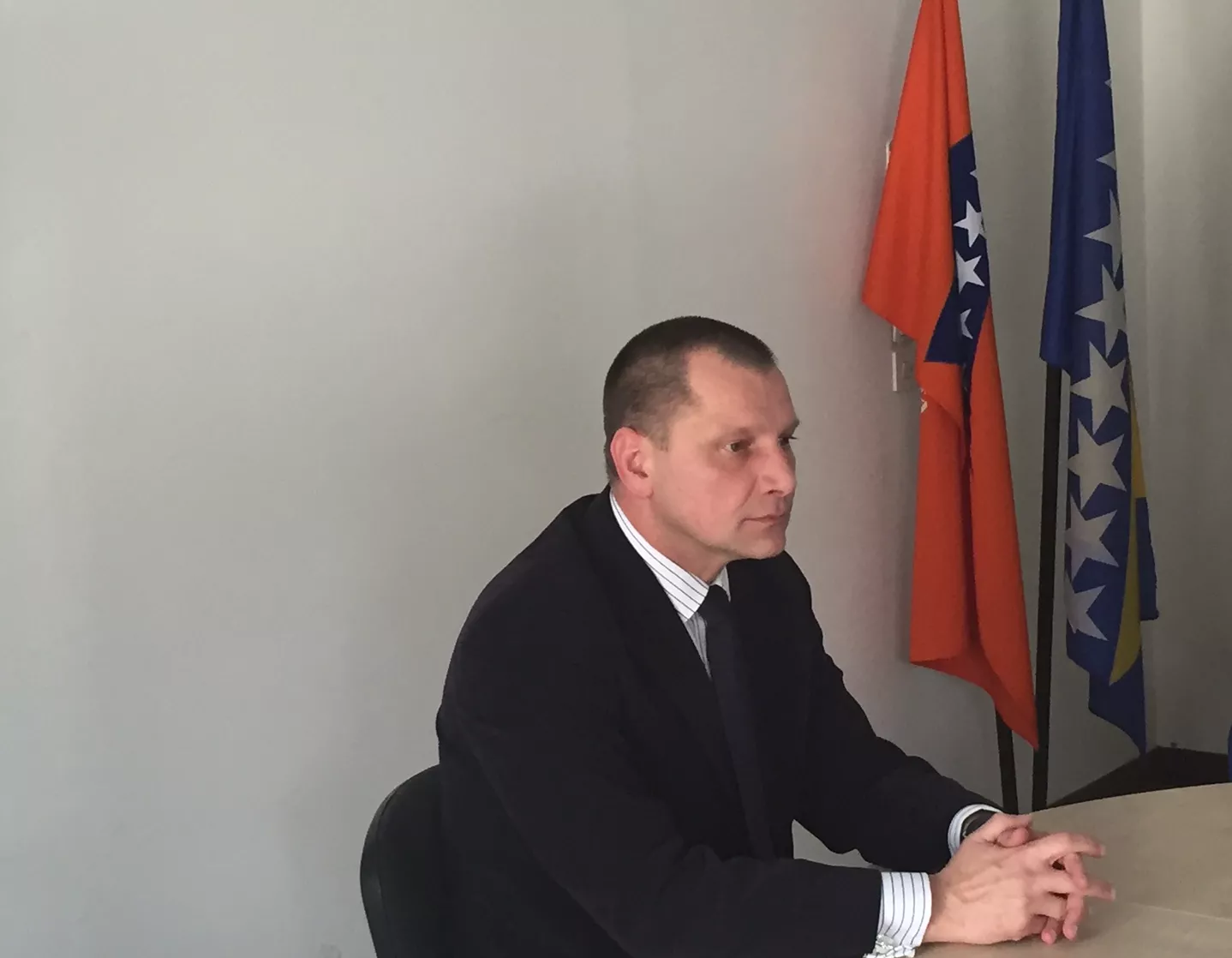
At the session of the Main Board of the Democratic Front held on 12/27/2015, Zlatko Miletić was elected as the Secretary General of that party. The appointment of the new secretary was also expected following recent personnel changes in the DF: the departure of Sifet Podžić from the position of Secretary General, who resigned from that post, and the expulsion from the party of recently high-ranking Reuf Bajrović and Emir Suljagić.
In addition, at the last Congress of the party, by the decision of the president and bodies of the party, the Democratic Front – Željko Komšić was renamed the Democratic Front.
The leader of the Democratic Front, Željko Komšić, on January 8, called on the patriots of BiH to “fight together with the DF against devastation, dissolution, and humiliation for the good of BiH”. He also invited DF members to leave “without hesitation or reservation” if they cannot or do not want to follow him in that fight.
In military-police jargon, the Democratic Front is closing ranks for the continuation of the fight, and we were interested in the role in the ongoing reorganization of the new party secretary general, long-time police official, Zlatko Miletić.
PATRIA: Congratulations on the position of Secretary General of the Democratic Front. This is your first political position. Does it represent a challenge in that regard?
MILETIĆ: Thank you for the congratulations. Until now, I was indirectly connected to politics through my previous work – primarily as police director. During two terms, from 2002 to 2010, I had to interact with politicians, cooperate, and sometimes argue to resolve issues such as the status of police officers, to be more effective in fighting crime, coordinating the work of police agencies, etc.
Then, for 3 years, I held the position of Executive Director of the Association of Police Directors of Southeast Europe. There, I gained some political experience in dealing with strategic affairs and strategic planning related to the fight against crime, corruption, migration, and other similar problems that burden the Balkan countries. In the last few months, I have been working as an advisor in the Ministry of Security. So, all the aforementioned jobs had some connection to politics. In essence, none had a direct connection like this job. I hope that in the coming period, given my experience related to politics, by bringing my integrity, personality, and relevant knowledge, I will bring additional credibility to all of this. In the context of all these events primarily related to the DF, I want to make myself available to the party bodies, so they can use my knowledge to improve the situation and “reset” the situation in the party in such a way that not only our members but also the citizens of BiH will be satisfied with the work of the DF.
PATRIA: Given that you have been involved in police work since the beginning of your career, that is your education, and it is known that you were a high-ranking police official for many years, the question arises as to how Zlatko Miletić will now do a civilian job. Do you think some adaptation, transition is needed? Is this a big change for you?
MILETIĆ: I must tell you that it is. At the same time, what represents an advantage for the Democratic Front as a political party is the fact that I possess knowledge or information about certain holders of public and political positions in BiH, their criminal activities, which we will certainly use in the coming period, in a manner appropriate for political activism. This does not mean that I will continue to perform the duties of an inspector, in the sense that I will investigate crime with the same intensity, but we will use my knowledge of the criminal activities of holders of public and political positions – we will. Of course, when the conditions are met and when the party bodies assess that it is necessary. The way this data is presented, of course, will not be as it was before. You know how it is done in politics; we learned a lot from them, so we will reciprocate.

PATRIA: Why did you choose the DF? Equally, why did the DF choose you?
MILETIĆ: Given that I am the child of a working-class family and grew up during the time of Yugoslavia, I have always been closer to social democratic convictions. Considering that most of my friends are in the DF (although I have them in various other parties), it was not difficult to decide.
When it comes to personal quality, although it may sound pretentious or boastful, I believe that I can bring new quality to the party in terms of organization, given that I have managed much larger systems than managing the DF Headquarters. It should be noted that these tasks are somewhat more specific compared to those, as there is more order there and that order relies on multiple procedures. We will try to transfer that order here – not in the sense of creating a police organization, but in that way to solve things that are not procedurally resolved, such as, for example, relations with the media. I don't think we have done that in a way that would meet the needs of the membership and the citizens of BiH. In every sense, where we see something not working properly, we will first address it within the context of procedures adopted by the party bodies. We will also work on strengthening personnel, bringing people into the party who know their job, who will know how to use all the advantages they have.
PATRIA: What is it like when someone from a precisely regulated, organized system like the military and police, where there is hierarchy and precise procedures, moves to a civilian one that is not structured and clearly regulated in the same way? How will you overcome any organizational-cultural shock?
MILETIĆ: I must admit that I have experienced a shock in that way, but the essence is that you need to be aware of that difference. Within the context of our Statute, everyone has the right to say what they think – that right also stems from our name. In public appearances, expressing opinions, whether it concerns political work, the law, etc., positions must be crystallized in the context of what the party or party bodies think about an important political issue. There should not be any major deviations. Just as we have the right to our own opinion, we in the party also respect different opinions – not only within the party but also in inter-party dialogue. Regardless of their economic, social, religious, or other status, some may be guided by impulses that I do not like at that moment. Some may be preoccupied, for example, with existential issues. And it is okay for us to deal with solving that issue as well. However, in the context of all these issues, an order must be established – no one forbids you from dealing with personal matters, but you must primarily care about the state, about the citizens, that is, about what is prescribed by the Manifesto and the Statute.
Part of that cultural shock for me is also when you encounter people who occasionally 'jump out' of all that. The essence of the story is that everyone finds their place here – there is a place for everyone here, even for those who are not members or sympathizers of our party. We will provide an opportunity for all citizens of BiH who believe they can change something to do so through our structure. If municipal elections are held in October, we expect the DF to decide to support a candidate in a certain area who does not have to be a DF member at all. Because, if we assess that this is a person who will bring about a very concrete positive change in that environment, we will support them even if they are not our member.
We are currently conducting elections in local committees. The Presidency recently appointed cantonal and municipal commissioners. I will take this opportunity to invite all our members and sympathizers to come to their local committees and participate in the work of their local commissioners to help each other organize the situation in local communities as the citizens of this country expect. We are their service, their government. We are open to all citizens in the local community if that is how they want to get involved.
PURGE OR CLARIFICATION
PATRIA: The position of Secretary General implies high operational capacity and coordination. What are the steps the new Secretary General is taking to start the year?
MILETIĆ: Your readers may not have had the opportunity to familiarize themselves with the description of such a job. I do not work alone; I work with the consent of the president and party bodies, primarily the Presidency and the Main Board. We must first confront some phenomena that have affected the DF, which can be considered common as they occur in all other parties. We will not sweep the problems we have under the rug, but we will demonstrate them publicly. We will not run away from problems – I am talking about internal party problems. We will make them public in a way and to the extent we deem necessary. All events concerning certain individuals, their departure from certain party functions – of course, we must go through all of that. To date, we have ten people who have left the Main Board. In that Main Board, there are still 102 people, which does not mean that people will not leave in the coming period, and others will not come. Unfortunately, we will have to say goodbye to some people. For some whom we consider to have changed, whose political activity does not support the postulates of the DF Manifesto and Statute, we will have to make some painful cuts for those individuals. Why? We cannot afford the luxury of dealing with this issue in the coming period because we will not have time for it. We will face great challenges and great trials in a strategic-political sense and will not have time to deal with ourselves further. How and in what way will we do this? First, we will organize our bodies within the party, primarily the Presidency, the Main Board, and the Headquarters itself. We will strive to bring in quality people and will ensure that everyone does their job so that all are in service of what the membership, sympathizers, and citizens of BiH expect from us. Those who are not on that path, I invite them publicly now – it is better for them to leave on their own than to find themselves in a situation where we have to sort things out.
PATRIA: What kind of membership do you need, or what does the ideal DF member look like?
MILETIĆ: In a formal legal sense, we have over 37,000 members. For some, this is an impressive number, and for some, like parties considered large, it is not a significant number. We want and strive to be a party of ordinary people, citizens who have equal rights in this country, who care as much as we do about BiH remaining a state. Every two years, or in certain cycles, someone starts talking about dividing the country, a third entity, or whatever they want to make of this country. So, the DF wants everything that is in the interest of this country for it to survive as a state entity, for all people in this country to be better off, for all people to find jobs, for us to restructure public administration, which has become the voting body of those large parties. If we have 180,000 employees in public administration, even if we have to have that many, let's make that public administration do its job. Let's bring competent people to certain positions, if we have the opportunity, even if they are not members of our party. In that sense, we must show our breadth because citizens must find their place.
BIH HAS NOT BEEN WORSE SINCE 1996
PATRIA: At a press conference on January 8, the leader of the DF stated that BiH is in the 'worst political situation since the war'. This is in stark contrast to the statements and reports of leaders of some major political parties about positive results. How would you comment on the current political and security situation in the country?
MILETIĆ: In the opinion of the majority, which I also support, the political, economic, and social situation in BiH has not been worse since 1996. Unfortunately, political elites in BiH, blinded by their personal interests or the interests of the lobbies that rule them, do not see 'beyond their noses', have contributed to such a situation. I think this is very bad for BiH as a state, for the entire society, and for the citizens of this country, regardless of their religion or nationality.
BiH faces a series of challenges in the coming period, especially as we approach the European Union. We do not view this approach formally, in the sense of just being present. However, our political goal is to become part of the EU. The goal of the Democratic Front is to establish such standards and procedures in this country, in all areas – healthcare, education, security, employment – that things are actually done as they are in Western European countries. That is the essence of our story, and we will fight for that story. In doing so, we will respect the decisions of the Constitutional Court, regardless of what they concern. We will respect the integrity of this country. We will not allow the disintegration of BiH, and we will use all democratic means in that fight.
PATRIA: The past year has been marked by an escalation of crime and corruption. Recently, we have also heard reports of armed bank robberies and peer violence, which have not been common types of offenses in this region until now. There is also talk of imported crime from neighboring countries. What, in your opinion, is at the core of the problem – despair due to a long-term crisis or something else?
MILETIĆ: In a country where you have half a million unemployed people, people simply have no other way to earn a living and then turn to various types of criminal activities.
There is also the issue of terrorism. A few years ago, I had the opportunity to debate with holders of public and political positions in BiH about whether terrorism exists or not. We had been convincing them since 1996 that it exists, but they denied it. When Maoča happened, I must remind you, we said that those events were not good for BiH, that we did not need that, and that we had to make additional efforts to narrow the space for such people to act, but we did not find understanding. Moreover, we were mostly accused of violating human rights and similar inappropriate things.
You have the situation related to juvenile delinquency. We have dealt with this issue several times, under public pressure, and we have done nothing. In a school where a child is mistreated in such a way, when abused, as determined by the competent investigative bodies, it is impossible that no one knows about it. It is even worse if professors, staff, and students knew about it – that no one reacted. That is what kills this country, in an individual, but also in a general, strategic sense.
PEOPLE SEE THAT NO ONE CAN DO ANYTHING TO ANYONE HERE
PATRIA: Can you comment on the recent remark by DF leader Željko Komšić about the 'perverted legal order of BiH' in which double standards prevail – rules that apply to citizens do not apply to politicians and high-ranking officials?
MILETIĆ: You have a segment of holders of public and political positions in BiH who have become so involved in crime that they have dozens of criminal charges. They relativize their responsibility in various ways by challenging the work of the police, which is very bad, by challenging the work of the Prosecutor's Office, the work of the courts, regardless of the level of government. Such an approach or behavior is reflected in the overall social reality. People see that no one can do anything to anyone here. And in that 'despair', everyone manages in their own way.
I can say anything about the work of police officers, but if we are unable, not in a unitarian sense, but when it comes to police bodies, to establish standards for payment, equipment, and work methods... then what are we talking about?! If we cannot find a solution for the Cantonal Prosecutor's Office in Sarajevo for years, where one prosecutor is assigned 150-180 cases! That individual prosecutor cannot physically handle that. We have a problem with correctional facilities where there is no space for convicted persons, while dozens of barracks stand empty. This is not being resolved intentionally to bring us into an atmosphere of fear, pressure, and existential blackmail. Because, here in BiH, the biggest problem is not terrorism, not crime, not juvenile delinquency. We are all prisoners of a terrorist policy towards the citizens of this country because for years we have not been allowed to catch our breath. When you give people jobs and a salary of 1000 EUR, then it doesn't matter to them who rules. People need to be given jobs, opportunities to show creativity, to use their inner strength, and I am convinced they have it.
Zlatko Miletić is neither the first nor the last policeman in the world to transition into political life. For a police official of his caliber, it is a natural move in his career and a step forward on the 'chessboard' he already knows well – from the inside. Serving the state and its citizens, a phrase Miletić often uses because it is engraved in his essence during his years in the police, is precisely reminiscent of the universal police motto that – for 'good police officers' – easily becomes a life motto.
We hope that in serving the state and its citizens, he will find a golden mean between police order, structure, and efficiency and civilian inclusivity and democracy.
Komentari (0)
Prijavite se za komentiranje
PrijavaJos nema komentara. Budite prvi!
Minuta
Sve →Iz drugih kategorija

High Representative Not Elected: Germans, French and British Against Americans, New Attempt at End of June

ČOVIĆ WITHOUT MERCY: How Those Who Brought Ademović to Office Created a Political Hell for Him



Sunny Saturday, quite warm



Tragedy in Albanian resort: Two minors drown












