
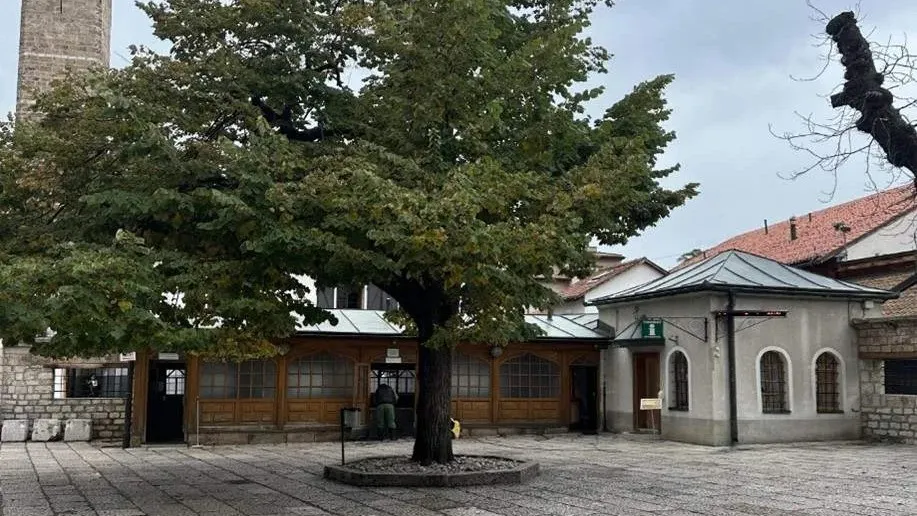
(Patria) - On the occasion of the event "Days of the Community and Mosques 2026," the Museum of Islamic Culture and Art, in cooperation with the Directorate for Religious Affairs of the Islamic Community in Bosnia and Herzegovina, will be presenting texts about interesting, more or less known facts about individual Bosnian-Herzegovinian mosques during the event.
Until the second half of the 20th century, ezans from minarets in Bosnia and Herzegovina were recited in central mosques from tall stone or, more commonly, from smaller wooden minarets of neighborhood mosques. In Herzegovina, due to the lack of wood, lower stone minarets were built even in neighborhoods, up to the height of the mosque roof.
Since in certain emergency situations, when there was severe weather, or during the month of Ramadan when prayers were rushed to break the fast as soon as possible, there were processed, more massive stones next to the mosques from which the muezzin would occasionally recite the ezan.
Next to this taller stone, there was usually a lower one that served as a step. Given that these stones were used as elevated places for reciting the ezan, they were called ezan-taš or akšam-taš. The most famous akšam-taš is located in Banja Luka in front of the Arnaudija mosque and is part of the national monument of Bosnia and Herzegovina.
Arnaudija, or Hasan defterdar's mosque, is one of the most famous and beautiful mosques in Banja Luka. It was built in 1594/95. The mosque served its purpose until May 7, 1993, when it was demolished by extremists of the Army of Republika Srpska. The mosque was renovated and ceremonially opened on May 7, 2024.
It is specific in that to the right of the slender mosque minaret, there is a small minaret, a covered stone pedestal from which the muezzin recited the ezan for the evening prayer, hence it was named akšam-taš.
This characteristic architectural detail, which preserves the memory of a fragment of the former tradition of the Bosniaks of Banja Luka, was restored after its demolition on May 7, 1993, and now adorns the mosque courtyard.
Although people in Banja Luka like to say that the akšam-taš next to the Arnaudija mosque is unique, a similar small minaret is located next to the Ali-beg Kapetanović mosque in Vitina. According to some researchers, this mosque was built on the site of an older mosque that was there until 1856-58, when Ali-beg built the current mosque in Vitina.
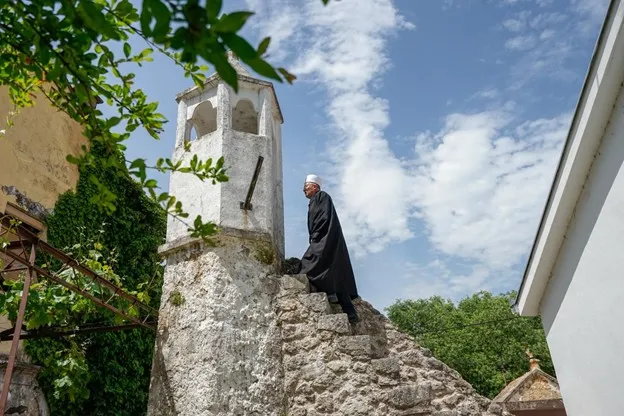 Small minaret in Ljubuški
Near the mosque, and completely separate from it, is a small stone minaret about 5 meters high, which was probably built during the reconstruction of the mosque in 1856-58. However, unlike the Arnaudija mosque, next to the mosque in Vitina near Ljubuški, there is no other minaret except this low small minaret, which is also part of the national monument of Bosnia and Herzegovina.
Ezan-taš next to the Bey's Mosque in Sarajevo
In the courtyard of the Bey's Mosque, to the right of the entrance, there is a massive, beautifully crafted stone. According to researchers, the stone was previously located on the west pillar of the Bey's Mosque's portico.
Due to the specific groove on the upper side of this stone, the alleged tradition that the stone was used to cut off the hands of thieves can still be heard. In reality, the stone was placed in the cemetery so that the ezan could be recited from it in certain situations during Ramadan, or while the minaret was being renovated. The stone is also known as ezan-taš.
Next to this larger stone is a smaller one that serves as a step to help the muezzin climb onto the ezan-taš.
Ezan-taš next to the mosque in Kovačevci near Glamoč
Next to the mosque in Kovačevci near Glamoč, the birthplace of our famous calligrapher Ešref Kovačević, there is an elevated stone with a carved step from which the muezzin occasionally recited the ezan. As researchers have recorded, this mosque had an old wooden minaret at the beginning of the 20th century.
Since these wooden minarets were not safe during severe weather, a stone was placed next to the mosque from which the muezzin recited the ezan in such situations, as well as in others. Although the mosque in Kovačevci was devastated during the aggression against Bosnia and Herzegovina (1992-1995) and then restored, the ezan-taš has been preserved.
It seems that as architectural additions to mosques, ezan-taševi were popular in the Glamoč Field. A very beautiful, probably the oldest of them, ezan-taš that has been preserved to this day is located next to the mosque in Malkočevići near Glamoč, built in 1565.
The mosque is located by a stream that dries up in the summer, but along the bank of the stream, there is still a stone slab that the community members used for ablution. Next to the mosque is an old ezan-taš for reciting the ezan, along with a step.
Komentari (0)
Prijavite se za komentiranje
PrijavaJos nema komentara. Budite prvi!
Minuta
Sve →Iz drugih kategorija

High Representative Not Elected: Germans, French and British Sabotaged Americans, New Attempt at End of June

ČOVIĆ WITHOUT MERCY: How Those Who Brought Ademović to Office Created a Political Hell for Him



Sunny Saturday, quite warm



Tragedy in Albanian resort: Two minors drown












