
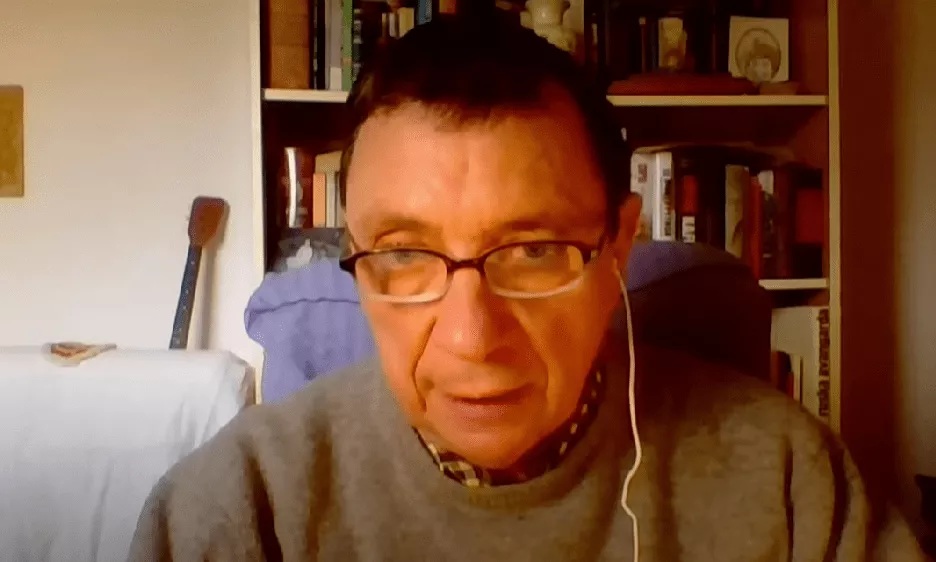
SARAJEVO, (Patria) - The Balkans is Russia's trump card in the conflict with the West over Ukraine, assessed Jutarnji list journalist Vlado Vurušić, in the show "I Know You Know" of City Radio Television.
He states that developments in the Western Balkans also depend on the situation with Ukraine.
"How Russia will position itself in relation to Kosovo, BiH, Montenegro, and North Macedonia depends on that. These are four very important countries, which are the backbone of the Western Balkans and which must decide how they will function," Vurušić announced.
When asked if President Vladimir Putin understood the message of his American counterpart Joseph Biden that the US would retaliate fiercely if Russia attacked Ukraine, and who is undermining the Minsk agreement, he replies that Moscow does not admit to being "cornered".
"The G7 countries have also warned Russia not to play with Ukraine's security and sovereignty, as the price it could pay would be high. Putin is aware that Russia can lose much more than it can gain. Biden announced that the US, in case of economic sanctions, would not send military aid to Ukraine, as that would mean a war between NATO and Russia," said Vurušić.
He states that Europe, especially since 2014 and the annexation of Crimea, has been living in a neo-Cold War period, and that relations between Russia and the West are very strained.
"Putin sought guarantees that NATO would not expand further into Eastern Europe, i.e., Ukraine and Georgia. Russia wants to create a situation where it is threatened, that the West is not fulfilling what was agreed upon since the time of the Soviet Union, when it was promised that NATO would not expand eastward. Russia is now cornered, it has lost a lot of political or maneuvering space. On the other hand, Moscow is also trying to destabilize the West," said Vurušić.
He recalls that Russia did not object when the three Baltic countries joined NATO, because Boris Yeltsin was in power at the time, while its policy changed with Putin's arrival.
"During Yeltsin's time, Russia was weak and conceded too much. Russia is losing positions it would like to have, especially with the strengthening of the West and the emergence of China as its number 1 rival, and Putin fears that Russia will fall into the background," Vurušić pointed out.
"Ukraine is a red line that Russia does not want to cross"
He emphasizes that Ukraine is a red line that Russia does not want to cross.
"It is strategically important for Russia, their sore point, the priority of all priorities. By returning Ukraine under Russia's wing, it would strengthen its position. By losing Ukraine, Russia admits defeat. The question is why the countries of the former USSR, one by one, are disobeying and turning to the West. Only very poor countries are with Russia," Vurušić stated.
"Serbia has taken on the role of a Russian satellite in the Balkans"
He also notes that Serbia, in a way, has taken on the role of a Russian satellite in the Balkans.
He adds that Serbian President Aleksandar Vučić is sitting on multiple chairs, and that Serbia currently does not have the military potential for a potential attack on a NATO member.
"They know very well that an attack on any NATO member means an attack on all. Serbia is not economically strong enough to show off its muscles, and it is also weak in terms of human potential," said Vurušić.
According to him, the leader of the Bosnian Serbs, Milorad Dodik, is the second arm of the same story, and Russia is using him to destabilize BiH as the central country of the Balkans.
"Dodik, for now, is fulfilling Russia's play to prevent the situation in the Balkans from calming down," Vurušić assessed.
Many analysts, he adds, believe that the Balkans is Russia's trump card in the conflict with the West over Ukraine.
"Even today, they speak out in Russia against Montenegro's entry into NATO. The Ministry of Foreign Affairs immediately welcomed the change of government and began to say that the time has come to consider Montenegro's exit from NATO. They are using part of the current government in Montenegro for that policy (DF), Dodik in BiH, VMRO DPMNE in North Macedonia, which is a party that relies on Moscow," Vurušić stated.
Commenting on Croatia's opposition to imposing sanctions on Dodik, he says that Croatian President Zoran Milanović has "dug himself in quite a bit" with some statements about BiH.
"On the other hand, it is commendable that the first statesman to visit Sarajevo after the events in Banja Luka was Croatian Prime Minister Andrej Plenković, who sent a message that the EU supports the unity, integrity, and indivisibility of BiH. If it comes to Brussels insisting on sanctions for Dodik and people from that region, then Croatia will eventually agree to it," said Vurušić.
Komentari (0)
Prijavite se za komentiranje
PrijavaJos nema komentara. Budite prvi!
Minuta
Sve →Iz drugih kategorija

High Representative Not Elected: Germans, French and British Sabotaged Americans, New Attempt at End of June

ČOVIĆ WITHOUT MERCY: How Those Who Brought Ademović to Office Created a Political Hell for Him



Sunny Saturday, quite warm



Tragedy in Albanian resort: Two minors drown












