
Written by: Amina Čorbo-Zećo
Following the elections in Slovenia and the swift formation of the parliament, part of the regional media raised the issue of the spread of the so-called “Serbian world” and the possibility that this European Union member state could become its new political space.
However, such a framing of the problem is fundamentally flawed, both analytically and politically. It is not about whether Slovenia is entering the “Serbian world,” because that project has long since entered Slovenia. Therefore, a much more precise question is whether the new government, however composed, has the capacity and political will to extricate itself from this influential circle at all.
Because the influence we are talking about is neither new, nor superficial, nor tied exclusively to political fringe figures.
Focusing on Zoran Stevanović and his party Resnica may be media-attractive, but it essentially obscures the broader picture.
The real problem is not on the political periphery, but in the very center of power. Here, one must first consider the long-standing role of Zoran Janković, a politician who has had a strong influence for years not only at the local level in Ljubljana, but also on broader political and business currents in Slovenia. His connections and political reflexes are often a subject of controversy, but have never been seriously politically addressed.
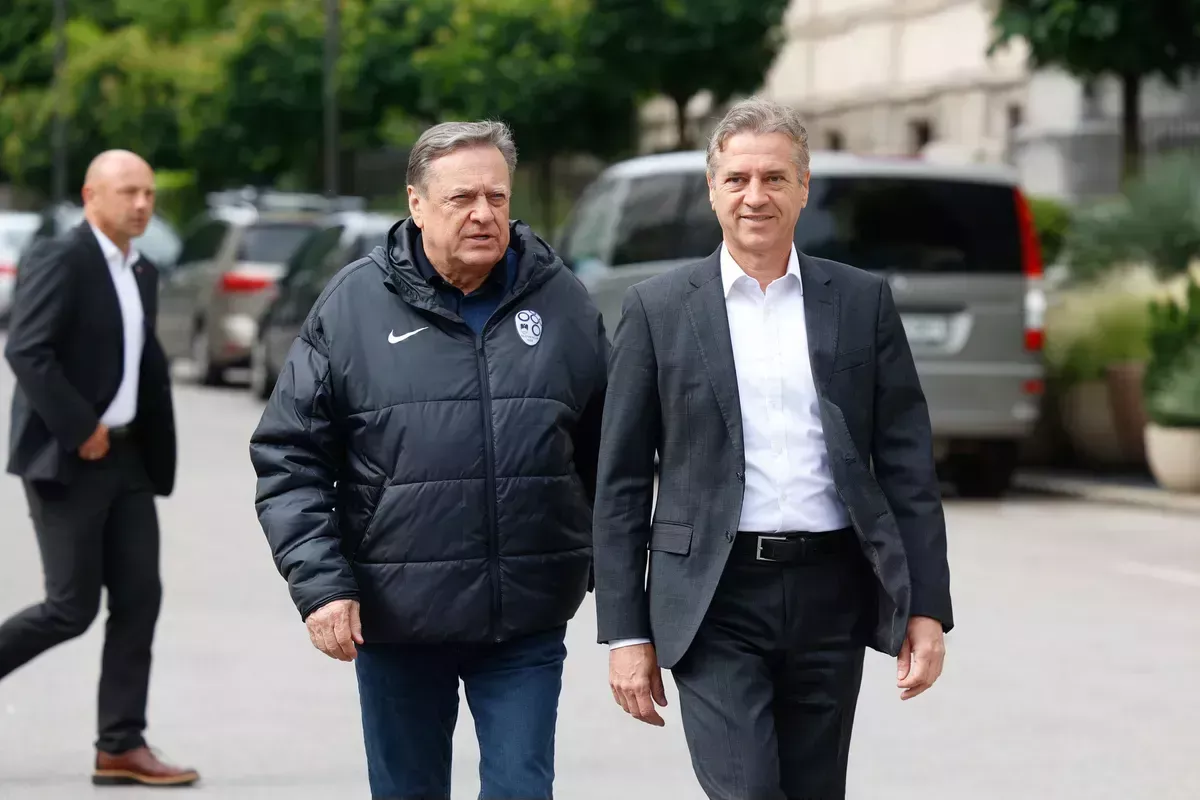 Janković and Golob
The mandate of former Prime Minister Robert Golob further laid bare the limits of such a policy. Although he tried to profile himself in public as a European, reformist, and principled leader, the concrete moves of his government showed a different picture.
The most illustrative example is the issue of sanctions against Milorad Dodik. Although there were announcements of a more decisive approach, and even prepared measures, the final decision was reduced to a minimum, a ban on entry, without any real incursion into business flows, assets, or financial networks. In other words, symbolism replaced substance.
Such an approach was not the result of diplomatic necessity, but of political calculation. The attempt to project an image of principle before Brussels, while simultaneously preserving existing relations and interests, led to a policy of double standards. Additionally, through media close to the government, the thesis was floated that there was supposedly no support from Washington for harsher measures, which served as a convenient alibi for the lack of concrete action.
In the meantime, the business connections of people close to the structures of power in the Republika Srpska continued to develop without major obstacles. Businessman Mladen Milanović, known for his closeness to political circles around Dodik, managed to expand his business activities into Slovenia as well.
His connections with people like Zoran Tegeltija, as well as indirect contacts with structures close to Dragan Čović, point to the existence of a wider network of political and business relations that transcend state borders. It is also important to note that some of his companies had previously ended up on the blacklists of international financial institutions, which further problematizes the fact that he operates unhindered in an EU member state.
Parallel to this, there are also symbolic, but politically significant moves that speak to the environment in which such relations develop. The decision of the Museum of Recent and Contemporary History in Ljubljana not to open an exhibition on the Srebrenica genocide during the mandate of the Golob government provoked justified reactions and raised the question of political influence on cultural institutions.
When all these elements are placed within the same framework, it becomes clear that the narrative about how a potentially stronger political result for Resnica could “introduce” Slovenia into the “Serbian world” represents a simplification of reality.
A much more serious problem is the fact that certain political, economic, and social influences of the “Serbian world” are already deeply rooted.
Therefore, the key question for the new government in Slovenia is not how to prevent entry into the “Serbian world,” but how to redefine existing relations, establish clear standards, and break the practice of selective principle, that is, how to exit the 'Serbian world'.
In this process, the role of Janković, as well as the political and business networks operating outside formal institutions, will be crucial. Because without confronting these structures, any story about European values will remain just a political declaration.
It should not be forgotten that Janković is Aleksandar Vučić's favorite political figure. Because, a year ago, Vučić offered Janković the position of Prime Minister of Serbia, and according to reliable sources, the Mayor of Ljubljana refused that offer in order to remain at the helm of Slovenia's capital until October this year. How much Vučić trusts Janković and how important a player he is to him is shown by the fact that he has been announced as one of the possible candidates of the SNS in the presidential elections in Serbia.
Until then, Janković will be the main foreign promoter of the EXPO fair in Belgrade and the key long-term link between Belgrade and the cadres of the “Serbian world” in Slovenia.
In summary, through his politics and influence on the state, especially during Golob's mandate, Janković was the key guarantor of the “Serbian world” in Slovenia, and therefore that state must ensure it cleanses itself of the influence of this Greater Serbian project, which did not arrive with the last elections, but much, much earlier!
Komentari (0)
Prijavite se za komentiranje
PrijavaJos nema komentara. Budite prvi!
Minuta
Sve →Iz drugih kategorija

High Representative Not Elected: Germans, French and British Against Americans, New Attempt at End of June

ČOVIĆ WITHOUT MERCY: How Those Who Brought Ademović to Office Created a Political Hell for Him



Sunny Saturday, quite warm



Tragedy in Albanian resort: Two minors drown












