
By: Amina Čorbo-Zećo
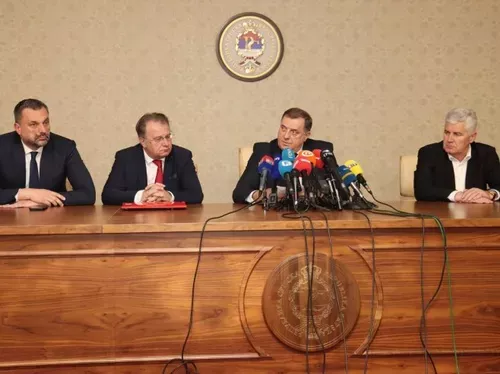
In the midst of everyday political tensions in Bosnia and Herzegovina, the question of whether some kind of informal agreement is being conducted behind the scenes between the Troika (SDP, NiP, Naša stranka) and Milorad Dodik is becoming increasingly legitimate.
It may sound illogical, like a conspiracy theory, but the situation in Bosnia and Herzegovina is becoming increasingly absurd and unbearable.
On the surface, we witness verbal conflicts, dramatic statements, and accusations. It is enough to listen to Elmedin Konaković, Zukan Helez, Denis Bećirović, but when one carefully examines the actual balance of power and concrete political moves, the impression prevails that little is really happening.
For years, Dodik has been systematically building parallel institutions in the entity of Republika Srpska, openly denying decisions of the Constitutional Court of BiH, ignoring laws, and threatening secession.
And while this was previously met with reactions from Sarajevo, today there is almost no serious response from the Troika except calls for calm and avoidance of incidents, along with the conclusion that Dodik will be arrested. And time is inexorably running out.
Such an approach opens space for suspicion that, consciously or unconsciously, a political arrangement is being entered into in which Dodik gets room to implement the model of an independent RS, through legislative, judicial, and executive control within the entity, while the Troika retains positions at the state level, avoiding conflicts and “selling” the international community a story of stability and political wisdom.
In this way, the public is offered a deception. Dodik shows his voters that RS “functions as a state,” without interference from Sarajevo, and the Troika explains to its voters that it “did everything to prevent conflict,” and that it maintained peace and order.
And what is the result of all this. The institutions of BiH are increasingly losing authority in the entity of RS, while at the same time, the domestic and foreign public is served an illusion of political stability. This strategy of “peaceful capitulation” appears as an attempt to sweep the crisis under the rug while de facto ceding control over territory, laws, and narrative to Dodik.
One should not exclude the possibility that this model also appeals to the international community, which is increasingly inclined to a “managerial” approach to the crisis without explosions, without war, without big headlines in world media. As long as no shots are fired, everything is under control. And as institutions decay, it can more easily be argued as an “internal matter of BiH.”
If this is the new paradigm of political action in BiH – verbal noise, without concrete responsibility – then we are truly entering a phase where it is formally acknowledged what Dodik has been trying to impose for years: that state institutions have no real authority in the RS.
Time will tell whether this is a transient political weakness or a quiet, long-term division of the country with the tacit consensus of all actors who care more about their own seats than about the constitutional order.
Because, according to several of my sources, SIPA never seriously considered arresting Milorad Dodik. It was all, apparently, a lie. A public spectacle.
As if the politicians from the Troika had only read Dobrica Ćosić from literature – and seriously accepted his “recommendation”: “Lie imaginatively. The lie is our truth.”
Komentari (0)
Prijavite se za komentiranje
PrijavaJos nema komentara. Budite prvi!
Minuta
Sve →Iz drugih kategorija

High Representative Not Elected: Germans, French and British Sabotaged Americans, New Attempt at End of June

ČOVIĆ WITHOUT MERCY: How Those Who Brought Ademović to Office Created a Political Hell for Him



Sunny Saturday, quite warm



Tragedy in Albanian resort: Two minors drown












