
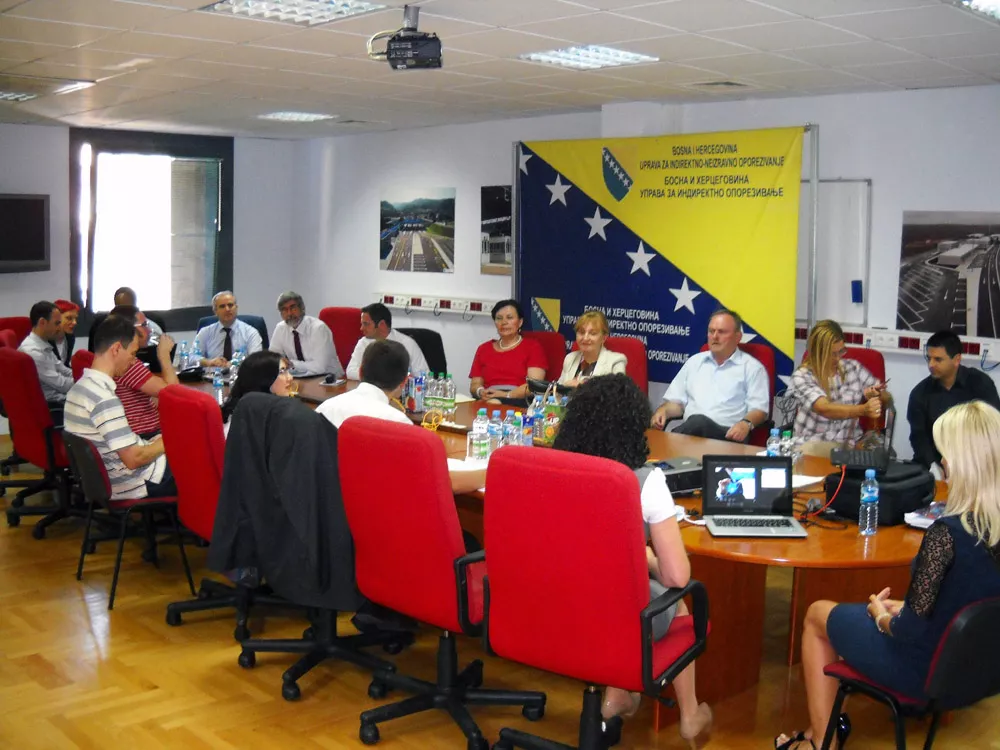
A working group composed of officials from the Indirect Taxation Authority of BiH, the Tax Administration of the Federation of BiH and the Brčko District of BiH, supported by experts from the IMF technical mission led by Justin Zake, held presentations today in Banja Luka on the topics: „Data Exchange and Risk Analysis“ and „Improving Tax Compliance in a Specific Economic Sector“, within which key activities, work results and recommendations for improving tax compliance were presented. The exchange of data sets between tax administrations in BiH is of great importance for better risk analysis at the BiH level, as well as for detecting shell companies and preventing all types of tax evasion in Bosnia and Herzegovina, the Indirect Taxation Authority of BiH announced, as reported by Patria.
Risk cards were also created, which describe the risks of specific economic sectors, within which construction and hospitality are currently identified as riskier sectors, as 179 high-risk taxpayers were identified in the construction sector and 29 high-risk taxpayers in the hospitality sector. For taxpayers belonging to these economic sectors, 5 strategies were developed with plans, activities and tasks, the implementation of which is planned in the coming period with the main goal of increasing compliance.
After all tax administrations in BiH signed a Memorandum on Institutional Cooperation and Data Exchange on Taxpayers from ten different areas in June 2013, a Coordination Body was established, composed of eight officials from the Indirect Taxation Authority, the Tax Administration of the Republika Srpska, the Tax Administration of the Federation of BiH and the Tax Administration of the Brčko District. The data subject to exchange are: registration, foreign trade exchange, amount of tax paid, data on final consumption, refund of indirect and direct taxes, realized turnover of goods and services, tax audits, enforced collection, and high-risk profile taxpayers. The goal of data exchange is to improve tax collection, which will help ensure macroeconomic stability and fiscal sustainability of BiH, the entities of RS and FBiH, and the Brčko District of BiH.
In the initial phase of using the application, certain irregularities were already detected, such as: the same business entities registered at different locations with different owners and responsible persons. Likewise, cases were discovered where certain taxpayers had debts to one of the entity tax administrations and were subject to enforced collection by them, while at the same time receiving VAT refunds from the Indirect Taxation Authority. With this kind of cooperation and information exchange, the relevant VAT refunds could be used by the entity tax administrations to settle debts based on direct taxes, for whose collection they are responsible, the Indirect Taxation Authority announced, as reported by Patria.
Komentari (0)
Prijavite se za komentiranje
PrijavaJos nema komentara. Budite prvi!
Minuta
Sve →Iz drugih kategorija

High Representative Not Elected: Germans, French and British Sabotaged Americans, New Attempt at End of June

ČOVIĆ WITHOUT MERCY: How Those Who Brought Ademović to Office Created a Political Hell for Him



Sunny Saturday, quite warm



Tragedy in Albanian resort: Two minors drown












