
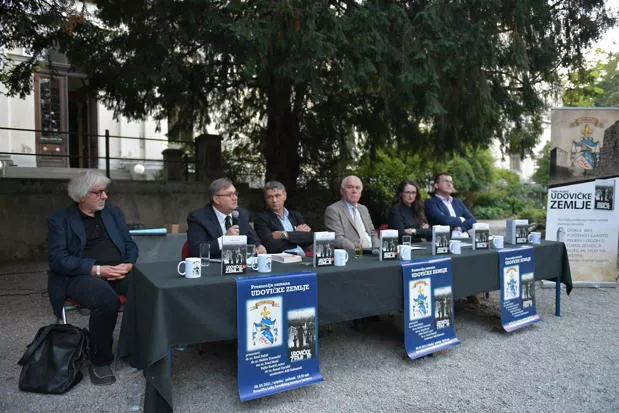
SARAJevo, (Patria) Last week in Sarajevo, at the Botanical Garden of the National Museum of Bosnia and Herzegovina, a well-attended promotion of the second edition of the novel Udovičke zemlje by author Fajko Kadrić was held. The promotion was organized by Krug 99 with the support of the Oprašić family.
In addition to the author, Dr. Sc. Esad Bajtal, writer, philosopher, and independent analyst, reviewers: Dr. Sc. Melida Travančić, M.Sc. Sead Husić, and Dr. Sc. Senad Oprašić, who also spoke as the heir of the medieval Bosnian noble family Oprašić, spoke very inspirationally about the novel.
The promotion was moderated by Professor Adil Kulenović, president of the Association of Independent Intellectuals Krug 99, who expressed his satisfaction at the beginning that Krug 99 was the organizer of this promotion and stated that the ambiance of the National Museum best suited the promotion of such a novel. He emphasized that the artifacts in the Botanical Garden best remind us of who we are, both when we are aware of it and when we are not.
Young actor Elmir Krivalić participated in the artistic part of the program, reciting a part of the text from the novel Udovičke zemlje.
Dr. Sc. Esad Bajtal spoke about the novel from today's perspective and the country of Bosnia, comparing the poetics of Kadrić's narrative with Makowski's and Selimović's experience of Bosnia. He emphasized that "this novel is a historical, skillfully literary, humanly told story about the phenomenon of medieval Bosnia, stating that this novel is a nuanced, skillfully, masterfully convincing, dialectically strong, and moving depiction of life in all its harshness and bitterness on one hand, and beauty and joy of living on the other. A good, humanly sensitively written book, emphasizing that the novel is a book that is read slowly."
Because the reader does not rush through the plot and events, but, whether they want to or not, driven by reader's curiosity, carefully watches over the maxims, skillfully crafted remarks, and thoughts, as well as the morally shaded lessons and messages that accompany the critical plot and events. Precisely because of this, the tragedy and drama of this book are not on the surface of events, happenings, and life twists, but in something else entirely. In that Selimović-like difficult, life-real, experientially critical, historically devastating, and socio-psychologically exemplary insight of the author that makes your skin crawl. An insight into the false friends and true enemies of this country and its people. Quoting a part of the text, he states the following: Their fate is false friends and faithful enemies, it has always been so and will always be so. They defended everyone from everyone, and with everyone, they attacked themselves. The trouble is that enemies know them better than they know themselves.
Dr. Sc. Melida Travančić pointed out that it is a historical novel, which is not historical in the classic sense of the word, and said: "First of all, it should be emphasized that this is not a historical novel in the classic sense, this is more a novel about the history of a country, in which the emphasis is on a certain historical period. This is the story of the honest knight and duke Radivoj Oprašić, a warrior who will carry the family name and glory to the next generation.
The novel, most accurately put, intertwines history and life. On one hand, it is the fateful destiny of the country and the people, as is the depiction of the social moment, or rather the situation we are "witnessing," which are the circumstances prevailing shortly before the end of a significant historical period, the period of the rule of the last Bosnian kings. On the other hand, the life of the ordinary person, the so-called small, marginal person who does not participate in historical changes, but who suffers the most consequences of these changes, is depicted in detail."
M.Sc. Sead Husić, who is the editor and reviewer of this novel, spoke about the editorial process and the historical context of this novel. Everything that history remembers and what this novel remembers fits and complements each other perfectly, and in that sense, Fajko Kadrić's text is a novel with historical trauma that remembers and records trauma in a factual sense, but we do not notice it in its narrative form, which is one of the best features of this novel. Kadrić, if we consider the current context, managed to defy the reader's horizon, not by following ideological but purely literary and narrative strategies, which proves to be a fruitful and brave approach."
Dr. Sc. Senad Oprašić, reviewer and heir of the medieval Bosnian noble family Oprašić, presenting the novel from his personal as well as scientific-professional perspective, emphasized that the story of medieval Bosnia, turbulent and uncertain times, love, the struggle between good and evil, dedication to the entrusted task, loyalty to family tradition, and one's own life as a pledge in the continuous chain of sacrifice for it and all that it represents. This novel has awakened the "Stone Sleeper," quoting the words of the seer character: "I see him in this and future times." The honest knight and duke Radivoj Oprašić will remain with us as long as even one Oprašić walks the earth, caring for a better and more just world and better social relations. Expressing undisguised pride in belonging to the medieval noble family Oprašić, which has always fought for Bosnia and all the people who live in it, he emphasized that the family name Oprašić has been present in Bosnia for over 700 years. Dr. Sc. Senad Oprašić invited all those who have a connection to the Oprašić family in their personal history and origin to proudly emphasize it, and through the promotion of knightly and noble behavior, such as the honest knight and duke Radivoj Oprašić had according to Fajko Kadrić's description, to promote Bosnian values.
The idea for such a novel, as author Fajko Kadrić pointed out, came to him 20 years ago when, shortly after the war ended, he was working on demining in a place founded in the 15th century by settlers from Podrinje.
To the barren land in the area of present-day Gradačac, which was devastated by the Germanic-Hungarian King Sigismund of Luxembourg in 1408, part of the population was moved from the village where the author was born. For decades, this barren land of Nenavišta was renamed after their old place, Skugrići, even bearing the names of individual locations, hills, and streams.
The author was convinced that he was one of the few who knew the story of the origin of this place, and then, by chance, he met a man who knew as much about it as he did. They represent two distant relatives whose wind-swept Bosnian fate imposed two different modern identities (Serb and Bosniak) and who until recently were shooting at each other, and now they are surprised by their identical knowledge and antagonistic behavior in different times compared to him.
Fajko Kadrić, writer, was born in 1965 in Skugrići, Vlasenica. So far, he has published two collections of short stories: Who Still Sings While Dying, The Muezzin of Ordija, and two novels: Protocol of the Fallen and Udovičke zemlje. He has won multiple awards for the best short story in BiH and twice in Montenegro. The collection of short stories The Muezzin of Ordija and the novel Protocol of the Fallen were supported by the Publishing Foundation, and the novel Udovičke zemlje received the award from the Publishing Foundation in Sarajevo for 2019 and was declared the best-selling book in 2020 and received the Golden Pen award from the publishing house Planjax.
Komentari (0)
Prijavite se za komentiranje
PrijavaJos nema komentara. Budite prvi!
Minuta
Sve →Iz drugih kategorija

High Representative Not Elected: Germans, French and British Sabotaged Americans, New Attempt at End of June

ČOVIĆ WITHOUT MERCY: How Those Who Brought Ademović to Office Created a Political Hell for Him



Sunny Saturday, quite warm



Tragedy in Albanian resort: Two minors drown












