
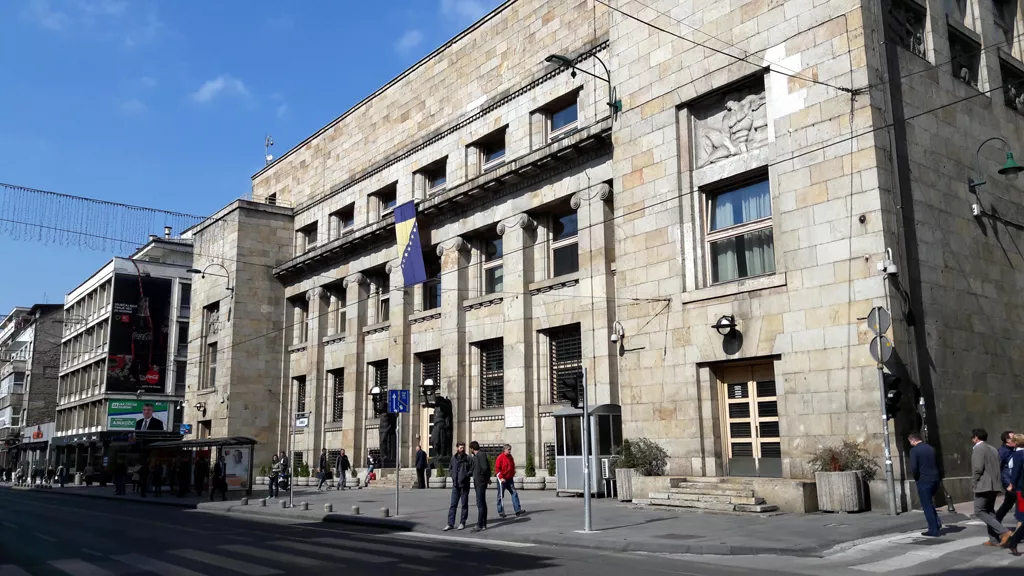
SARAJevo, (Patria) - Recession has been announced, caused by the COVID-19 virus, which, in addition to health damage, has caused significant economic damage worldwide.
An important lesson learned from the great recession of 2007 is that there were simply no indicators for many important economic phenomena, nor was there sufficient quality control and linkage of statistics.
All of this led to a situation where threats that eventually escalated and caused enormous damage and shook the global economy went unnoticed.
Reliable statistics are a necessary prerequisite for quality decision-making and market analysis, and are equally necessary for the business community, government institutions, and researchers in various fields.
Only on the basis of comprehensive and timely statistical data is it possible to understand what is happening in economic trends and what corrections need to be made to enable stronger economic activity and prevent crises and imbalances.
The domestic statistical system and data production are underdeveloped compared to the standards in developed countries and the European Union.
It is estimated that BiH produces about 30% of the required EU statistical sets. Many statistical data sets and surveys have not yet been established or do not have sufficient frequency, so the domestic statistics face a major task of increasing the volume and quality of statistics.
However, the Central Bank of Bosnia and Herzegovina (CBBH) is making significant efforts to expand the sets of economic statistical information, on the one hand, to enable more precise analysis and monitoring of economic trends and to conduct discussions with other institutions, and on the other hand, to provide additional objective indicators to the wider public.
As we were explained, "in early 2019, quarterly data on the non-banking financial sector in BiH were established, which includes more than 100 financial institutions for which balance sheet data are collected and processed".
"Although the source data differ in structure, a unified International Monetary Fund (IMF) scheme is used, and at the end, through processing, aggregated balance sheet data with the same structure for all sub-sectors are obtained. Based on this, it is possible to analyze individual sub-sectors – insurance, investment funds, microcredit organizations, leasing – and to directly compare them with the banking sector," the CBBH states.
The trend in more developed financial systems is that an increasing part of financial intermediation occurs outside the banking sector, so it is important to have reliable statistical data on the non-banking sector and to monitor its development and how it finances the real sector.
"The survey on inflation expectations is a standard tool used to gather valuable information about the public's perception of inflation. Monetary institutions usually pay great attention to inflation trends, and it is very important to know how other market participants assess inflation trends. The European Central Bank (ECB) and the European Commission (EC) have suggested that a survey of this type should be established, and the CBBH launched it in 2019 and published the results.
Based on the responses of professionals from the financial sector, it was shown that there was no fear of uncontrolled inflation acceleration in 2019 and 2020, that inflation expectations were well-anchored, and that there was confidence regarding this macroeconomic phenomenon. However, these results point to some other problems in official statistics that have been discussed for some time. The survey view of inflation, above 1%, largely deviates from the officially stated inflation measured by the consumer price index, below 0.5%, which indicates some potential shortcomings in official statistics and the need to check the quality of CPI index compilation," it was emphasized.
An objective assessment of the fiscal position is one of the key macroeconomic analyses, and based on it, fiscal policy and its impact on the economy can be assessed, as well as insight into the financing of government deficits and debt. Fiscal statistics are inherently complicated, but in BiH, they are further complicated by significant fiscal decentralization and a large number of budgets that need to be consolidated.
"The CBBH has been developing this statistic for several years, according to EU standards, and finally this year sent a full set of data to Eurostat. This data reflects the total government revenues and expenditures consolidated for BiH, including municipalities, cities, cantons, entities, and BiH institutions, and given the same methodology, it is possible to directly compare with member and candidate countries. In this regard, public debt according to the definition from the Maastricht criterion is available on a quarterly basis. The very definition of public debt is a very controversial topic, and we were obliged to apply the standard definition in the EU, which can be used to assess convergence and MIP indicators of imbalances.
The country's external position is measured by several sets of macroeconomic data, one of which is the international investment position (IIP), through which the amount of claims and liabilities towards other economies is assessed. As a transitional country, BiH is in a position to receive significant financial inflows from abroad in various forms, and to be in a net debtor position, meaning it has higher liabilities than claims towards the rest of the world," it is stated.
The CBBH has developed a quarterly international position instead of the previous annual one, so changes in investment positions can now be measured more precisely.
This type of statistics is already established in many economies, so BiH will also be able to present its external position, including total external debt, every three months, which will help analysts and policymakers understand the dynamics of cross-border financial flows, in conjunction with balance of payments flows.
"A new survey related to banks' credit activity will be launched soon. This survey examines the demand and supply of loans from commercial banks, and based on the collected information, market conditions can be assessed. Central banks widely use this standard survey to assess monetary conditions and necessary adjustments.
Aggregated results will be publicly available, so everyone will have insight into whether credit conditions are tightening or loosening and what the demand for loans is. It is planned to expand indicators related to interest rates according to ECB methodology. Average interest rates for the entire loan portfolio, on total balances, will complement the set of average interest rates and enable even more detailed analysis for analysts and banks.
Statistical activities of central banks are sometimes overlooked and remain in the shadow of other functions in the financial segment. However, all European central banks pay exceptional attention to compiling statistics, and central banks within the eurozone have reduced many functions due to conducting a single monetary policy, but statistics is one of the functions that requires further expansion and new resources. The CBBH, as part of the statistical system in BiH, will continue to work on expanding statistics within its domain and improving its quality.
The existing Stabilization and Association Agreement with the EU, and hopefully the upcoming candidate status, will necessitate a very rapid development of economic statistics, as it is one of the essential prerequisites for conducting quality dialogue on economic policies and reforms, as is customary in Brussels," the CBBH emphasizes.
Komentari (0)
Prijavite se za komentiranje
PrijavaJos nema komentara. Budite prvi!
Minuta
Sve →Iz drugih kategorija

High Representative Not Elected: Germans, French and British Sabotaged Americans, New Attempt at End of June

ČOVIĆ WITHOUT MERCY: How Those Who Brought Ademović to Office Created a Political Hell for Him



Sunny Saturday, quite warm



Tragedy in Albanian resort: Two minors drown












