
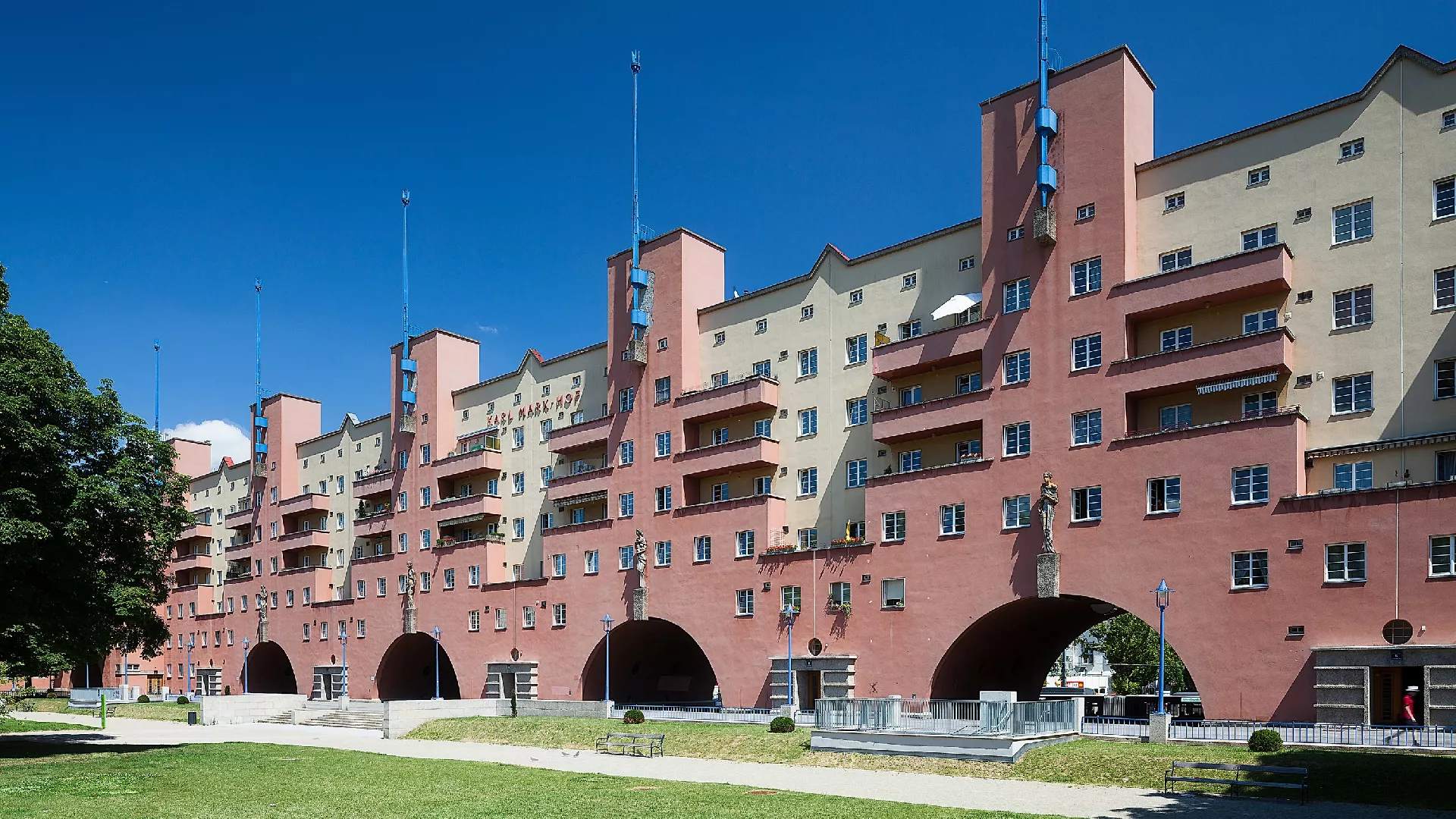
(Patria) - Karl Marx Hof is the longest residential building in the world and probably the most famous example of social housing in Vienna.
It is located in Heiligenstadt in Döbling, Vienna's 19th district, and is a true icon of residential development in socialist Vienna in the 1920s and 1930s.
It was built on an area that was the Danube until the twelfth century, deep and navigable.
Over time, the course changed, and the water level dropped, leaving only a small lake by the mid-18th century.
Karl Marx Hof was built according to the design of Karl Ehn, a student of Otto Wagner, and was completed in 1930, after only three years of construction.
The eastern side of the complex extends uninterrupted for the length of four tram stops, or a kilometer and almost 200 meters. And it has four addresses.
Vienna, like other European cities, faced a major housing crisis, overcrowding, and mass unemployment after World War I.
The city authorities at the time did not respond to these problems by displacing the population to the periphery, but by renovating the city center.
The idea was to keep workers at their jobs in densely populated and connected communities, but with a much higher standard than they had before.
Karl Ehn was given a demanding task - to design a building that, in addition to affordable housing, would offer all the facilities necessary for a comfortable life according to modern standards.
After all, Karl Marx Hof was supposed to accommodate 5,000 inhabitants, so the need for non-residential facilities is understandable.
With 1,382 apartments ranging from 30-60 square meters and all the necessary communal and social facilities - laundromats, public baths, kindergartens, doctor's offices, cafes, a post office, a library, a pharmacy, a veterinary clinic, and a dentist, Karl-Marx-Hof remains a model in the planning of gigantic residential complexes to this day.
The built part of the complex, which follows the edges of the plot and resembles a rampart, is only slightly more than 18 percent of the area. The rest consists of landscaped courtyards, playgrounds, and inner gardens.
This is the true value of this architectural masterpiece - a good layout and planned facilities that guarantee a good life for all residents.
Apartments in Karl-Marx-Hof were among the first apartments in Vienna with an indoor toilet, running water, and balconies.
The complex was also called the Ringstrasse des Proletariats by contemporaries (Proletariat Ring Road), a paraphrase that refers to Vienna's main street, the Ringstrasse, which forms a circle around the center of Vienna and was conceived as a showcase of the size and glory of the Habsburg Empire.
During the Austrian Civil War in 1934, the police, the Austrian army, and the Austro-fascist paramilitary forces bombed the building and unarmed residents, so Karl Marx Hof also became a symbol of anti-fascism.
Today, the building has been renovated and is still residential, although many of the original facilities no longer exist or have had their purpose changed.
For example, the communal bathhouse, or Waschhouse No. 2, is now open to the public as the museum of "Red Vienna" - Das Rote Wien Waschsalon, writes Punkufer.
Komentari (0)
Prijavite se za komentiranje
PrijavaJos nema komentara. Budite prvi!
Minuta
Sve →Iz drugih kategorija

High Representative Not Elected: Germans, French and British Against Americans, New Attempt at End of June

ČOVIĆ WITHOUT MERCY: How Those Who Brought Ademović to Office Created a Political Hell for Him



Sunny Saturday, quite warm



Tragedy in Albanian resort: Two minors drown












