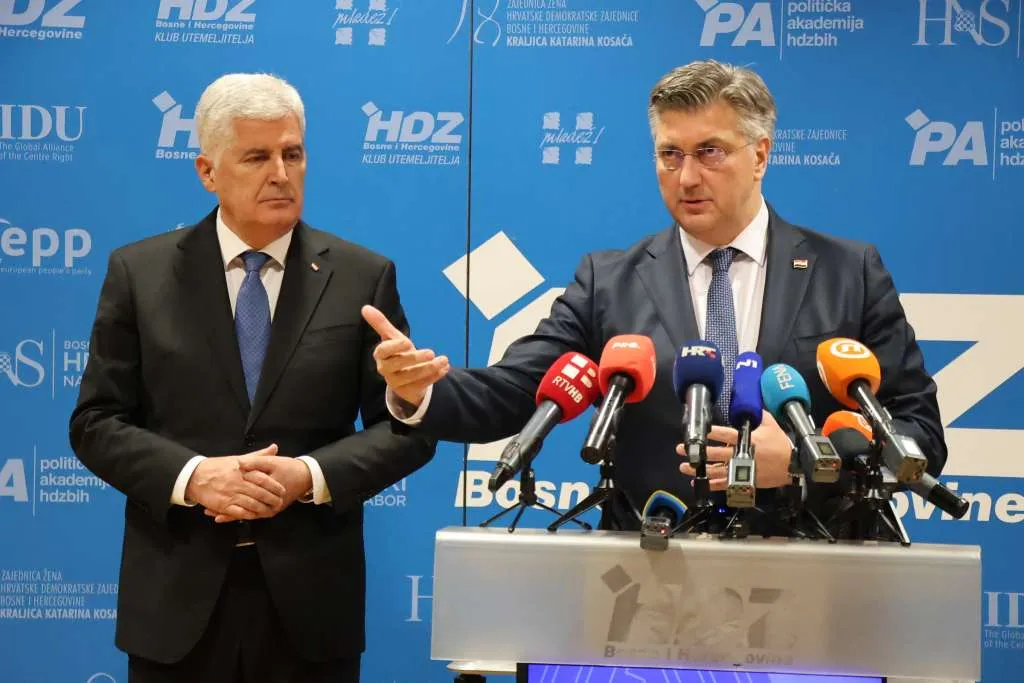
The interview of Croatian Prime Minister Andrej Plenković for Federal Television will likely provoke less controversy than his earlier statements on Bosnia and Herzegovina.
Because it sounds more 'peaceful' and 'European', and in essence he only used milder rhetoric, but the substance is the same.
Although most media dryly report Plenković's presentation, I cannot help but notice a particularly interesting part where he speaks about the possibility of forming a third entity.
Namely, Plenković did not say he is against a third entity. He did not say that such a solution would be harmful for Bosnia and Herzegovina, nor that it would further deepen ethnic divisions. Instead, he said that 'at this moment he does not see the political strength' that could implement such a change.
That is an important difference. When a politician rejects an idea for principled reasons, he says so clearly. Plenković did nothing of the sort.
His statement is an analysis of the assessment of current political circumstances rather than a rejection of the very concept of a third entity. In other words, the problem is not in the idea, but in the lack of political power to realize it. And, of course, a good part of the BiH public is aware of this, but there is also a good part of the political elite that is satisfied with the statement that 'at this moment he does not see that political strength'.
Equally interesting was his attempt to explain Croatian demands for changes to the Election Law. Plenković claims that Croatia would be against a situation in which a majority of Croats would elect the Bosniak member of the BiH Presidency, just as today he claims it is not acceptable for Bosniaks to decide on the Croatian member of the Presidency.
At first glance, this is an argument that calls for equality. However, the question arises why the same standard is not applied when it comes to the position of Bosniaks in areas where the HDZ politically dominates. If the principle is that no people should be majorized, then that principle should apply everywhere and to everyone. They could have shown us that in the municipalities of Stolac, Čapljina, Mostar...
Because it is precisely there that Bosniaks have been warning for years about marginalization in municipalities and cantons with a Croatian majority. They point to insufficient representation in public institutions, unequal access to certain functions, but also to an education system that divides children by ethnicity.
In such circumstances, it is hard not to notice a certain inconsistency. While the issue of legitimate representation of Croats is presented as a key democratic issue, the problems of other peoples often remain on the margins of political debates.
It is particularly problematic that the concept of 'legitimate representation' in practice increasingly boils down to the right of ethnic parties to be the sole interpreters of the interests of one people. This makes political pluralism within the peoples themselves almost undesirable, and citizens are viewed primarily as members of ethnic groups, and only then as voters with their own political views.
Therefore, Plenković's statements raise more questions than they provide answers. If it is truly a struggle for equality, then it must apply equally to Croats, Bosniaks, Serbs, and all other citizens of Bosnia and Herzegovina. This is ultimately highlighted by the rulings from Strasbourg. And, if the principle is applied selectively, depending on who is politically disadvantaged at a given moment, then we are no longer talking about equality but about political interest.
And when it comes to the third entity, the impression is that Plenković did not reject it. He only assessed that there is not enough political strength for it today. Perhaps he should have been asked a follow-up question: what if there were political strength?
Therefore, these are two completely different messages, and the difference between them is by no means insignificant.
Komentari (0)
Prijavite se za komentiranje
PrijavaJos nema komentara. Budite prvi!
Minuta
Sve →Iz drugih kategorija

High Representative Not Elected: Germans, French and British Against Americans, New Attempt at End of June

ČOVIĆ WITHOUT MERCY: How Those Who Brought Ademović to Office Created a Political Hell for Him



Sunny Saturday, quite warm



Tragedy in Albanian resort: Two minors drown












