
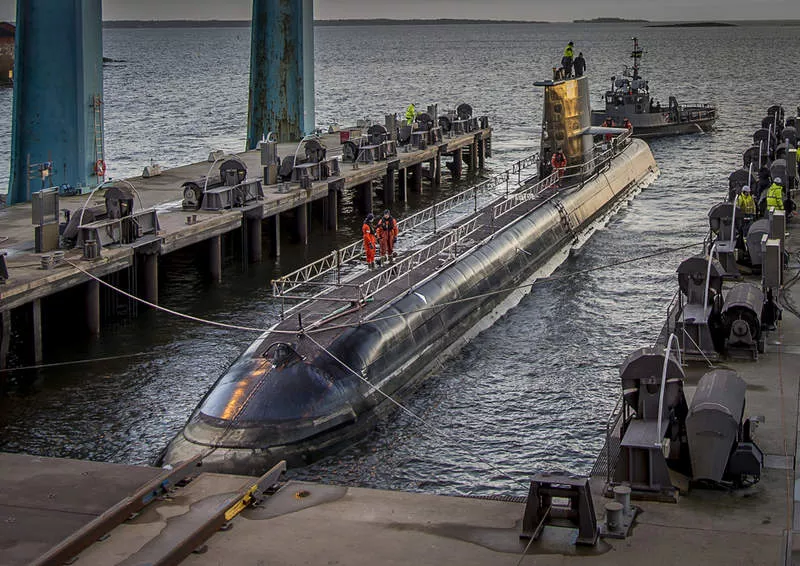
(Patria) - When Sweden joins NATO, it will help the alliance reduce its vulnerability in northwestern Europe, in the Baltic Sea, a common waterway with Russia with a bottleneck for access to ports in eight countries, including Germany, Reuters writes.
Sweden's key to maintaining navigable waters in a conflict is its fleet, which analysts say has some of the most advanced conventional submarines ever built.
"The Swedish submarine fleet is well-prepared for this environment and will significantly contribute to NATO's overall submarine capabilities in the Baltic," a NATO official told Reuters.
The shallow Baltic Sea, which some in naval circles call a "submerged meadow," has an average depth of about 60 meters, making it too shallow for the nuclear-powered submarines that make up the bulk of Russia's submarine fleet and the entire US Navy.
Sweden has three advanced Gotland-class submarines and an older model that will be retired when two new A26 vessels are delivered in 2027 and 2028, bringing its total to five by the end of the decade.
What makes the Swedes so strong? Experience. Sweden has been operating submarines in the Baltic Sea since 1904. None of its neighboring countries have been as active underwater as the Swedes.
"We have regional expertise, which fills a gap, expertise that NATO does not have," said Submarine Flotilla Commander Fredrik Linden.
The Baltic Sea is also a complex waterway, with many rivers flowing into it, and it has varying salinity levels. These affect both the submarine's buoyancy and how sound travels underwater, requiring local knowledge for successful navigation.
Swedish submarines can stay submerged for weeks. Submerged conventional submarines run on batteries. Most have to surface every few days so their diesel engines can run and recharge the batteries. But Swedish submarines have liquid oxygen stored in tanks to run their diesel engines underwater to recharge their batteries, allowing them to stay submerged longer and reduce the risk of detection.
How will this help in the future?
In 30 or 40 years, perhaps sooner, underwater warfare will likely be autonomous, says Sebastian Bruns, a senior researcher at the Institute for Security Policy at Kiel University. Sweden has already ordered two new submarines, scheduled for delivery in 2027 and 2028. Known as the A26, the vessels built by SAAB Kockums will be larger and more versatile than the Gotlands and will feature a unique characteristic - a 1.5-meter diameter opening called a multi-mission
portal.
This will allow remotely operated vehicles (ROVs), autonomous vessels, or diver teams to easily enter and exit. Bruns says this makes the submarine ideal for seabed warfare, for example, protecting or destroying pipelines or other critical infrastructure on the seabed.
"Seabed warfare is currently the most important issue in naval circles," says Bruns, referring to the 2022 explosions that destroyed the Nord Stream gas pipelines running through the Baltic Sea.
ROVs can perform tasks such as retrieving or placing objects on the seabed, scanning large areas, or deploying or destroying mines. They can also dive deeper than conventional submarines.
Komentari (0)
Prijavite se za komentiranje
PrijavaJos nema komentara. Budite prvi!
Minuta
Sve →Iz drugih kategorija

High Representative Not Elected: Germans, French and British Sabotaged Americans, New Attempt at End of June

ČOVIĆ WITHOUT MERCY: How Those Who Brought Ademović to Office Created a Political Hell for Him



Sunny Saturday, quite warm



Tragedy in Albanian resort: Two minors drown












