
Written by Dean Džebić
The sea south of Cyprus has never been warmer at this time of year, never has it boiled so much from the large steam generators of cruisers and destroyers, nuclear reactors in nuclear submarines and aircraft carriers.
How significant the concentration of European and world navies is, is indicated by the rerouting of civilian corridors
of commercial flights, which suggestively bypass the wide perimeters where the position of the US carrier strike group "USS Gerald Ford" is estimated.
While the USN Dwight Eisenhower is arriving across the Atlantic, US KC-135 tankers and other large transport aircraft are hurriedly arriving in Cyprus. Soon, the entire Sixth Fleet of the US Navy will be at sea, given that about 1,500 Marines have been delivered, along with reinforcements of F-16 fighters that have flown to Middle Eastern air bases.
Finally, the command ship of the Sixth Fleet, "USS Mount Whitney", has sailed to Cyprus, meaning that the fleet commander, Rear Admiral Ishee, is involved in coordinating naval aviation operations, the disposition of
surface vessels and submarines, in cooperation with partner and allied navies of Turkey and Greece.
Mount Whitney, as a command ship, is essentially a large, floating operational-communications center into which data from other vessels and aircraft flows, with the fleet commander directing fleet operations from it.
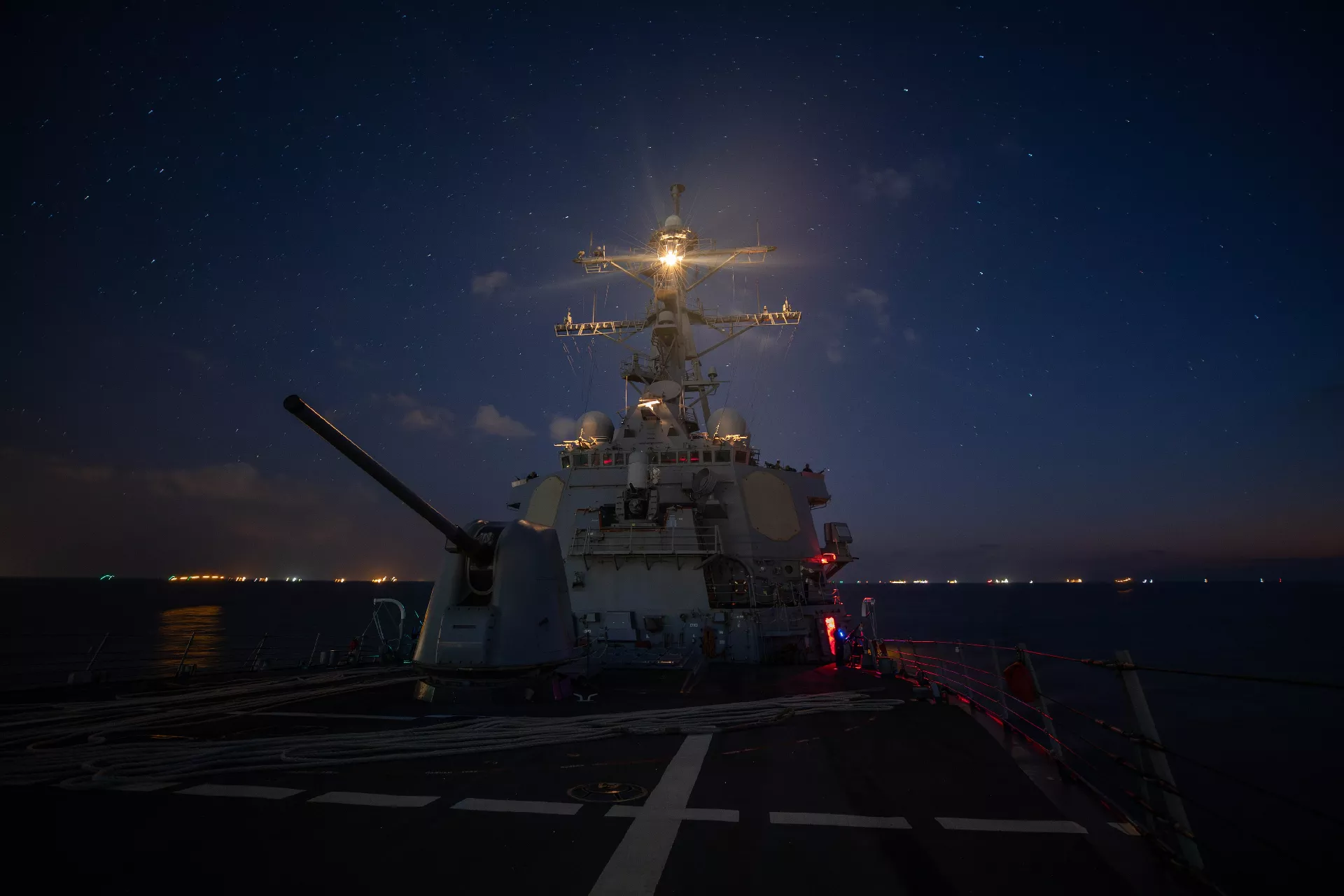
However, although aircraft carriers attract the most attention due to their significance, cost, and power projection, the joint squadron of the Fifth and Sixth Fleets south of Cyprus is actually made powerful by the "Arleigh Burke" class guided-missile destroyers. These destroyers, in their class with the Aegis system, represent a mobile anti-ballistic shield, which, along with the announced deployment of the THAAD system, provides the real answer to why the largest naval squadron since the second Iraq war has been assembled in the Eastern Mediterranean.
With two-stage SM-3 (RIM-162) interceptor missiles at a speed of 4.5 kilometers per second (Block II version), "Arleigh Burke" class destroyers are capable of primarily defending USN aircraft carriers, but also Israel if necessary. 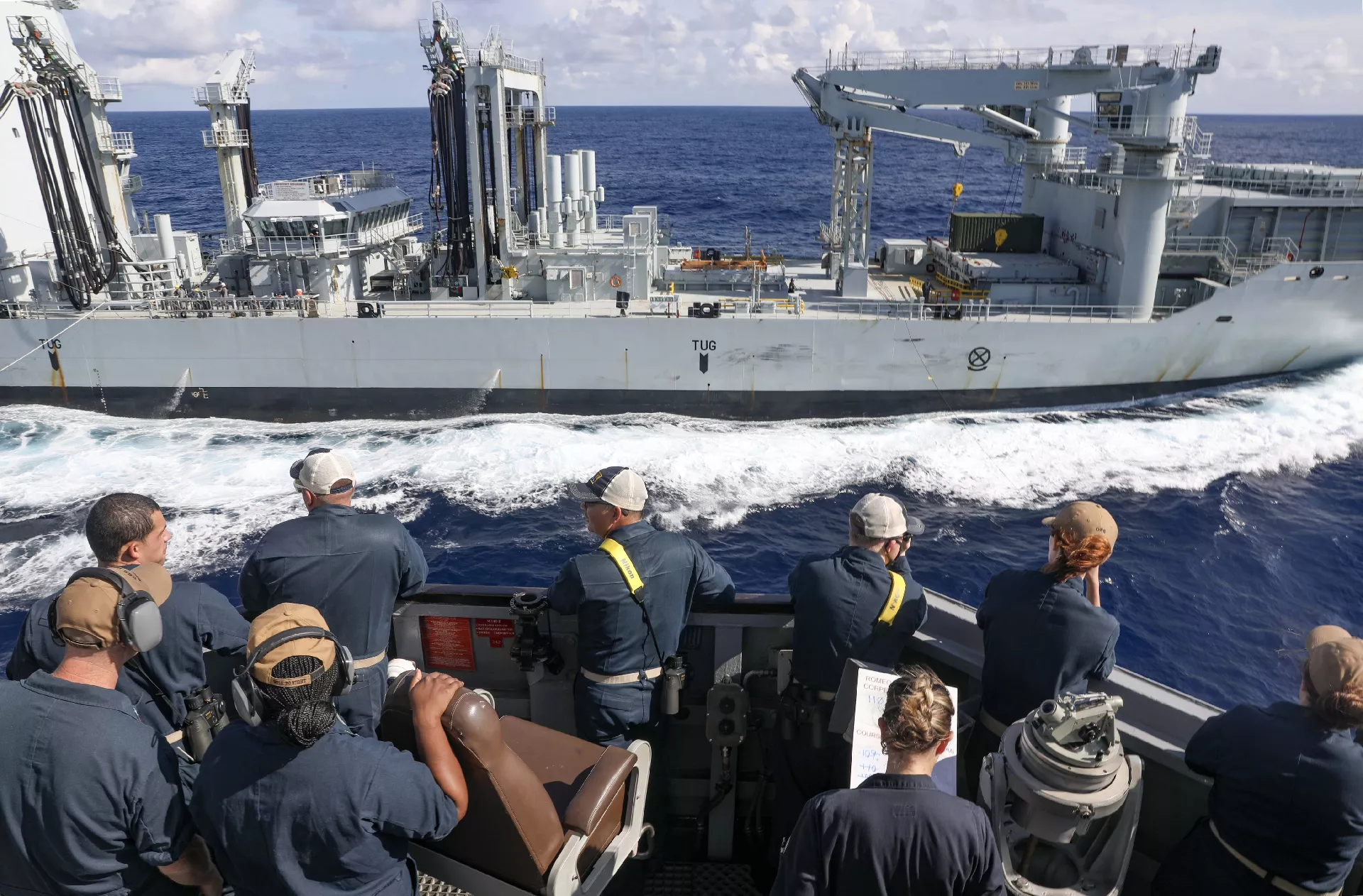
USSCarney en route to the Suez Canal
Which they are already doing, given that a few days ago, "USS Carney", a destroyer of the aforementioned "Arleigh Burke" class, shot down three ballistic missiles and eight unmanned aerial vehicles launched by the Houthis at Israel. Without additional technical details, the Arleigh Burke has 90 vertical launch cells for various types of missiles, for anti-ballistic, anti-air, and anti-submarine warfare, with the capability to launch BGM-109 Tomahawk cruise missiles for striking land targets.
On the "Gerald Ford" class carrier itself, there are four air wings with F/A-18 fighters, of which three air wings (10-12 aircraft per wing) are E versions, while one wing is the modernized F version "Super Hornet". Along with the four fighter wings, there are also EA-18 Growlers intended for electronic warfare and jamming.
With the arrival of the second "Nimitz" class carrier, the USN Dwight Eisenhower, the number of fighters will double, giving us a true outline of power projection capabilities. With additional amphibious ships capable of supporting the landing of up to 2,500 Marines, the joint fleet of the Fifth and Sixth Fleets will be able, with the support of guided-missile destroyers or cruisers, to deter any form of direct Iranian interference in the Israeli-Palestinian conflict.
The gravitational point that will decide whether there will be direct American engagement will be the start of the IDF ground invasion. If the IDF finally launches a ground invasion, only then will the real escalation begin, in which, according to game theory, Hezbollah would first take part, with attacks on Israeli and even American targets, depending on the status of the US naval squadron in the Mediterranean.
Synchronized, Israel could be attacked with short and medium-range ballistic missiles from Yemen by
the Houthis, from Lebanon by Hezbollah, and ultimately from Iran itself, which would mean the final operationalization of the Iran-Israel war.
This is where the deployment of the THAAD system comes into play, which, alongside the Israeli Arrow 3 system, is the most reliable
anti-ballistic system for targeting objects in the exosphere (above 300 km from the Earth's surface). In addition to the United States defending Israel with its anti-ballistic and anti-missile shield, with the existing naval aviation capabilities, strikes on Iranian installations, specifically ballistic missile silos and uranium enrichment facilities, without which Iran cannot have nuclear weapons, are not excluded.
But honestly, this whole scenario looks like something we've seen before, and in fact, we have seen it, on the big screen in the premiere of "Top Gun 2". Tom Cruise, with his crew flying Super Hornets, had a similar mission to destroy Iranian uranium enrichment facilities.
Although unconfirmed, two days ago, steak was served to the entire crew on the carrier "USS Gerald Ford". According to tradition and practice, steak is served as an announcement of major combat operations ahead for the fleet and the entire ship's company. But also, steak is served in cases of low morale or collapsed fighting spirit on the ship, both among the technical staff and among the pilots on the carrier.
What is certain is that Tom Cruise often likes to say that he pays close attention to his diet, to which he owes his youthful appearance; however, this time, the steak might be a bit tougher than usual.
Komentari (0)
Prijavite se za komentiranje
PrijavaJos nema komentara. Budite prvi!
Minuta
Sve →Iz drugih kategorija

High Representative Not Elected: Germans, French and British Sabotaged Americans, New Attempt at End of June

ČOVIĆ WITHOUT MERCY: How Those Who Brought Ademović to Office Created a Political Hell for Him



Sunny Saturday, quite warm



Tragedy in Albanian resort: Two minors drown












