
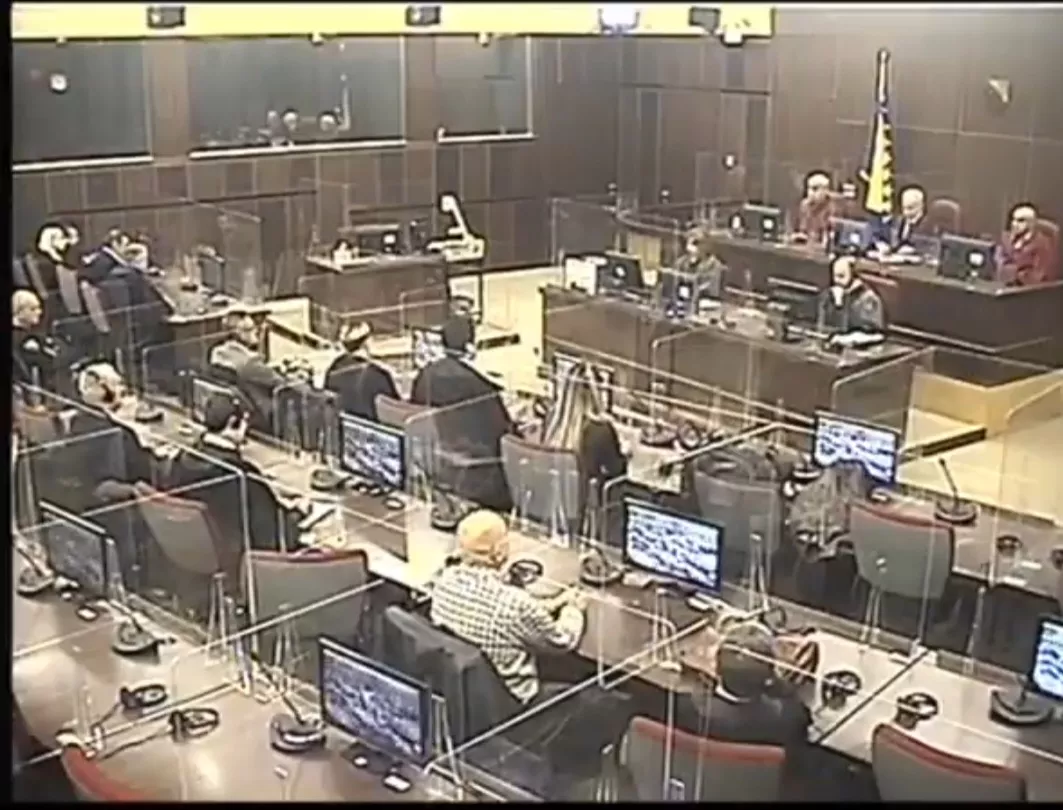
(Patria) - The three-member Panel of the Court of BiH, consisting of judges Branko Perić, Nenad Šeleda, and Izo Tankić, issued a verdict acquitting Zijad Mutap, Alisa Ramić, Hasan Dupovac, Josip Barić, and Muamer Ožegović of charges that, as members of an organized criminal group, they concealed evidence about the manner of Dženan Memić's death.
Presiding Judge Branko Perić, during the explanation of the verdict, stated that the Panel had before it an indictment that resulted from an "investigation of the investigation" which has not yet concluded, which has not been recorded in judicial practice to date.
"This fact explains all the difficulties faced by both the Prosecution and the Court."
He stated that among the accused is the injured party who sustained injuries in the incident.
"We are not aware of a victim in a criminal offense being accused of aiding an unknown perpetrator of that same offense. By the nature of their criminal legal status, the victim has an interest in the perpetrator of the criminal offense being discovered and in assisting the prosecutor in the discovery, and the prosecutor is legally obligated to protect the victim's rights. We also have two police officers accused of destroying evidence and aiding the perpetrator of a criminal offense, without knowing whom they are helping and for what motives. For the existence of a criminal offense and criminal responsibility, awareness and intent to commit a criminal offense are necessary. The so-called subjective element of a criminal offense. We are not aware of such a case," said Perić, adding that this case will open many complex legal issues and produce many legal, political, and other social consequences.
He stated that the investigation did not clarify how Dženan Memić and Alisa Ramić sustained their injuries.
"The Court and the Prosecution still do not know who the perpetrator of that attack is. We also do not know whom the accused in this case helped by destroying and hiding evidence. From the evidence presented by the prosecution, it was not possible to conclude what motivated the accused to unite into an organized criminal group and what could have connected the motives of these individuals to destroy evidence and help conceal the perpetrator of that criminal offense. What connects the motives of the two police officers with the motives of Alisa Ramić, Zijad Mutap, and Muamer Ožegović. The prosecution did not present evidence on this, nor was it discussed in the closing statement," said Judge Perić.
He added that the prosecutors heard 69 witnesses and experts, of whom 14 were witnesses with protective measures.
"What was proven and the way it was proven indicates that the prosecution's construction was not based on solid foundations and strong evidentiary material. The testimonies of a large number of witnesses related to their participation in the investigation as authorized officials and what they testified about in the concluded proceedings before the Cantonal Court in Sarajevo. They did not testify about the criminal acts attributed to the accused. A number of witnesses were heard on completely irrelevant circumstances. There were witnesses whose testimonies suggested the conclusion that a traffic accident occurred, although this was not the prosecution's thesis. It was sometimes unclear to the Court Panel why certain witnesses were brought before the Court," said Perić.
He added that 29 witnesses passed through the courtroom whose testimonies were completely useless for this case.
"In the end, the prosecutor withdrew from about ten witnesses and experts who were proposed in the indictment. It seemed that the prosecutors themselves were struggling with their case and were becoming victims of easy accusations," said Perić.
He then referred to the essential characteristics of the criminal offenses attributed to each accused.
Thus, he stated that Zijad Mutap was accused of forming an organized criminal group to conceal evidence about the manner in which fatal injuries were inflicted on Dženan Memić, which was joined by the accused, his daughter, Dupovac, Barić, and Ožegović.
"We did not learn during the evidentiary proceedings when the group was formed, whom the accused helped, and for what motives. The prosecution presented evidence of telephone communication between Zijad Mutap and police officers who conducted the investigation. There is nothing in these communications other than pointing out circumstances and facts that were indeed significant for the police or the investigation at the time. There is nothing in them that would direct the investigation down the wrong path. Evidence of Mutap's communication with the police is not evidence of the existence of a criminal plan and motives. It is normal for the father of an injured daughter to provide information about the event to the police and the prosecutor and to want to know who the perpetrator of the criminal offense is," stated the judge.
He referred to the diary kept by Zijad Mutap about the event and stated that it contained no notes about the existence of a plan to hide evidence, no notes from which it could be concluded that Alisa Ramić knew something and was hiding it to help someone.
"The accused presents his assumptions and doubts. He also suspects Ploskić Mirza, which is completely logical, given the threats he learned about a few days before the event. There are no records from which it could be concluded that Zijad Mutap led the investigation astray," said the judge.
Regarding Alisa Ramić, the judge explained that she is accused of refusing to testify as an eyewitness about the manner in which serious bodily injuries were inflicted on Dženan Memić, feigning amnesia, thereby preventing evidence from being presented, aiding the perpetrator, and giving a false statement.
"However, from the evidence presented, it follows that the accused gave a statement at the scene, in which she said that a vehicle had hit them and did not stop after the impact. She did this before Zijad Mutap arrived at the scene. From the testimony of police officer Ristovojević, who stated that she provided her personal details and it could be concluded without expert examination that she did not have complete amnesia. The question arises whether Alisa knows something more about the event than what she stated in her initial contact with the police," said Perić, adding that it should be noted that she also sustained injuries and that her leg injuries resulted from falling to the ground.
"The event took place at night and the attack was unexpected. Could Alisa have seen more than what she said? We heard nothing about this in the evidentiary proceedings. We assume she could have seen, but assumptions, however logical, are not evidence in criminal proceedings. The court cannot make decisions based on assumptions," said Perić.
He added that from the findings of Abdulah Kučukalić, it follows that the described injuries of Alisa Mutap exclude the possibility of organically caused amnesia, i.e., not remembering for a long period after the event, but it is also possible that due to the trauma experienced, she may have short-term psychogenic amnesia due to which she does not remember certain details of the tragic event.
"Considering the circumstances of the injuries sustained in the event, the Court could not conclude beyond a reasonable doubt that she could remember all the details of the event and that she intentionally withheld facts to prevent evidence from being presented. Her testimonies are indeed confusing and uncertain," said Perić.
Hasan Dupovac is accused of intentionally directing the investigation towards a traffic accident while searching for a green "Renault Clio".
"From the evidence presented by the prosecution in that regard, it is not possible to draw such a conclusion. The investigation into the green "Clio" is a logical direction for the investigation because traces of broken plastic and green paint were found at the scene during the inspection. We still do not know the origin of these traces at the scene. All that the accused undertook is logical operational work of an authorized official. Prosecutor Meris Ćato confirmed that the accused informed him of everything," said Perić.
Furthermore, Dupovac is accused of removing video surveillance from the house of Šerif Konjević and the Kuwaiti residence building without a court order.
"It is true that he was at Šerif Konjević's house and organized the retrieval of the CD with video surveillance from the Kuwaiti residence, but neither was deleted, hidden, or destroyed. Both were used in the proceedings before the Cantonal Court in Sarajevo. The retrieval of video recordings by Tarik Hošić, who maintained Konjević's video surveillance, was a voluntary act for operational purposes and cannot in any way be classified as illegal conduct with criminal intent," said Perić.
Dupovac is also accused of discarding an envelope with glass traces, collected by two police officers the day after the event during a broader inspection of the scene, into a trash can without consulting the prosecutor.
"None of the witnesses heard confirmed the accused Dupovac throwing away an envelope with evidence. Witness Meris Ćato confirmed that he informed the accused about these subsequently found traces and that the accused informed him that these traces were not legal because they were not collected during the inspection," explained Perić.
Regarding Josip Barić, who is accused of conducting an interview with Alisa Ramić in front of the UKC Sarajevo without the prosecutor's authorization and presenting the facts stated in official documents in different ways, and of not seizing her t-shirt with bloodstains.
"There is no evidence that the accused Barić intentionally included untrue facts in the official records after the informational interview. From all the conversations held with Alisa Ramić, it is clear that she is not sure what happened. From this, it can be reasonably concluded that Barić recorded what she said. Drawing the conclusion that this was done with the intent to commit a criminal offense is mere arbitrariness, especially since it is unclear why Barić would hide something and misinterpret it," he said.
He added that the defense did not dispute the fact that Barić did not seize the sweater with bloodstains from Alisa.
"This undisputed fact could by itself be considered an oversight by a police officer. However, there is no evidence that he did this with the intention of hiding evidence and thereby helping an unknown perpetrator of a criminal offense. Prosecutor Meris Ćato said that this did not affect the investigation," he added.
Regarding the accused Muamer Ožegović, who is accused of deleting video surveillance recordings from the Crystal Hotel in Ilidža from February 8 to 11, 2016, Judge Perić stated that it is not disputed that the video recording existed, nor that police officers had begun to download it when the power went out, and that the police officers returned and found it deleted.
"The prosecution concludes that Ožegović deleted the recording because he had the most IT knowledge, knew why the recording was being sought, and was present during both police visits (...) Besides the accused, all receptionists, waiters, and the manager had access to the video surveillance unit. It was also determined that access to the computer was free, meaning it did not have a password. Access was free. Given this situation, the Court could not conclude beyond a reasonable doubt that the accused Ožegović deleted the video recording. Everyone who had access could have had an interest in deleting the recording for various reasons, including the owner of the establishment and hotel guests during the critical period. We are all aware of who the most frequent guests are in hotels in attractive locations, especially on weekends," stated Judge Perić in his explanation.
"The public and the injured parties want the event to be clarified and to see the culprits for Dženan Memić's death here. I don't know how it's possible to explain to the injured parties and the public that the Prosecution is dealing with secondary culprits, while it is unknown what is being done to identify the main culprit or culprits. Searching for omissions in the investigation before resolving the event only increases the suffering of the injured parties. Control of investigations and accountability for professional work must be established within the institutions," said Perić.
Komentari (0)
Prijavite se za komentiranje
PrijavaJos nema komentara. Budite prvi!
Minuta
Sve →Iz drugih kategorija

High Representative Not Elected: Germans, French and British Sabotaged Americans, New Attempt at End of June

ČOVIĆ WITHOUT MERCY: How Those Who Brought Ademović to Office Created a Political Hell for Him



Sunny Saturday, quite warm



Tragedy in Albanian resort: Two minors drown












