By Dr. Elmida Burina
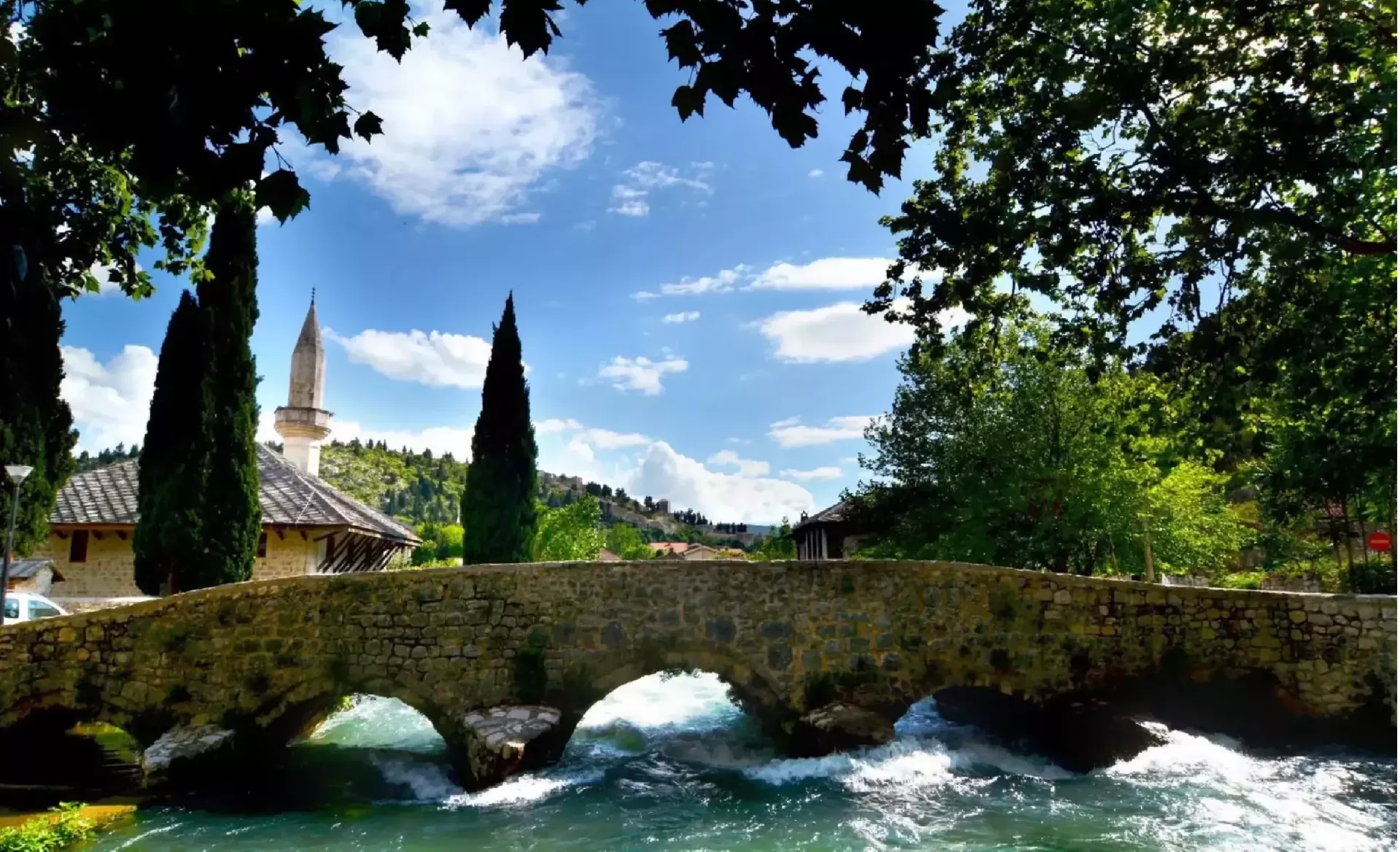
Stolac is a city whose walls are visible to the naked eye. The strong ramparts of the fortresses, standing above and around the city, testify to its rich history. However, today Stolac is guarded by different walls, invisible, silent, and internal, which strongly influence everyday life.
These are the boundaries that divide basic human rights, the right to access institutions, and political influence. They are felt in conversations, seen on the streets, in schools, kindergartens, cafes, sports fields, in other words, in all segments of society. They do not divide space, but power. Because of them, people live together in the city, but not equally.
A small town, located in the valley of the Bregava River, is one of the most historically rich cities in Bosnia and Herzegovina. Few can boast of the ancient Illyrian Daorson, the Radimlja necropolis, one of the most significant necropolises of stećci in Europe, the medieval town of Vidoški, and the residential complex of bey families from the Ottoman period, which is why Stolac is rightly called an open-air museum. Its past is a testament to a long continuity of life, a meeting of different cultures. Precisely because of this, the feeling of a part of its citizens is difficult today because they do not feel a sense of belonging in their city, which has developed from a long-standing feeling of exclusion. Institutions send a clear message: you are present, but you are not equal. For us, you are institutionally invisible.
The city then becomes a territory with a clearly defined hierarchy of privileges and power, concentrated in the hands of the ruling structure, which does not accept anyone outside that structure, even when they formally belong to the same ethnic group.
Discrimination That Is Not Spoken Aloud
Discrimination that is not spoken aloud is not invisible, but it is tolerated. For years. All this passes without sanctions and real institutional reaction. It is carried out in silence, through institutions, and in the long term, which makes it even more dangerous. Precisely because of this, one can speak of "voluntary apartheid," not as a free choice of citizens, but as a conscious acceptance of permanent inequality by the authorities in Stolac.
Discrimination ceases to be a problem and becomes a custom, or rather a practice, which over time turns into a structure.
It is important to emphasize that this situation is not accepted by everyone. In Stolac, there are individual citizens and informal groups who publicly point out injustice and fight against the produced system through legal means and public discourse. Therefore, resistance exists.
The local government remains silent and ignores, continuing to act according to its own plans, without regard for legal regulations and court decisions. Higher levels of government outside Stolac generally remain passive or limit themselves to formal statements.
A city in which citizens' voices are heard, but ignored or systematically disregarded, turns into a city of formal equality and actual inequality.
Why Talk About Apartheid?
While apartheid in history was based on laws of separation, in Stolac we have its more modern form: rights exist on paper, but in reality, they rarely produce equality.
This form of discrimination is worse than overt discrimination. It is presented as stability, but in reality, it is a pattern that produces long-term social and political asymmetry, loss of trust in institutions, and a feeling of being a second-class citizen. Discrimination is carried out through sentences like: "there are no conditions," "it is not within jurisdiction," "it is not a priority," "it concerns the development of the city," or even through administrative silence. Public sector job openings are reserved exclusively for one ethnic group (Croats), public investments bypass settlements with Bosniak populations, or projects in those parts of the city are postponed, reduced, or remain unfinished, budget funds are allocated selectively and discriminatorily, and the treatment of the mosque cemetery and burial ground is a test of dignity and respect for basic human and cultural rights.
Due to all of the above, Stolac can be viewed as an example of ethnocracy with elements of institutional and cultural discrimination.
We must talk about apartheid as loudly as possible, so that it is heard further and stronger. Because a situation that has no name cannot be changed. A voice that is not raised cannot be heard. And injustice that is not named remains acceptable.
Komentari (0)
Prijavite se za komentiranje
PrijavaJos nema komentara. Budite prvi!
Minuta
Sve →Iz drugih kategorija
High Representative Not Elected: Germans, French and British Sabotaged Americans, New Attempt at End of June

ČOVIĆ WITHOUT MERCY: How Those Who Brought Ademović to Office Created a Political Hell for Him


Sunny Saturday, quite warm

Tragedy in Albanian resort: Two minors drown