
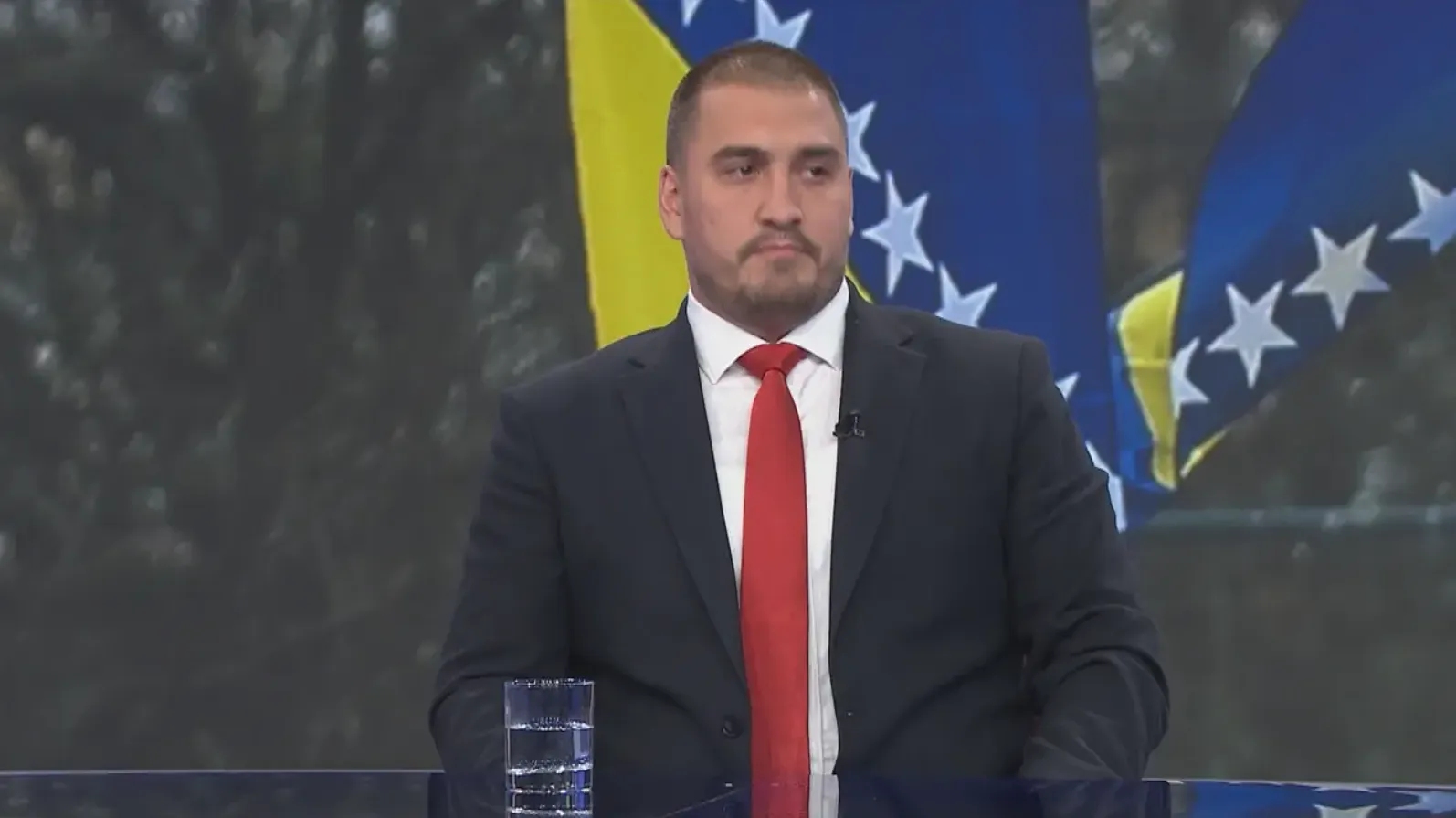
The appearance of SDA Vice President Haris Zahiragić on the show "Otvoreno" on HRT attracted great public attention in Bosnia and Herzegovina, as well as in Croatia. Not only because of the topics discussed, but above all because of the way he advocated state-building positions before an audience in neighboring Croatia.
At a time when domestic politics is often reduced to statements, mostly filled with whining, mutual accusations, and the expectation that the international community will solve problems that domestic politicians are unwilling or unable to solve, Zahiragić's appearance opened an important question: why have determination, arguments, and political courage become rare on the pro-Bosnian political scene?
Regardless of whether one agrees with all his political views, it is difficult to dispute the fact that he appeared in Zagreb confidently, prepared, and argumentatively.
He did not speak the language of insults nor resort to populism. By presenting facts about the constitutional order of Bosnia and Herzegovina, the electoral system, and the representation of peoples in institutions, he tried to challenge the narratives that have been promoted for years in part of the Croatian political space.
Perhaps this is the most important message of this appearance. Citizens of Bosnia and Herzegovina expect their political representatives, above all, to defend the interests of the state and society with arguments, knowledge, and dignity.
This latter quality, in times of widespread spinelessness, is especially valued. Citizens expect people who will be able to wage political battles without complexes towards Zagreb, Belgrade, or any international center of power. Because the easiest thing is to be 'Zagreb's good boy'.
For too long, the impression has been created in Bosnia and Herzegovina that key problems will be solved by the intervention of foreigners, embassies, high representatives, or international organizations. This is exactly what we are witnessing in the polemics surrounding the selection of Christian Schmidt's successor.
As if some Landi or Troccaz will bring security to Bosnia and Herzegovina. But security is not imported; it arises deep within the country. Just as water in a well springs from within, from the bowels of the earth, because no matter how much water you pour into a well, you cannot fill it until a spring gushes from within.
And such an approach has led to political passivity and the creation of a belief that domestic politicians do not have to take full responsibility for processes in their own state.
No international institution can have a greater interest in Bosnia and Herzegovina than its citizens and legitimately elected representatives. Help from outside can be useful, but it cannot replace political determination within the country.
That is why the resonance of Zahiragić's appearance is much greater than a single television debate. Many citizens saw in him not just a representative of one political party, but an example of a politician who was ready to go to the studio of a neighboring country's public service and defend his views face to face, without intermediaries and without calculations.
Bosnia and Herzegovina today lacks precisely such appearances—clear, argumentative, and dignified. Politicians with an upright backbone are missing, who will understand that respect is not gained through pleas or by calling on foreigners to fight our battles, but through knowledge, principle, and the readiness to defend one's own views wherever necessary.
If one broader lesson can be drawn from the Zagreb appearance, it is this: the citizens of Bosnia and Herzegovina want politicians who believe in their own state enough to represent and defend it themselves.
Because a state that does not build its security and future from within sooner or later becomes dependent on the will of others. And the history of Bosnia and Herzegovina has shown many times how costly such dependence can be.
Komentari (0)
Prijavite se za komentiranje
PrijavaJos nema komentara. Budite prvi!
Minuta
Sve →Iz drugih kategorija

High Representative Not Elected: Germans, French and British Sabotaged Americans, New Attempt at End of June

ČOVIĆ WITHOUT MERCY: How Those Who Brought Ademović to Office Created a Political Hell for Him



Sunny Saturday, quite warm



Tragedy in Albanian resort: Two minors drown












