
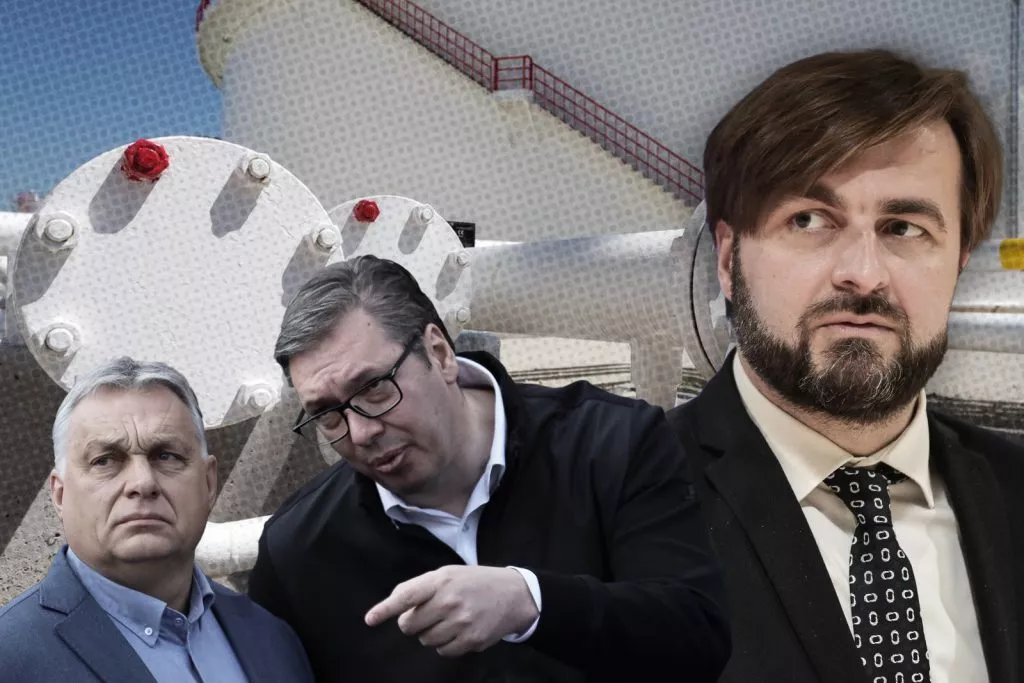
SARAJEVO, (Patria) - According to Nacional, Economy Minister Tomislav Ćorić and the management of the Croatian domestic oil pipeline operator JANAF have seven more weeks to start implementing the decision of the EU Council on the ban of crude oil supply to the Serbian oil company NIS, which is majority-owned by Russian Gazpromneft, a long-term JANAF partner and lessee. The JANAF management will have to take this step after the EU Council, as part of the fourth package of sanctions against Russia, decided on March 15 to ban all business transactions with companies outside the Union that are majority-owned by Russian state-owned companies. This decision takes effect on May 15. NIS is a significant JANAF partner because it transports about three million tons of crude oil annually through the Croatian pipeline for its refinery in Pančevo and its lubricant production facility in Novi Sad. Based on this cooperation, JANAF earns about 40 million euros annually, or almost a third of its own annual revenue.
By Council Decision EU 2022/430 of March 15, 2022, the earlier Decision 2014/512/ CFSP on restrictive measures concerning actions by Russia destabilising the situation in Ukraine was supplemented and expanded. Article 1 added a provision which, among other things, prohibits “directly or indirectly participating in any transaction with a legal person, entity or body resident outside the Union, in which legal person, entity or body the entity referred to in Annex X has, directly or indirectly, a share of more than 50 percent” or “a legal person, entity or body acting on behalf of or under the instructions of an entity referred to in point (a) or (b) of this paragraph”. Annex X, referred to in Article 1, lists Russian state-owned companies subject to the ban, including Russian oil companies Rosneft, Transneft, and Gazpromneft. The oil company Gazpromneft is the majority owner of Naftna industrija Srbije (NIS), holding a 56.15 percent stake, with the Serbian state owning 29.87 percent of the shares.
Nacional requested comments on the situation, specifically the requested cessation of crude oil supply to Serbian NIS and the potential consequences for JANAF's business, from both the company's management and the Ministry of Economy and Sustainable Development headed by Tomislav Ćorić. Both parties chose to remain unavailable, avoiding answering questions and commenting on the current situation.
In mid-January this year, JANAF signed a new crude oil transport agreement with NIS, under which the Serbian company leased JANAF's transport capacities on a “full for empty” basis for 3.2 million tons of oil, with a possible deviation of +/- 10 percent, which is about 16 percent of the pipeline's installed capacity. According to the statement by JANAF CEO Stjepan Adanić at the time, NIS leased slightly larger pipeline capacity with this agreement than in previous years. However, the agreement, although signed only two months ago, should be terminated based on the EU Council Decision, and the oil should flow to other refineries in the EU instead of NIS's refinery in Pančevo.
Serbia is anxiously awaiting Croatia's reaction to the decision announced by the European Council, and whether it will be respected and implemented, as Croatia's response could have fateful consequences for Serbia, even determining whether Serbia will now have to change its general foreign policy.
As is known, Serbia – which claims to want to become an EU member but maintains very close ties with Russia – has found itself in a very awkward situation due to Russian aggression against Ukraine because of this “sitting on two chairs” policy. Although it supported the resolution condemning the aggression at the United Nations, it has not imposed sanctions on Russia, as required by the European Union and other Western powers. Serbian President Aleksandar Vučić has been complaining for days about pressure from both sides, as the West demands Serbia join the sanctions, while Russia threatens to completely cool relations with Serbia and cease providing crucial support on Kosovo in the UN Security Council if it does. When the European Union decided to impose sanctions on Gazpromneft, Serbia interpreted this as another, hitherto the most severe, form of pressure on Serbia – an EU candidate country – to align its policy with that of the EU and join the European Union's sanctions policy. Vučić dedicated almost all 90 minutes of his appearance on the widely watched Prva TV program last week to this EU decision, which is disastrous for Serbia, almost crying as he explained the difficult situation to the broadest Serbian public.
Indeed, after JANAF terminates its cooperation with Naftna industrija Srbije, an extremely perilous situation will quickly arise for Serbia, as Naftna industrija Srbije is Serbia's sole supplier of oil and oil derivatives, and Naftna industrija Srbije can currently only obtain oil through JANAF and no other way. Previously, some quantities arrived via Romania, where barges with oil arrived at the port of Constanța via the Black Sea, but this has now been cut off due to the war in Ukraine, and possible imports via Montenegro are not functional. Therefore, panic reigns in Serbia while awaiting JANAF's decision. Serbia has, admittedly, filled its oil reserves almost completely in recent months, but these reserves, if JANAF cuts off supply, will last less than three months, as Vučić said, after which Serbia will be left without oil. There is a possibility of overcoming this situation and starting to import oil derivatives from Hungary, but the question remains – despite the excellent relations between Vučić and Hungarian leader Viktor Orbán – whether this will be possible due to the EU's stance towards Serbia, certainly not to the full extent Serbia needs, and at what prices.
Vučić has announced that Serbia will appeal to the European Union regarding this decision, but he also added that it is almost impossible for Serbia to be exempted from these measures, as it would require a vote of all 27 EU countries, which is not to be expected. He specifically mentioned Bulgaria, the Netherlands, and Croatia as countries that would oppose it. There would be some possibility only if Serbia urgently changed its current policy and joined the sanctions against Russia, which would provoke Russian countermeasures against Serbia and numerous public protests, as the Serbian public is pro-Russian oriented. In this regard, JANAF's decision to cease oil supply to Serbia would have significant political implications, as it could decisively influence Serbia's future alignment in the broader European context, and thus the general situation in the so-called Western Balkans.
According to unofficial information obtained by Nacional from well-informed oil circles, the requested ban on oil transport to Serbia should not harm JANAF, as there are already companies interested in leasing the available capacity, so the pipeline will not remain empty. The projected capacity of JANAF's pipeline is 34 million tons of oil per year, but the installed capacity is 20 million tons. In addition to supplying refineries in Croatia, Slovenia, Serbia, and Bosnia and Herzegovina, the pipeline also supplies refinery facilities in Hungary, the Czech Republic, and Slovakia with crude oil to a lesser extent.
Unofficial sources from oil circles with whom Nacional spoke claim that the capacity of JANAF's pipeline, which would be freed up by ceasing transport to Serbia, would not remain unused.
“Hungarian MOL is already trying to ‘jump into’ the potentially empty space, showing its intention to lease the available capacities for its needs, so JANAF will transport oil for the needs of refineries in Hungary, the Czech Republic, and Slovakia,” claims Nacional's source.
Vučić is further concerned by the very real possibility that Serbia could also lose gas supplied through TurkStream, or rather Bulgarian Stream from Russia, for the same reasons, as Bulgaria is also an EU member that will have to comply with the EU Council Decision. In his statements to the Serbian media, calling the EU Council decision absurd, Vučić claimed that it does not prevent EU member states from importing Russian oil, nor does it prevent Russia from exporting oil to the Union, but exclusively prohibits third countries from importing oil if the companies or refineries are majority-owned by Russia. “They didn’t punish the Russians, they didn’t punish themselves, they punished us,” complained Vučić. Indeed, Russian oil continues to reach European countries without hindrance, as the EU Council Decision clearly stated that the ban does not apply to contracts concluded by EU member states with Russian energy exporters before March 16, 2022, and that “the ban does not apply to transactions that are strictly necessary for the purchase, import or transport of fossil fuels, in particular coal, oil and natural gas, as well as titanium, aluminium, copper, nickel, palladium and iron ore, from or through Russia to the Union.”
However, if Russia decides to close the valves on the main Druzhba pipeline, which supplies oil from Russia to Hungary and Eastern European countries like Poland, the Czech Republic, and Slovakia, in retaliation for the sanctions, JANAF will certainly become one of the most important entry points for oil imports from Africa, the Middle East, the Levant, or other routes to Southeastern and Eastern Europe, as well as to refineries in Central Europe, which numerous oil companies in the EU will certainly take advantage of. Energy consultant Miroslav Skalicki predicts precisely such a possible development, stating that oil could be transported to Central Europe precisely via JANAF's terminal in Krk. A source very close to JANAF's management confirmed that, in addition to the possibility of transporting oil for European refineries, JANAF will now also make good use of its storage capacities, in which the company has invested heavily over the past decade.
Former JANAF CEO Dragan Kovačević deserves great credit for this. During his tenure from 2012 to 2020, despite the opposition of many managers within the company and politicians in relevant state institutions at the time, he initiated an investment cycle in oil and derivative storage capacities in Omišalj, Sisak, and Zagreb, which increased them by more than a million cubic meters.
During that period, seven large crude oil tanks, each with a capacity of 240,000 cubic meters, and several derivative tanks were built at JANAF's terminal in Omišalj, along with two more crude oil tanks in Sisak and several derivative tanks at the terminal in Zagreb. With this investment, Croatia could finally store all its strategic mandatory reserves of oil and derivatives physically within Croatia, which significantly contributed to the stability of oil and derivative supply to the market. Until then, strategic reserves of crude oil and derivatives were stored in intangible form in ports and terminals outside Croatia (Rotterdam, Antwerp, Hamburg), and the Croatian state held coupons with the right to purchase oil and derivatives in case of need. It is unnecessary to mention that such coupons would become worthless in crisis situations like the current one, when the supply of oil and derivatives to the entire Europe in the coming months hangs in the balance and depends on the goodwill of one man – Vladimir Putin.
“What Vučić is saying now – that Serbia needs to invest in increasing storage capacity – Croatia has already done through the smart investment policy of the JANAF management from 2012, led by Kovačević. This not only ensured supply security for the domestic market but also enabled JANAF to generate additional profit by renting out available storage capacity at very high prices,” explained another independent Nacional source, who points out that Economy and Sustainable Development Minister Tomislav Ćorić himself recently boasted that Croatia currently has enough oil and oil derivatives from strategic reserves stored in Croatia, but he “forgot” to mention who deserves credit for this fact.
Minister Ćorić has also, to this day, failed to explain another tragedy of Croatian energy policy, behind which lie his Ministry and Prime Minister Andrej Plenković's government, and which is becoming fully apparent in these very weeks.
Indeed, the current situation with a very likely derivative supply crisis in Serbia has exposed the catastrophic consequences of the Croatian government's foolish decision – to passively observe MOL's closure of the oil refinery in Sisak. Vučić also announced that Serbia would fill all available derivative storage facilities, as he said, “to the brim,” but he does not hide that the country lacks sufficient storage capacity and that solving this problem still lies ahead in the coming years. Had it remained open, the Sisak refinery could now be generating profits by supplying derivatives to the Serbian market, which could be left without its own derivatives if the refineries in Pančevo cease operations, as well as the one in Bosnia and Herzegovina, since Zarubežnjeft's refinery in Bosanski Brod has also been non-operational for years. Serbia will turn to importing derivatives from Hungary and Romania – it is unnecessary to emphasize that MOL will profit the most in this scenario – and Croatia will only serve as an entry point, as derivatives for Serbia's needs will be imported via the terminal in Ploče and by road and rail through BiH, which significantly increases the final price for buyers.
Komentari (0)
Prijavite se za komentiranje
PrijavaJos nema komentara. Budite prvi!
Minuta
Sve →Iz drugih kategorija

High Representative Not Elected: Germans, French and British Against Americans, New Attempt at End of June

ČOVIĆ WITHOUT MERCY: How Those Who Brought Ademović to Office Created a Political Hell for Him



Sunny Saturday, quite warm



Tragedy in Albanian resort: Two minors drown












