
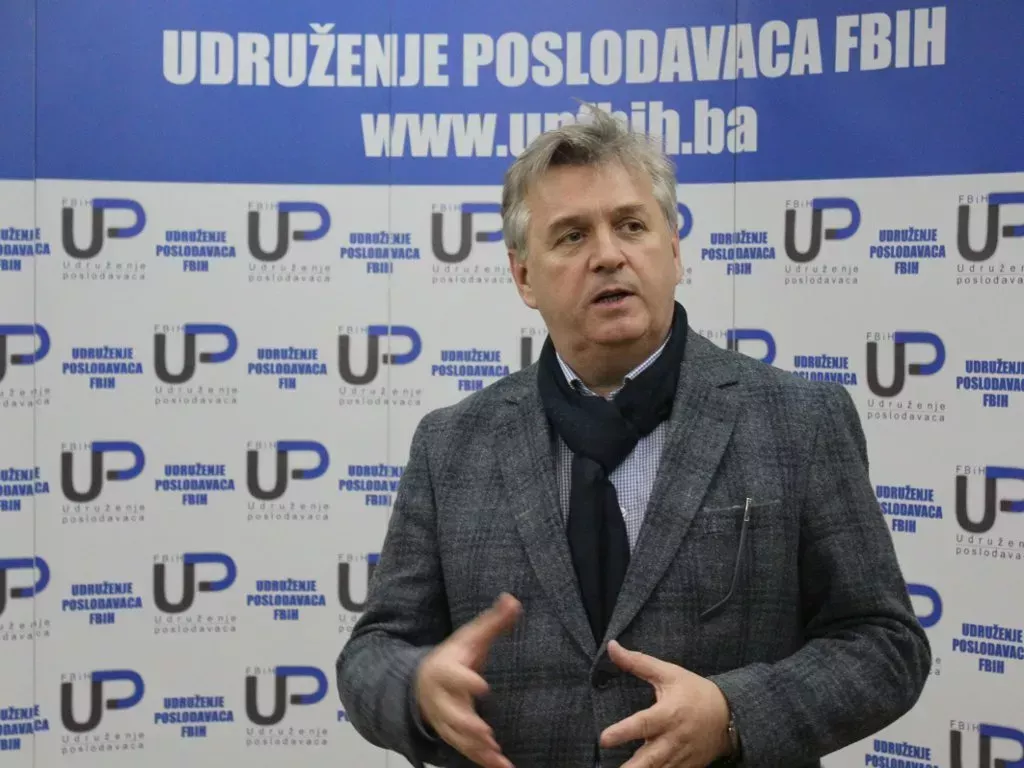
The FBiH Employers' Association expects the FBiH Government to submit a set of fiscal laws, as well as the Law on Minimum Wage, to the procedure as soon as possible. President of the FBiH Employers' Association Adnan Smailbegović, in an interview with Patria, discusses the minimum wage, the FBiH Government's decree on the payment of aid to workers, and dialogue with the FBiH Government.
Patria: How does the FBiH Employers' Association comment on the frequent statements by Federal Prime Minister Nermin Nikšić that they "have already enabled a minimum wage of 1,000 KM," and that it is up to employers whether they will respect it? Nikšić clarified this by stating that the minimum wage is 619 KM, and that the FBiH Government, through a decree, enabled employers to pay 2,520 KM per worker until June 30, 2024, and proposed a monthly payment of 420 KM, although the decree is not binding. Is this a misleading statement by the Prime Minister, given that it is left to the will and possibility of employers whether they will pay part of that amount, the entire amount, or not at all?
Smailbegović: The Employers' Association, at its Management Board meeting at the beginning of this year, took the position that the two key priorities in 2024 are the reduction of fiscal and parafiscal levies and the liberalization of the labor market, whether it concerns improving the position and strengthening the domestic workforce or improving procedures for importing labor from abroad, in those sectors and parts of the FBiH where domestic labor is lacking. We continued cooperation with the Prime Minister and members of the FBiH Government on these issues, and two weeks ago we held a meeting at the Government and emphasized the importance and urgency of resolving these issues. On that occasion, it was concluded that the leadership of the Association will continue close cooperation with members of the FBiH Government, primarily with Deputy Prime Minister Vojin Mijatović, in order to initiate and implement concrete and visible reforms as soon as possible.
Regarding your question about the nature of the one-time aid that employers can pay to workers in the first half of this year, it is certainly one of the measures aimed at improving the situation and position of workers in the real sector, but it is not what workers are asking of us, which is stable and increased wages that will enable a better standard for them and their families.
In recent days, we have begun field visits within the Association to our members and other business entities in the Federation. During the meetings, while businessmen expressed gratitude for this measure of the FBiH Government, everyone expects systemic measures, a reduction in the burden on labor costs, and the abolition of at least some of the parafiscal levies, of which there are about 3,200 in the FBiH! We would not even accidentally label Prime Minister Nikšić's statement as misleading, because we are sure that the Government is facing a major challenge in harmonizing the interests of different participants and interest groups on this issue. On the one hand, a stable and favorable business environment is important, because today, according to all available data, we are the country with the highest fiscal and parafiscal burdens, and on the other hand, all this is accompanied by large and constantly growing needs in the social sector, healthcare is not being reformed, the administration is too expensive and growing, while being inefficient... It is not easy to do business in such a complicated system.
Employers have started paying this one-time aid to their workers, and on this occasion we also call on all businessmen and craftsmen who are in a position to pay this aid to workers. We repeat, in addition to aid, workers need a solid and appropriate salary for their work. Therefore, we expect the Government to announce the planned reforms as soon as possible through the Law on Contributions, the Law on Income Tax, the Law on Profit Tax, the Law on Minimum Wage, but the expected adoption of the Law on Health Insurance and the abolition or at least appropriate reduction of a certain number of very burdensome parafiscal levies, etc., will certainly help a lot.
Patria: Given that the FBiH Government has not yet submitted to the procedure a set of fiscal laws that would reduce taxes and contributions, which employers have requested, thereby opening space for increasing workers' wages, do you expect the Government to respect what it announced and for these laws to be adopted by the end of the year and for the minimum wage to be 1,000 KM?
Smailbegović: We fear that postponing the deadlines for adopting the mentioned and other regulations aimed at reducing the burden on labor costs would be counterproductive and would lead to new departures of workers from BiH, which would further complicate the situation in the real business sector in the FBiH. We believe that the Government will initiate reforms as soon as possible. We expect the continuation of talks with the Prime Minister and members of the Government in the next 15 days or so, as we concluded at the previous meeting, and these measures that are in force, Government members also announced as temporary and transitional in a way. All of us must discuss and improve policies in these areas on a daily basis, as well as their standardization.
Patria: Are you satisfied with the dialogue with the FBiH Government, given that it is evident that employers are the ones who fill the budget, as Prime Minister Nikšić also admitted?
Smailbegović: We have repeatedly emphasized the importance of starting the Economic and Social Dialogue in the FBiH. The Prime Minister announced the resolution of this issue as soon as possible. We are waiting for an invitation to the first session of the Economic and Social Council of the Federation of BiH, because talks between the authorities, employers, and unions have no alternative.
Patria: Does it seem to you that the Government is delaying the adoption of fiscal laws precisely to avoid a drop in budget revenue?
Smailbegović: It is no secret that ensuring the functioning of such a complex system is a major challenge for the Government. A lot of administration, disconnected authorities at three or four levels, an expensive social sector, the perspective of filling the PIO/MIO funds, the sustainability of the health system, etc. We understand that the government is concerned about filling the budget and planning for the next period. We constantly offer ourselves to help, to offer solutions, to see what possible reforms must be implemented immediately, and what should be done in the near future.
Komentari (0)
Prijavite se za komentiranje
PrijavaJos nema komentara. Budite prvi!
Minuta
Sve →Iz drugih kategorija

High Representative Not Elected: Germans, French and British Against Americans, New Attempt at End of June

ČOVIĆ WITHOUT MERCY: How Those Who Brought Ademović to Office Created a Political Hell for Him



Sunny Saturday, quite warm



Tragedy in Albanian resort: Two minors drown












