
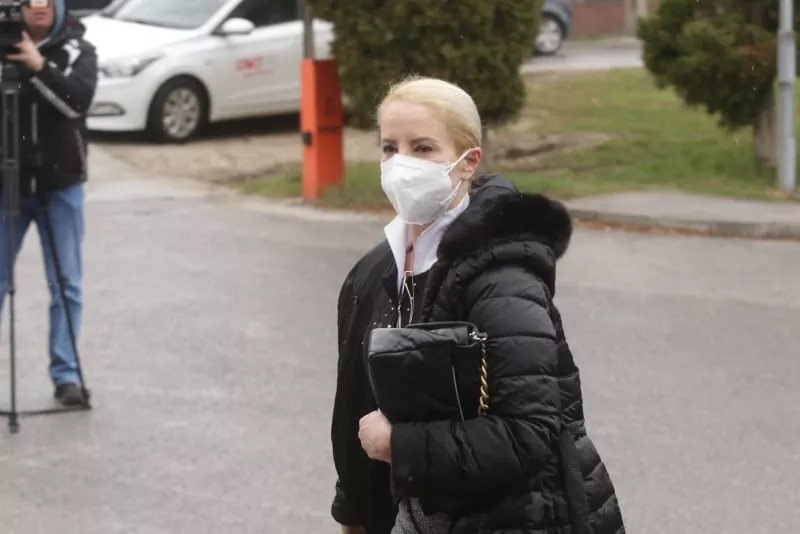
SARAJevo, (Patria) - The trial in the case of "Fadil Novalić and others" continued today at the Court of Bosnia and Herzegovina, with Sebija Izetbegović, director of KCUS, and Denis Đulalić, director of the company Cubicus, which procured medical equipment during the pandemic, testifying as witnesses.
Prosecutor Džermin Pašić asked Director Izetbegović about the needs of KCUS for medical equipment procurement in March 2020. She confirmed that they received two requests, one from the FBiH Ministry of Health and another from the FBiH Public Health Institute, which were supposed to specify the quantities needed, and the tables listed equipment: gloves, protective suits, tests, ventilators...).
When asked by the prosecutor whether KCUS had commented on the specifications of the ventilators, Izetbegović said they had not.
She attended the FBiH Government session on March 16, 2020, to which other clinical center directors (Tuzla, Mostar) were also invited, and the topic was how the FBiH Government could assist healthcare institutions.
The director of KCUS confirmed today that the hospital did not conduct public procurements based on the FBiH Government's conclusion.
She said they had initiated a procedure for the procurement of ventilators, which they had paid for, but the procurement was not realized because someone else bought those ventilators at four times the price.
When asked by the prosecutor about procurements and suppliers, she stated that she does not negotiate with suppliers; that is handled by the public procurement service.
The prosecutor showed the witness the contract between KCUS and Cubicus for the procurement of ventilators, which she recognized, but could not recall if there had been any discussion with the bidder. She could not remember the price of the ventilators.
When asked if she had spoken with Prime Minister Novalić or the director of FUCZ, Fahrudin Solak, about the ventilators, she said she did not remember.
"I spoke with my neighbors, with my hairdresser, I said I didn't know how we would survive without ventilators," said the witness.
She also denied that KCUS was consulted in any way regarding the type of ventilators the FBiH Government decided to procure.
Prosecutor Pašić then used one of the emails sent from the FBiH Government's Prime Minister's Office to the official email of the General Director's cabinet.
The email was sent on April 1, 2020, and was presented to the witness, who said, "I'm not sure if I remember this at all."
The email mentions the name Vildan, and Izetbegović said it was her former secretary, adding that there are certainly "30 Vildans" at KCUS.
The prosecutor was interested in whether this was official correspondence, given that it was an official email, to which Izetbegović replied that she does not recognize "email correspondence as official, only what officially arrives at the protocol and is entered into the books."
In further questioning, Izetbegović confirmed to the prosecutor's questions that she knows Edita Kalajdžić, secretary of the FBiH Government, because she was the president of the KCUS Supervisory Board when Izetbegović was elected director.
She said that Kalajdžić is a "thorough person, even extremely meticulous," and that she called when she saw different markings on the boxes containing the ventilators on the Klix portal.
She denied having commented on the ventilators, stating that she is a "gynecologist" and deals with a part of the body that is "far from the head."
The prosecutor then presented a Viber conversation between Kalajdžić and Hasan Ganibegović, then director of the Prime Minister's Office.
"Seb. is calling, bad ventilators. Terrible. We are in huge trouble if that's true, and it is guaranteed," it states.
Izetbegović denied commenting on the quality, only on the numbers she saw on the boxes.
When asked if she consulted with anesthesiologists about these ventilators, she emphasized that she did not because she was not the one buying them.
The prosecutor also asked the witness if she knew Fikret Hodžić and if she had heard of Srebrena malina, to which she replied that she had never heard of it.
The witness was cross-examined by lawyer Vasvija Vidović, who represents the accused Novalić.
She asked the witness to confirm that KCUS failed to purchase the ventilators they had already paid for, which she confirmed. Vidović reminded her that the World Bank bought those ventilators at an increased price, which Izetbegović also confirmed.
She also confirmed that she was aware that the EU had decided to ban the export of medical equipment at that time (mid-March 2020).
"The day before the FBiH Government session, on March 15, the EU banned the export of medical equipment. I also received information that Turkey had banned exports and that a truck with ventilators for Bosnia and Herzegovina was stopped, not for KCUS, and I received an inquiry asking if I could help them still reach Bosnia and Herzegovina. At that moment, we were left with China and Korea," said Izetbegović.
When asked by Vidović if she could recall the situation at the time, Izetbegović said that as early as November 2019, she had received information that something was happening in China.
"I knew that we wouldn't move an inch in January. In January, we felt that a big problem would arise, that it would spread to us from Italy and Austria," she said.
Izetbegović stated that it was not possible to procure Drager ventilators at that time and that they were informed about it. She emphasized that Drager ventilators were her personal favorite.
"No one asked us about the type, quality, or price of the ventilators. We were only asked to provide the quantity," said Izetbegović, referring to the request from the FBiH Public Health Institute.
She confirmed that Chinese ventilators were already in use at KCUS even when millions were being spent on procurement.
She added, in response to Vidović's questions, that they knew they could not get any ventilators from Europe and that there was panic, and prices were "going wild."
"This was not only for ventilators but also for other protective equipment, gloves, masks, tests," said Izetbegović.
The last question Vidović asked the director of KCUS concerned the ventilators that are the subject of the indictment (ACM812A), specifically whether the ventilators are still in use today.
"Thirty ventilators are in operation in the respiratory center and are used for both invasive (intubated patients) and non-invasive therapy for high-flow oxygen," she said.
Lawyer for Fahrudin Solak, Kadrija Kolić, asked the witness if they received COVID tests through FUCZ.
"Yes, our tests are checked in Berlin, and every one of our tests has been rated as impeccable. FUCZ saved us by procuring tests because we only had 300 tests," she said.
In additional questions, Prosecutor Pašić asked the director of KCUS, "If she is not qualified, why did she say that Drager is her favorite?"
"Because I have been a doctor for 27 years and I have operated on patients who were on Drager. I like Drager, it's like a favorite song." We had no problems with Mindray or Make either," she said.
Judge Džemila Begović asked the witness whether the anesthesiologist spoke about the Drager ventilator or her, to which she replied that it was the anesthesiologist. She confirmed that KCUS had not had this type of ventilator before, but she had heard that "Serbia is covered" with them.
Prosecutor Pašić asked Izetbegović if she had discussed COVID tests with Prime Minister Novalić, which she denied.
The prosecutor presented a message with the following content:
"You must react quickly to 150,000 tests because someone else will buy them. We have no time to lose. I said to reserve them for us and with Solak. We have no time to lose." The message from Novalić to Kalajdžić states. The next message reads only: Sebija.
When asked by the prosecutor if Sebija Izetbegović was the author of this message, she said she did not remember.
"I only remember that we received tests through FUCZ, and through UNDP," she said.
The next witness was Denis Đulalić, director of the company Cubicus, which procured medical and protective equipment.
Judge Begović asked the prosecutor what the intention was in questioning this witness about KCUS procurement when it was not part of the indictment. Prosecutor Mirza Hukeljić stated that they wanted to show "proper ventilator procurement."
Cubicus is a medical consulting company, said Đulalić, and the company did not deal with the procurement of medical equipment before the pandemic.
The witness explained that he received an inquiry from a company in Slovenia with which he collaborates, asking if there was a need for equipment in Bosnia and Herzegovina, and based on that, he prepared an offer which he sent to multiple addresses: hospitals, ministries, institutes.
"These were offers for ventilators, protective suits, masks, tests," he said.
In the offer he sent to KCUS's official general director's email, he offered Mindray ventilators at a price of 80,000 KM per unit plus VAT. He calculated for 10 to 15 ventilators.
He said he sent the offer on Sunday, and on Monday, he was contacted by the general director's office, as well as by other hospitals.
"I was called by the general director's office, and I spoke with Ms. Izetbegović about whether the offer was serious, whether these were ventilators for adults, and what the delivery time was," said Đulalić, noting that offers changed by the hour and that he could guarantee the offer after receiving the money.
A contract was signed, and KCUS made a payment of 3 million KM, which was transferred to the supplier in Slovenia. However, the contract was not realized.
Lawyer Vidović asked the witness why the contract was not realized.
"The supplier informed us that there were problems, that the airports were closed, and it was not possible to deliver from China. We would have to pay KCUS 30,000 KM for each day of delay, and I decided to return the money because the supplier could not determine when they would deliver," said Đulalić.
He confirmed that Cubicus also procured tests for FUCZ and that Director Fahrudin Solak personally contacted him because he got his number from UNDP.
Đulalić also attended the FBiH Crisis Staff meeting and explained the procurement and the type of tests involved.
Responding further to the defense's questions, Đulalić said that the situation changed by the hour and that the models of available ventilators also changed.
"All countries more serious than Bosnia and Herzegovina mobilized all their resources and intelligence apparatus to procure equipment," he said.
To the questions of lawyer Marcela Bajramović, who represents Solak, Đulalić confirmed that he also sent an offer to FUCZ, which included ventilators at a price of 109,395 KM per unit. Although he could not recall if he had spoken with Sanita Alagić from FUCZ after being shown the SIPA interrogation record from May 2020, Đulalić confirmed its authenticity.
He stated that he had informed FUCZ that they were unable to procure ventilators due to market changes.
Although he wanted to obtain permission from the Agency for Medicines and Medical Devices of Bosnia and Herzegovina for the trade of medical equipment, Đulalić said he was advised to engage a registered wholesaler because the registration procedure would take too long. He specified the name of the person who advised him to engage a wholesaler: Mladen Čančarević.
Lawyer Mirna Avdibegović, who represents Fikret Hodžić, asked the witness if he had sent offers for equipment procurement on his own initiative, which he confirmed. He also stated that when he sent the offers, he did not have the items in stock. He declined to comment on the margin he included in the offer.
The next hearing will be on April 2, when two new witnesses will be heard.
Komentari (0)
Prijavite se za komentiranje
PrijavaJos nema komentara. Budite prvi!
Minuta
Sve →Iz drugih kategorija

High Representative Not Elected: Germans, French and British Sabotaged Americans, New Attempt at End of June

ČOVIĆ WITHOUT MERCY: How Those Who Brought Ademović to Office Created a Political Hell for Him



Sunny Saturday, quite warm



Tragedy in Albanian resort: Two minors drown












