
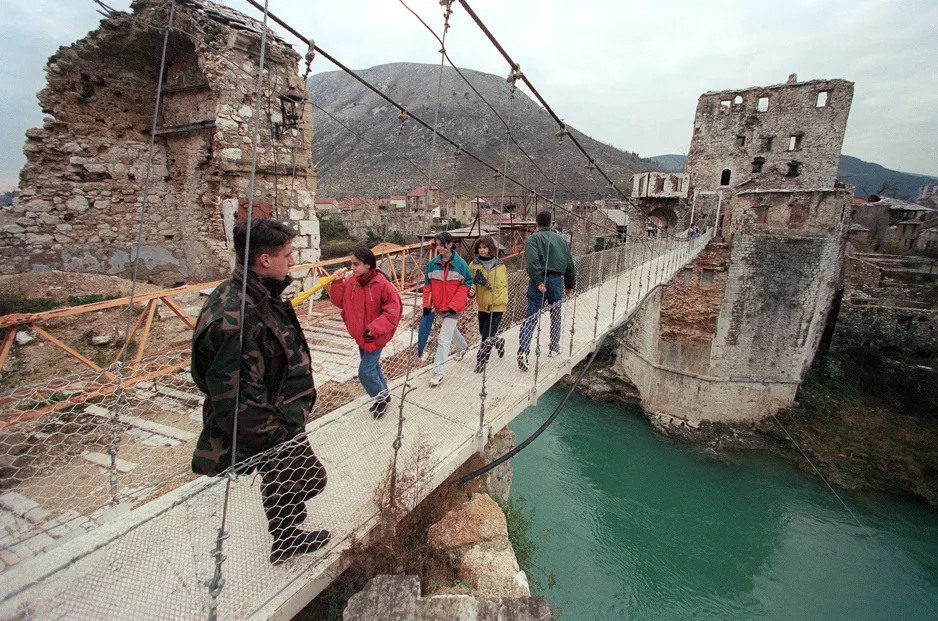
From March to August 1992, Mostar experienced horrific urbicide. Buildings of theaters, hospitals, libraries, mosques, and monasteries over 500 years old were destroyed and burned. Mostar is a city of bridges. Its bridges were the most beautiful and possessed a special beauty among all cities. In 1992, within a span of a few months, eleven bridges, built by the people of Mostar regardless of their religious affiliation, were destroyed in Mostar.
Perhaps such savagery has not been recorded in world history.
Who destroyed those bridges? To say that only the Serb side destroyed them is incorrect.
The people of Mostar recognized another crime when they saw the burning of the old Kujundžiluk monument. Immediately after the liberation of the left bank, this part of the city was set on fire by members of the Croatian Army (HV) and the Second (so-called Miners') Battalion of the Croatian Defence Council (HVO).
From the top leadership of the Republic of Croatia, specifically from the Croatian Democratic Union (HDZ), there are warnings these days about terrorist threats from Bosnia and Herzegovina.
It would be appropriate to ask them these days why the bridges of Mostar, like those of the Yugoslav People's Army (JNA) and Karadžić's terrorists, were an obstacle to them?
Who were the people who destroyed the beautiful bridges of Mostar?
In his book "Treachery and Defense of Herzegovina '91-'95," Mostar resident Dr. Suad Ćupina, a karate coach for the BiH national team, wrote: "Mostar was relentlessly destroyed for a Greater Serbia, and by people who most often came to our city to serve prison sentences in Šantićeva."
At the same time, Dr. Ćupina cites excerpts from an interview with Valentin Ćorić, who is currently indicted as a member of the Prlić group, given to the newspaper "Samuraj" in Zagreb. Ćorić admitted that he had been involved in special military and police tasks since 1990: "I formed a sabotage-engineering unit in Čitluk, which consisted of about 100 engineers and saboteurs, and I was its commander. We were stationed in the Kompas camp in Međugorje. The unit's purpose was rapid intervention. We mined all the bridges on the Neretva River. I was in charge of engineering because I worked as an engineer in the Čitluk mine, so I had miners who mined all the roads towards Čitluk, Ljubuški, and so on."
Another bridge destroyer was Branko Simić, who lived on the left bank of the Neretva in the village of Žitomislići, across from the village of Paoča, where Valentin Ćorić lived.
The destruction of bridges in Herzegovina began as early as April 1992. Thus, the Bridge in Stolac over Radimlja was destroyed on April 12. The concrete bridge in Begov Han near Jablanica, on the main road Sarajevo - Mostar, was destroyed on the same day. The bridge in Žitomislić was destroyed on April 19, when the railway line between Konjic and Jablanica was mined for the second time. The Begov Han Bridge was destroyed in May 1992, and there are witnesses to this terrorist act stating that it was carried out by Tuta Naletilić's Penal Battalion.
Then began the terrorist destruction of the beautiful city bridges of Mostar. The bridge in Vojno in Potoci, a northern suburb of Mostar, built during the Austro-Hungarian era, was destroyed on May 20, 1992.
The Lučki Bridge, or Mujaga Komadina Bridge, built in 1913 as the first concrete bridge built in Bosnia and Herzegovina, was destroyed on May 20, 1992. The War Bulletin of SAO Herzegovina announced that the Lučki Bridge was destroyed by the Ćupina brothers. "The fact that they accused me and my brother meant to me that the Lučki Bridge was destroyed by a joint Serbian and Croatian strategy," states Dr. Suad Ćupina in his book "Treachery and Defense of Herzegovina." On the same day, May 20, three bridges were destroyed. This horrific terrorism would continue.
The Bijela Bridge at the northern entrance to Mostar, on an arm of Lake Salakovac, built in 1961, was destroyed in May 1992. It was destroyed by the Penal Battalion.
The concrete Tito's Bridge, or Musala Bridge, located in the city center, was destroyed on the night of May 29-30.
The Customs Bridge was destroyed on June 11. Rinald Kovačević is cited as a witness to the destruction of the Customs Bridge, having seen Žiko Savić from Bačevići planting explosives. Vojislav Babić was also present. The explosives were placed on the underside of the bridge and detonated remotely. On the same day, the Railway Bridge, or Sutina Bridge, located between Raštani and Sutina, was destroyed. The Hasan Brkić Bridge, or Čekrek Bridge, built in 1980, was destroyed on June 11, 1992. The Railway bridge in the industrial part of Bačevići was destroyed on June 11. Thus, three beautiful bridges were destroyed on the same day in these horrific acts of terrorism. The very next day, June 12, the Aviator Bridge, or Military Bridge in Rodoč, was destroyed.
Finally, on November 9, 1993, the HVO artillery destroyed the world-famous structure, the Old Bridge in Mostar. While other bridges were destroyed by planting explosives, the Old Bridge was destroyed by constant shelling. The Chetniks, under the command of JNA General Perišić, were the first to start destroying it, and then it was finally destroyed by HVO artillery. At that moment, a UNESCO flag was flying on it.
An interesting conversation took place in the office of Franjo Tuđman on November 10, 1993, the day after the Old Bridge was destroyed. Present were Mate Boban, Mate Granić, Jadranko Prlić, and a certain Jukić. The conversation was mostly flattering. Tuđman asks:
"By the way, that bridge in Mostar, who destroyed it?"
Mate Boban says: "There were terrible rains. So much shooting before, that it fell on its own."
Tuđman then asks: "Otherwise, between us, the destruction from a military point of view, who benefits more?"
"Us," says Boban, and Jukić adds what should be said for the public: "I am of the opinion that we should go with collapse. So, we will say the destruction or collapse of the bridge, as the rain had affected it and so on. Blame the war events and the complete destruction of all assets in Bosnia and Herzegovina."
Who needed so much destruction of bridges in Mostar and Bosnia and Herzegovina? On the Sava, Vrbas, and Bosna rivers, 17 bridges were destroyed. With another 15 bridges in Herzegovina, that makes 32 bridges.
Tuđman and Milošević had meticulously planned the division of Bosnia and Herzegovina. Just two days after the destruction of the last bridge in Mostar, on June 14, 1992, the HVO offensive on the left bank of the Neretva in Mostar began.
According to some Serbian sources, the bridges were destroyed from both sides to allow for the peaceful withdrawal of Serbian units. The aim was to stop at the borders of the Banovinas, and they passed through Podveležje. After the agreement between Karadžić and Boban in Graz, Austria, the Croatian side issued a statement stating that Croatian territory was "the area defined in 1939, i.e., the border of the Croatian Banovina." In a recorded conversation between Momo Mandić and Bruno Stojić, old associates in the MUP of RBiH, a discussion arises: Border on the Neretva or on the Banovina: "Only the Banovina from '39 gave the Croats natural borders. We only want those borders," says Stojić, a prominent HDZ official.
The Serbs relented, and after the destruction of the bridges, their withdrawal to the Banovina borders began. The bridges were destroyed through precise agreements. Those who did not know about these agreements risked their lives.
In that same conversation with Stojić, Mandić suggests: "Why don't you sit down and agree: the left bank for the Serbs, the right for the Croats, and the Muslims down the Neretva."
This terrorism has been adjudicated in multiple trials at the Hague Tribunal. It was the policy of the leadership of the HDZ, both in Zagreb and in Grude. Today, that same HDZ demonizes Bosniaks and Bosnia and Herzegovina, accusing them of being terrorists and a threat to peace.
Komentari (0)
Prijavite se za komentiranje
PrijavaJos nema komentara. Budite prvi!
Minuta
Sve →Iz drugih kategorija

High Representative Not Elected: Germans, French and British Sabotaged Americans, New Attempt at End of June

ČOVIĆ WITHOUT MERCY: How Those Who Brought Ademović to Office Created a Political Hell for Him



Sunny Saturday, quite warm



Tragedy in Albanian resort: Two minors drown












