
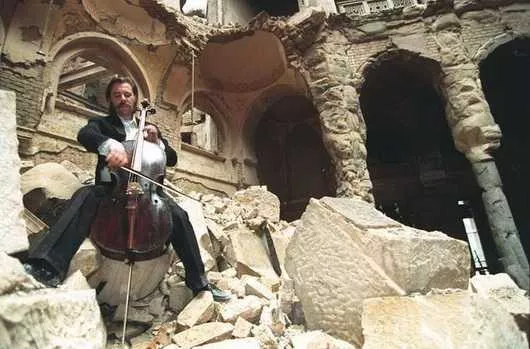
Sarajevo was under siege, exposed to constant shelling and snipers on June 19, 1994. On that day, a true miracle happened for the city, which had been surrounded for more than two years.
In the ruins of Sarajevo's City Hall, the Sarajevo Philharmonic Orchestra performed a concert under the baton of maestro Zubin Mehta. Mozart's Requiem was performed. The soloists were Jose Carreras, Ruggero Raimondi, Cecilia Gasdia, and Ildiko Komlozi. The Sarajevo Philharmonic Orchestra itself had ceased operations for two years due to the aggression, suffering significant material and human losses. This concert marked a turning point in its future work.
Maestro Mehta said at the time: "We are all completely devastated by what we see. We hope that after we leave, something will happen that will convince someone to stop this madness."
Media reported the joy and excitement of Hidajeta Tanković, a cellist with the Sarajevo Philharmonic, who borrowed an instrument for this performance because her own had been pierced by a shell fragment:
- I couldn't sleep for two days. Tonight's concert has given my life meaning.
In fact, it was a sign that the world wanted to end the agony of Bosnia and Herzegovina. The concert was attended by all important figures of Bosnia and Herzegovina, starting with the President of the Presidency of Bosnia and Herzegovina, Alija Izetbegović, to the UNPROFOR commander, British General Michael Rose. They sat next to each other. Rose's memoirs also described that concert. That description by the general spoke mostly of all the delusions, first of himself and then of parts of the international community in Bosnia and Herzegovina.
Namely, Rose cynically viewed the fact that the old Bosnian president, who, as a Muslim, did not, in his opinion, appreciate serious music. He wondered: Where did he get this feeling for a Christian musical work?
Rose, whom Bosnians consider a man with the most misconceptions about the Muslims of Bosnia and Herzegovina, seemed to have forgotten that he was listening to the Philharmonic, which included two-thirds Bosniak Muslim musicians. Secondly, Mozart's Requiem was not essentially a church work, but a commissioned piece dedicated to the love of an Austrian nobleman for his wife.
Rose concluded that it was awkward for Izetbegović, as a Muslim, to listen while a Jew was conducting. And that was a mistake because Zubin Mehta is of Indian descent and a Zoroastrian. The specifics of that small religion were even described by the German philosopher Friedrich Nietzsche.
This concert attracted the attention of a huge number of world media and received unprecedented publicity. Misconceptions about what was happening in Bosnia and Herzegovina were nearing their end, but they were not disappearing. Despite exceptional people like maestro Mehta, the famous Carreras, and other world-renowned artists who were awakening world public opinion to the horrific crimes in Bosnia and Herzegovina, people like that general, lost in their delusions, still prevailed.
A year later, the genocide in Srebrenica occurred. And there was no longer any room for any deceptive games regarding the horrific crimes.
This grand concert will never be forgotten in the hearts of Sarajevans. It was the day when the most beautiful sounds echoed through the city and its homes, instead of the shells that sowed death.
Komentari (0)
Prijavite se za komentiranje
PrijavaJos nema komentara. Budite prvi!
Minuta
Sve →Iz drugih kategorija

High Representative Not Elected: Germans, French and British Against Americans, New Attempt at End of June

ČOVIĆ WITHOUT MERCY: How Those Who Brought Ademović to Office Created a Political Hell for Him



Sunny Saturday, quite warm



Tragedy in Albanian resort: Two minors drown












