
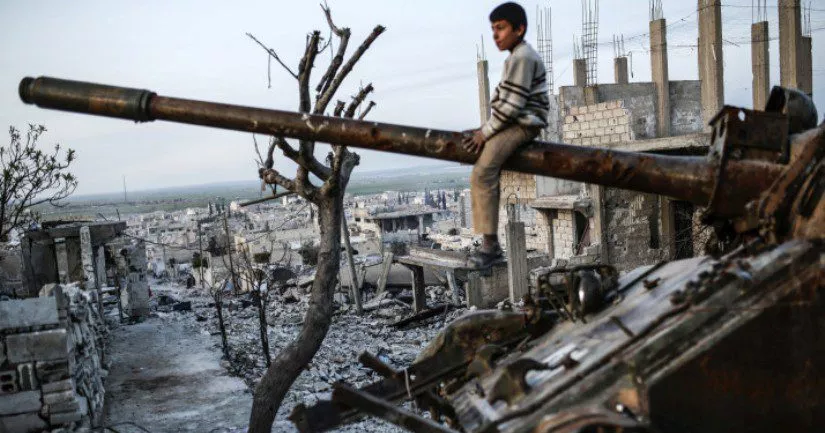
The International Institute for Middle Eastern and Balkan Studies (IFIMES) from Ljubljana, Slovenia, regularly analyzes events in the Middle East and the Balkans. IFIMES has prepared an analysis of current events in Syria following the declaration of a ceasefire. The news agency Patria is transmitting the most important and interesting parts from the extensive analysis titled "Syria: Between a Ceasefire and the US-Russian Plan B".
With the agreement between US President Barack Obama and Vladimir Putin on Saturday, February 27, 2016, the first serious ceasefire in Syria came into effect, which does not apply to ISIL and the Al-Nusra Front, which control more than half of Syria. The agreement also excludes other terrorist groups, which comprise 25 different organizations. At the same time, Syrian President Bashar Al Assad called for regular parliamentary elections on April 13, 2016.
According to that agreement, the Western international coalition against ISIL, as well as Syrian and Russian aircraft, will continue their operations against terrorist organizations without hindrance. The Western coalition will continue to destroy ISIL targets and infrastructure in eastern Syria (Raqqa, Deir ez-Zor, Aleppo countryside, Palmyra, etc.), while Russian and Syrian aircraft can continue their operations in the west of the country without hindrance. Kurdish units control northern Syria (Qamishli, Kobani, Afrin) and are trying to capture the city of Azaz to connect the entire Kurdish north of Syria and simultaneously cut off Turkey's transport link to the area under the control of the Syrian opposition, ISIL, and Al-Nusra.
Ceasefire Does Not Cover All Actors
According to data from December 2015, 149 organizations are active in Syria in the Syrian civil war. Efforts to achieve a ceasefire in Syria began in accordance with the agreement reached based on UN Security Council Resolution 2254 of December 18, 2015, which was achieved by representatives of the Friends of Syria group, comprising 11 countries, including Russia and the US, and six international organizations.
The biggest difficulty and challenge for a lasting ceasefire are the undefined lines of demarcation between the warring parties and their connection to regional powers such as Turkey, Saudi Arabia, Iran, etc. After the end of the two-week trial ceasefire, the warring parties will begin negotiations to achieve lasting peace.
Regional powers, such as Saudi Arabia, are not satisfied with the situation on the ground. Saudi Arabia, which generously supports and finances the opposition, will not allow Assad, who is an exponent of Iran and Russia, to remain in power under any circumstances. Turkey openly assists some opposition Islamist organizations and at the same time opposes the Kurdish party PYD, which effectively controls northern Syria, from becoming part of the negotiation process in Geneva. Turkey otherwise supports rival Kurdish organizations that have no weight on the ground, such as the Kurdish Islamic Front and the Kurdish National Council, which are part of the moderate Saudi opposition. These two parties are represented in the Geneva negotiation process.
Iran on Two Fronts
Iran, which is on two fronts in Yemen and Syria, supporting Saudi adversaries (the Houthi movement in Yemen and Bashar Al Assad's regime), will not allow solutions that involve Assad's withdrawal.
The fact is that the ceasefire is not a result of an agreement between the regime and its opponents, but rather a result of an agreement between the US and Russia. Therefore, the ceasefire has been imposed on the warring parties. This is simultaneously a test of good intentions between the government and the opposition.
Russia has pledged to be strict with the government in Damascus and the Shiite militias fighting on the regime's side. While the US has left the opposition to decide on the ceasefire itself. Diplomatically speaking, this means that the opposition has the last opportunity to achieve peace and that the US has other options on the table. The Americans are talking about Plan B in case the imposed ceasefire fails. This is a weak message to the opposition, as it gives them hope for American or Turkish-Saudi military intervention to achieve what they could not achieve in five years of fighting.
While the weapons have quieted down somewhat, several details about the American and Russian Plan B have emerged in public.
US-Russian Plan B
US Secretary of State John Kerry and the Saudi government are talking about some kind of second Plan B, which was also confirmed by General James G. Stavridis, former NATO commander in Europe. In case of a ceasefire violation, the US will intervene in Syria with ground forces, with the help of Saudi units from the north and Jordanian units from the south, and by establishing security zones with a no-fly zone over these areas. US President Obama already spoke with Jordanian King Abdullah II in Washington last week. The Americans discussed with the Jordanians ways to prevent the spread of ISIL's influence to southern and southwestern Syria from its strongholds in Palmyra.
Plan B is likely a good basis for stopping the wave of refugees from Syria. According to some data, more than seven million displaced persons are waiting for an opportunity to leave the country.
The Russian Plan B, as presented by the Deputy Minister of Foreign Affairs of the Russian Federation, Sergey Ryabkov, speaks of the federalization of Syria, i.e., three federal units: an Alawite entity in the west with Damascus and Kurds, Turkmen, Christians, Arabs, and others; a Sunni entity in the east of the country, which is now under ISIL control; and a Kurdish-Christian minority entity.
The Russian Plan B could be interesting for peace talks in Geneva as a starting point for organizing the future Syrian state.
The opposition also has its model of federation and would choose a model that would be a combination of Russian, Swiss, German, Emirati, or American federal models.
Regardless of the shortcomings and ambiguities of the ceasefire agreement, it represents a lifeline for the opposition, which was on the verge of complete defeat. With the possible loss of half of Aleppo, which it still controls, and the road corridor to Turkey (65 km), the opposition would lose its logistical rear in Turkey and would lose its entire territory in the central part of the country. In such a position, it would not be a respectable partner for the Geneva negotiating table at all. The regime, which has lost more than 80,000 soldiers in the five-year war, needs a respite to consolidate its ranks. From a military perspective, both sides are exhausted and need a break for the next round, which will likely be military again, not political.
Peace will be achieved when regional powers Iran, Saudi Arabia, and Turkey resolve their disputes outside the borders of Syria and when the opposing sides realize that they are defeated and cannot win.
Bombing in Function of Sanctions Removal and Crimea Recognition
The International Institute IFIMES believes that a solution needs to be sought in the Riyadh-Tehran-Ankara triangle with the cooperation of formations and factions on the ground and with the support of superpowers. Stopping Russian bombing is necessary because it is causing a new wave of refugees towards Western Europe. The question is justifiably raised whether Russia's military intervention in Syria is intended to pressure the EU into lifting sanctions under the pressure of a new wave of refugees and possibly forcing the recognition of the illegal occupation of Crimea.
Komentari (0)
Prijavite se za komentiranje
PrijavaJos nema komentara. Budite prvi!
Minuta
Sve →Iz drugih kategorija

High Representative Not Elected: Germans, French and British Sabotaged Americans, New Attempt at End of June

ČOVIĆ WITHOUT MERCY: How Those Who Brought Ademović to Office Created a Political Hell for Him



Sunny Saturday, quite warm



Tragedy in Albanian resort: Two minors drown












