
Written by: Armin Sijamić
In just a few days, in at least three places, the important news was about threats from the air, specifically, in this case, missiles and drones. Ukraine has requested long-range missiles from its Western allies, Dmitry Medvedev threatened with nuclear weapons, Austrian Defence Minister Klaudia Tanner announced that her country is preparing for a missile attack, and Iran said it repelled a drone attack on a weapons factory.
Events from the Ukrainian war constantly remind the rest of Europe that destruction could spread beyond that country's borders, whether as a result of a mistake or as a consequence of the intention to defend one's own territory. A series of incidents reminds us of this. In March, an unmanned aerial vehicle fell on Zagreb; in November, a civilian was killed in Poland by the remnants of a missile that was most likely intended for interception; an oil pipeline in Ukraine supplying Hungary was damaged; and Moldova was left without electricity due to a Russian strike on Ukrainian power infrastructure. Recently, Moldova announced it had found missile remnants on its territory after a violent Russian attack on Ukraine.
Recently, former US President Donald Trump stated that arming Ukraine with modern weapons leads to nuclear war. This was also said by former Russian Prime Minister and President Medvedev, who says Russia will defend Crimea with nuclear weapons. Medvedev's statements come after the West decided to send Ukraine over 300 tanks and thousands of armoured vehicles, and Kyiv requested aircraft and long-range missiles. This suggests an offensive is being prepared, i.e., an attack on fortified Russian lines using armoured vehicles. Whether Ukraine will move towards Crimea or elsewhere is unknown. However, it is becoming clear that things can go wrong, regardless of the measures taken. Austria, a neutral state and member of the European Union, takes these threats seriously and is taking steps to prepare the country for a missile attack!
Missiles near Austria
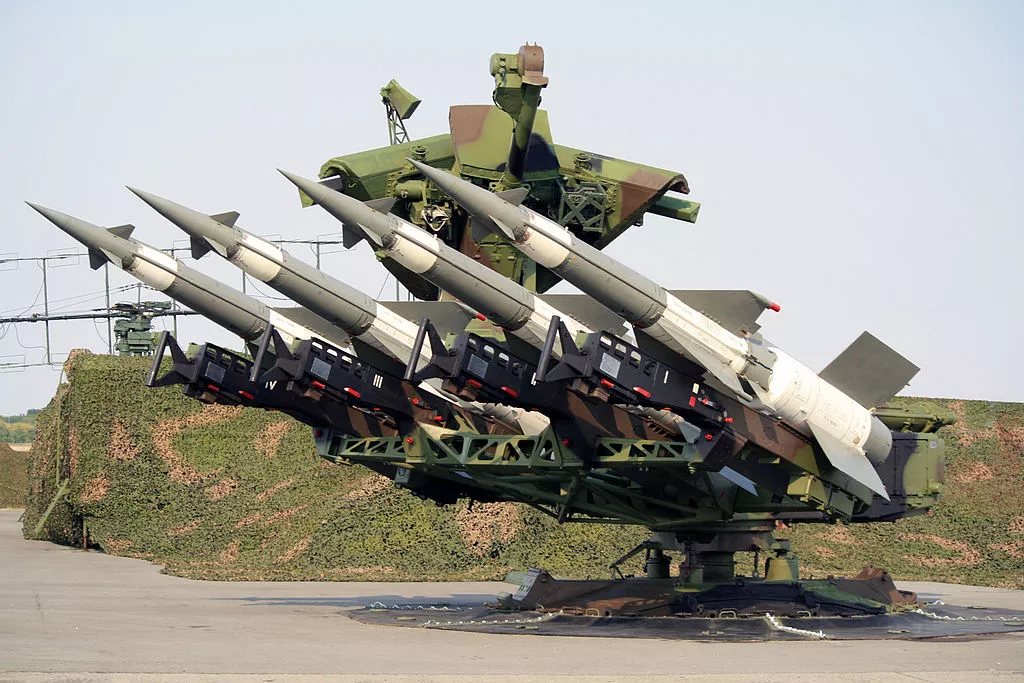
On Saturday, Austrian media reported parts of a report from the country's Ministry of Defence stating that, due to increasingly complex circumstances, Vienna is preparing for missile attacks. From whom exactly is not specified, but the mentioned report is cited, stating that there is a large number of missiles and cruise missiles of various calibres "near Austria and Europe." It further states that "it is not only about conventional war, but about interaction with unconventional hybrid warfare." Tanner believes that Europe will respond to the threats and that a joint anti-missile shield will be quickly established, of which Austria will be a part, even though it is not a NATO member. In a statement reported by Salzburger Nachrichten, the minister emphasises that despite her country's neutrality, Austria's contribution to peace in Europe and the world is great and that they therefore deserve to be part of the solution.
Tanner expressed hope that Austria will benefit from the "Sky Shield," an initiative launched by Germany that includes fourteen other countries. Germany wants a joint air defence across the continent. The plan envisages that Germany, together with the United Kingdom, Belgium, the Netherlands, Norway, Finland, Estonia, Lithuania, Latvia, the Czech Republic, Slovakia, Slovenia, Hungary, Romania, and Bulgaria, will form capacities to counter threats from the air. The media reported that this shield would be intended for threats from Russia and possibly Iran.
There was also talk about a possible supplier of this system, and it was concluded that the American "Patriot" is not sufficient, but that similar systems should also be purchased from Israel. The plan angered France and Italy, which believe they have the knowledge to develop European systems and that there is no need for foreign ones. Mentioning Iran in this case is not new. Washington has accused Iran of wanting to target European soil with its missiles, i.e., US forces. Iran still does not have missiles capable of hitting, for example, Brussels. It was clear that the main target was Russia, i.e., Russian strategic missiles, and for that purpose, a base was built in Deveselu, Romania, and another in Redzikowo (Poland), where US troops are stationed and missile interception systems are deployed. Therefore, there is no doubt that the Sky Shield is aimed at Russia and unconventional threats, and the statements of Minister Tanner confirm that there is a major security problem.
What is the minister aiming at?
Before the start of the war in Ukraine, Russia was considered a superpower in air defence, and Moscow proudly stated that it could shoot down everything - from small drones to missiles coming from space. Ukraine has since received modern systems from the West. However, it is not enough. Skilled Ukrainian soldiers at the beginning of the war "pierced" Moscow's air defence with commercial drones. Media from Ukraine report that Chinese drones, specifically quadcopters from the company DJI, cause enormous damage. Thus, aircraft costing a few hundred euros became an unsolvable enigma for the Russians, and later for the Ukrainians as Russia began doing the same, adding larger Iranian drones to its arsenal. Ukrainians attach explosives to the cheap aircraft and send them into trenches or to gathering places of the opposing army.
In addition, drones are used to correct artillery fire, so in one video, a Ukrainian soldier says that every third of their shells hits the target. For now, there is mostly no defence, because drones are very small and difficult to detect by radar, unlike expensive military ones. And if they are detected, the question remains whether to spend projectiles costing hundreds of thousands of euros on them. Russia has resorted to the tactic of attacking Ukraine in waves, first with cheap drones, then with Iranian-made ones, and finally sending missiles, putting the attacked side in a position where it must choose which targets to try to shoot down. The effects of such attacks are horrific, and Ukraine has stated that it cannot defend itself from such attacks, especially Iranian drones.
In this case as well, mentioning Iran means that Tehran is less, and Moscow more, the reason for the next steps, just as in the above-mentioned case. The experience from Ukraine worries armies around the world. Thanks to the quadcopter and the modification made to it to carry an explosive payload, it has become possible to destroy a country with very few resources in a way as if a war were being waged against it. It is enough for an individual or a group to use these means to attack factories, energy infrastructure, or warehouses and thus cause enormous damage.
We witnessed this in the war in Syria, where drones were used by all sides. ISIL published video materials showing drones dropping a rifle grenade or hand grenade above a certain location. The Ukrainian war has shown Europe that a commercial quadcopter can be a huge threat, even to the armies of Moscow and Kyiv. News from Iran suggests that the attack on the weapons factory there was carried out using three smaller drones.
The war in Ukraine has thus shed light on a series of technological discoveries that are accelerating changes on the military, political, and social levels. It has been shown that the use of widely available technology can lead to enormous successes on the battlefield. A few weeks ago, a Russian soldier posted his photo on the internet, and then was showered with Ukrainian rockets. Moscow admitted the oversight, and Ukraine claimed to have killed hundreds of Russian soldiers. Namely, Kyiv, using tools available to everyone on the internet, determined exactly where the soldier in the photo was located and opened fire. There should be no doubt that in the future, the use of widely available technology will create new challenges even for the strongest armies.
Komentari (0)
Prijavite se za komentiranje
PrijavaJos nema komentara. Budite prvi!
Minuta
Sve →Iz drugih kategorija

High Representative Not Elected: Germans, French and British Against Americans, New Attempt at End of June

ČOVIĆ WITHOUT MERCY: How Those Who Brought Ademović to Office Created a Political Hell for Him



Sunny Saturday, quite warm



Tragedy in Albanian resort: Two minors drown












