
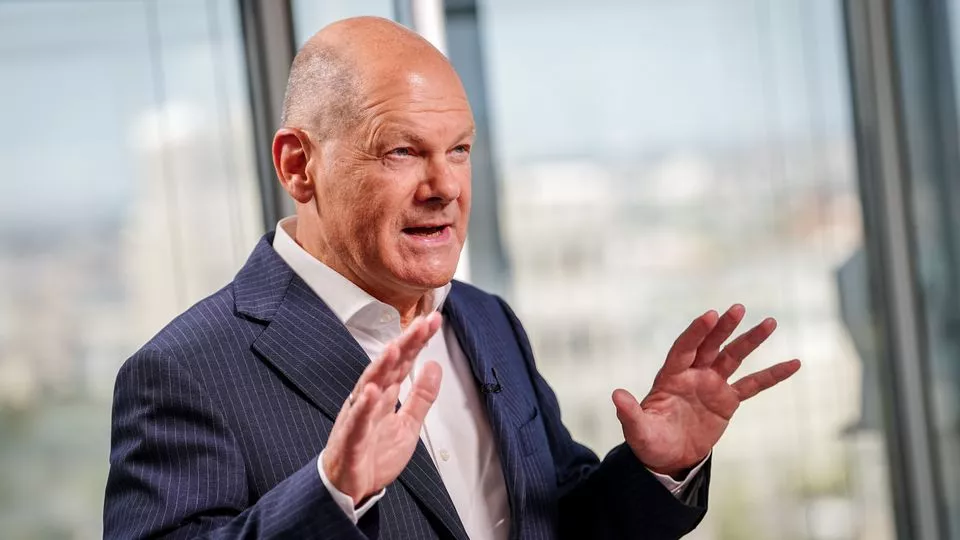
(Patria) - Olaf Scholz's Social Democrats won Sunday's election in the eastern German state of Brandenburg, narrowly beating the rising far-right party. The vote was held three weeks after the far-right made gains in two other eastern German states.
According to final results released by the state election administration on Sunday evening, the Social Democrats won 30.9% of the vote in the election for the parliament of Brandenburg, a state that surrounds Berlin. The far-right Alternative for Germany (AfD) came in second with 29.2%. The new left-wing movement, Sahra Wagenknecht Alliance (BSW), came in third with 13.5%, while the center-right Christian Democrats won 12.1%, AP reported.
The first-place finish for the Social Democrats brought relief to Scholz, whose three-party ruling coalition has performed poorly in elections so far this year. The Social Democrats have continuously governed Brandenburg since the reunification of Germany in 1990, and a loss would have been a major blow to Scholz, who has his constituency in the state's capital, Potsdam.
Scholz has said he would like to be the party's candidate for chancellor in next autumn's federal election, and Sunday's vote was watched for what it might signal about his political future.
"It's great that we won," Chancellor Scholz said from New York, where he was attending a United Nations meeting, the German news agency dpa reported. But the Social Democrats' success in Brandenburg, after defeats elsewhere, was largely not attributed to Scholz but to the efforts of the popular state governor, Dietmar Woidke. He distanced himself from Scholz during the campaign and promised to resign if the far-right won. He could celebrate his political survival on Sunday evening.
"This is an important victory for me, it's an important victory for my party, and it's an important victory for the state of Brandenburg," Woidke said after the polls closed.
He also said he believes the strong showing of the far-right party means there is work to be done. "They (AFD) achieved around 30 percent, many voters voted for the AFD, and that is too much. Therefore, we must think about these results and we must improve our policies," Woidke said.
The far-right party has gained support amid growing resistance to mass migration over the past decade and recent extremist attacks. Germany's economy, once a powerhouse, is weakening, contributing to a general sense of malaise.
Sunday's vote followed a heated election campaign focused on issues of migration, internal security, and peace. Both the far-right and the new left-wing movement want to stop arms deliveries to Kyiv as Ukraine tries to defend itself against Russia's full-scale invasion.
Alternative for Germany won the most votes in the federal state of Thuringia, and also performed well in Saxony in the elections held on September 1. The new left-wing party (BSW) also had a strong impact, while the parties in Scholz's unpopular national government achieved extremely poor results, as they did again on Sunday in Brandenburg.
The vote in Thuringia marked the first electoral victory for a far-right party in Germany since World War II. It has raised concerns in Germany and abroad about growing support for the far-right in a NATO member and the European Union's most powerful country.
Towards the end of voting on Sunday afternoon, a group of anti-AfD demonstrators gathered near a restaurant where supporters of the far-right party had gathered to learn the election results.
Their chanting and whistling sought to disrupt the celebration. One carried a banner that read, "AfD is so 1933," referring to the year Adolf Hitler and the Nazis came to power.
Komentari (0)
Prijavite se za komentiranje
PrijavaJos nema komentara. Budite prvi!
Minuta
Sve →Iz drugih kategorija

High Representative Not Elected: Germans, French and British Against Americans, New Attempt at End of June

ČOVIĆ WITHOUT MERCY: How Those Who Brought Ademović to Office Created a Political Hell for Him



Sunny Saturday, quite warm



Tragedy in Albanian resort: Two minors drown












