
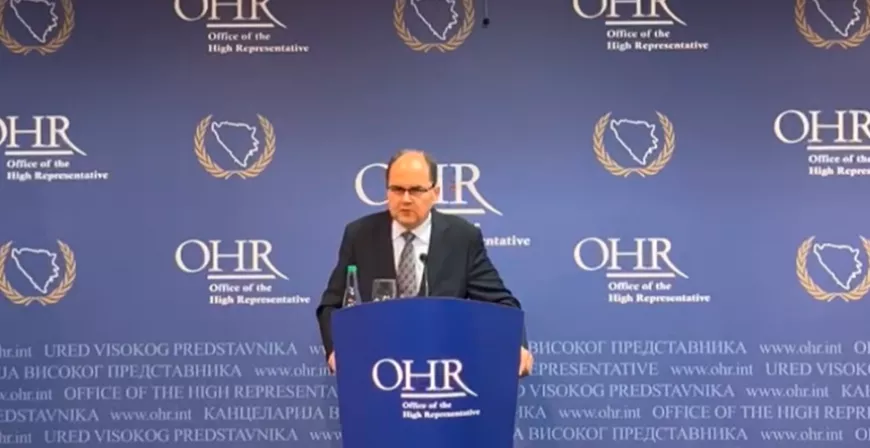
“God forbid.”
This is the only sentence worth quoting from all the sentences uttered by High Representative Christian Schmidt during a one-hour press conference. To six decent journalistic questions, Schmidt always gave the same answer. Incoherent. And that is why we have no choice but to have the journalists themselves answer the journalists' questions instead of Schmidt.
“If the goal,” asked Klix portal journalist Semir Hambo, “was to resolve the issue of Goražde where Bosniaks elect Croatian representatives, why did you not raise the threshold for nominating the President and Vice Presidents of the FBiH from six delegates to seven, but instead raised it to eleven, a threshold that now and for who knows how many years into the future only the HDZ can reach? Do you not think that in this way you have pushed a large number of parties to the right and catered to ethnonationalist parties?”
Here is Schmidt's response.
“The possibility to propose a president, and not with eleven or twelve votes. What, please, will happen? Can you explain to me what has been happening so far?”
Here is what has been happening and what will happen. Eleven years ago, political parties not close to the HDZ BiH managed to elect six Croatian delegates to the House of Peoples of the FBiH. The President of the Federation was Živko Budimir, and the HDZ was in opposition. After the results of these elections are confirmed, the Croatian Club of the FBiH House of Peoples will have at least six delegates not under HDZ control. But after Schmidt raised the quota for nomination to 11 delegates, the possibility of ousting the HDZ from the FBiH Government no longer exists. Because according to calculations, the six new Croatian delegates introduced by Schmidt will come from West Herzegovina (1), Herzegovina-Neretva (2), Canton 10 (1), Central Bosnia (1), and Zenica-Doboj (1). Thus, out of the six “new” delegates, five go to cantons with an HDZ majority. So Dragan Čović's party will have a secure sixteen delegates in the FBiH House of Peoples, and consequently four delegates in the House of Peoples of the BiH Parliamentary Assembly.
“By the 2015 ruling,” Istraga.ba asked the High Representative, “the BiH Constitutional Court, on Željko Komšić's appeal, found that the European Convention on Human Rights had been violated. Why did you not give others the right to be candidates for President and Vice Presidents of the FBiH?”
Schmidt's response was: “First, with your political assessment of the Komšić ruling, you are right. I completely agree with you that this should also go to the state level. But look at page 30 of that ruling, it says that this must be resolved at the state level and that it must not, so to speak, build the state as it should be at the Federation level.”
First, the High Representative did not accurately quote the BiH Constitutional Court's ruling on Željko Komšić's appeal. The BiH Constitutional Court nowhere said that “one must not, at the level of the Federation of BiH, build the state as it should be.” The Constitutional Court only concluded that “it is currently impossible to predict the scope of these amendments,” and therefore did not order the deletion of the disputed provisions of the FBiH Constitution. Schmidt, therefore, arbitrarily interpreted the BiH Constitutional Court's ruling, claiming that it “so to speak prohibits building” a civic state “as it should be” at the Federation level.
“And how do you comment,” asked N1 television reporter Adisa Imamović, “on the statement of Mr. Andrej Plenković, who said that he negotiated with you for months about changes to the election law? Has the sovereignty of BiH been compromised by this?”
Schmidt had no comment. Which means he cannot say that the Croatian Prime Minister is not telling the truth. Because he is. Plenković, we recall, said that for months he “discreetly worked with the High Representative on changes to the election law in BiH.”
“I will not comment on that statement,” Schmidt said.
“Mr. Schmidt,” continued the Patria Agency journalist, “why did you decide to apply the 2013 census for the Federation Parliament, and the 1991 census for the FBiH Government?”
The High Representative will answer that he is now “focused on the FBiH House of Peoples.”
And do you know what the real answer is? If the 2013 census were applied to the Government of the Federation of BiH, Croats would lose at least one ministerial position. Which, of course, is not Schmidt's task. That is why the 1991 census was applied to the FBiH Government, so that the number of Croatian ministers would not decrease. At the same time, the 2013 census will be applied for the House of Peoples. The reason is simple – the HDZ BiH benefits the most from this census. So, when forming the executive branch, the 1991 census is applied because it suits the HDZ, and for the legislative branch, the 2013 census is used because that also suits the HDZ.
“Why, Mr. Schmidt,” asked Istraga.ba, “does the Sarajevo Canton give five delegates from the Serbian people and one Croatian, if in the Canton, according to the 2013 census, more Croats live than Serbs? Are Sarajevo Croats worth less than Sarajevo Serbs?”
“God forbid,” said Schmidt.
Komentari (0)
Prijavite se za komentiranje
PrijavaJos nema komentara. Budite prvi!
Minuta
Sve →Iz drugih kategorija

High Representative Not Elected: Germans, French and British Sabotaged Americans, New Attempt at End of June

ČOVIĆ WITHOUT MERCY: How Those Who Brought Ademović to Office Created a Political Hell for Him



Sunny Saturday, quite warm



Tragedy in Albanian resort: Two minors drown












