
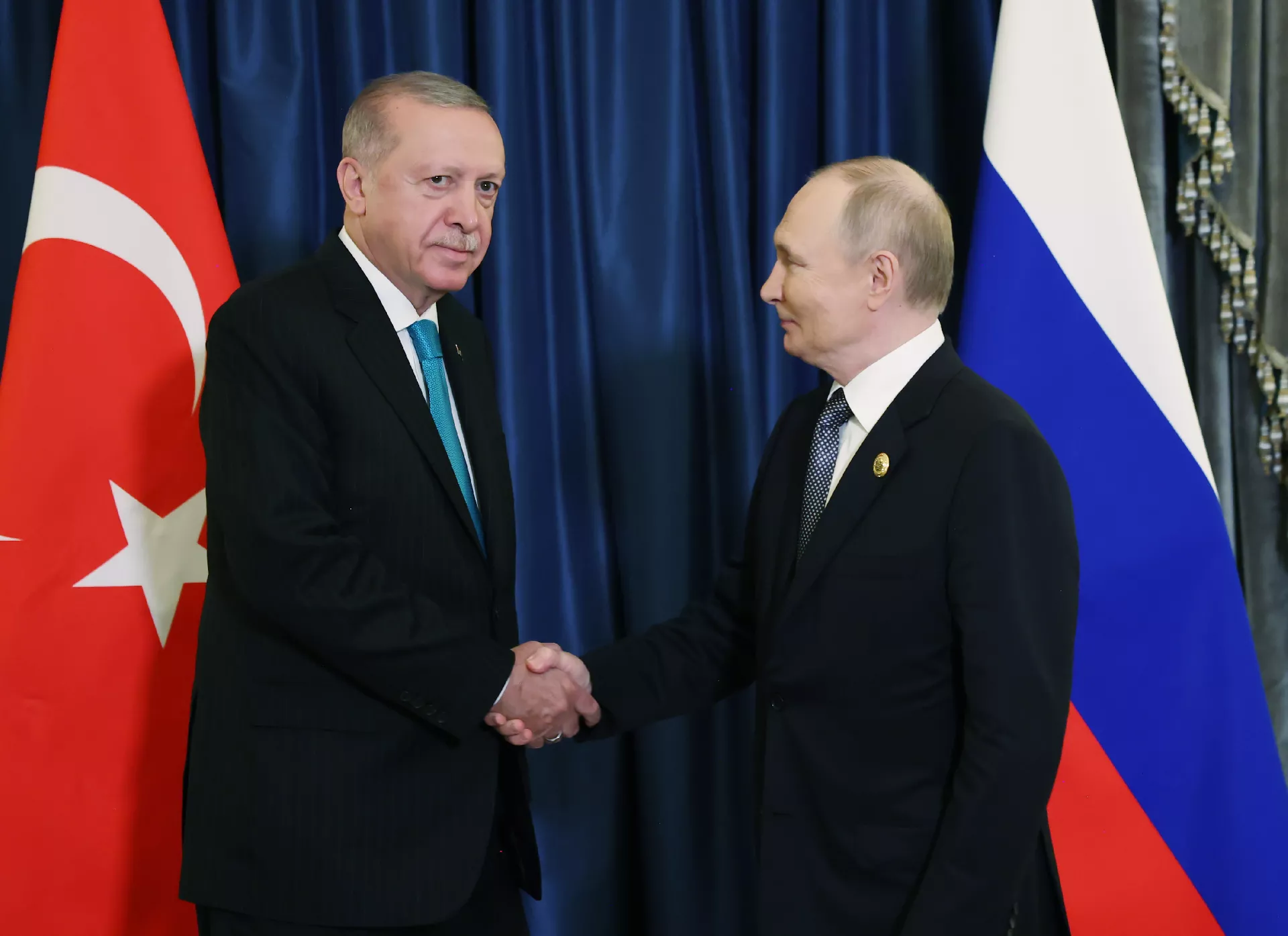
(Patria) - Turkish President Recep Tayyip Erdogan met with his Russian counterpart Vladimir Putin on Monday on the sidelines of the 25th Shanghai Cooperation Organization (SCO) summit.
Erdogan met with Putin at a hotel in Tianjin, which is hosting the 25th summit of the SCO Council of Heads of State.
Erdogan was accompanied by Turkish Minister of Foreign Affairs Hakan Fidan, Minister of Energy and Natural Resources Alparslan Bayraktar, Minister of Treasury and Finance Mehmet Simsek, Minister of National Defense Yasar Guler, Minister of Industry and Technology Mehmet Fatih Kacir, Minister of Trade Omer Bolat, Head of the National Intelligence Organization Ibrahim Kalin, Head of the Turkish Directorate of Communications Burhanettin Duran, and Chief Presidential Advisor Cagri Erhan.
During the meeting with Putin, Turkish President Erdogan discussed bilateral relations between Turkey and Russia, as well as regional and global issues.
Turkey continues its efforts for a just and lasting peace in Ukraine, and the negotiations in Istanbul contributed to this process, said Turkish President Erdogan.
Turkish President Erdogan and Putin also exchanged views on Israeli attacks on Gaza and the development of Syria while preserving its political unity.
Putin thanked Turkey for its mediation efforts to end the conflict in Ukraine and expressed his confidence that Ankara will continue to play a special role in finding a solution.
Putin said that three rounds of direct negotiations between Russia and Ukraine have been held in Istanbul since May. According to him, these negotiations have allowed the parties to make progress on several humanitarian issues.
He emphasized that Ankara's participation was crucial in creating space for dialogue, describing Turkey's contribution as significant and sought-after.
The Russian leader also said that he and Erdogan discussed several regional issues, including the Middle East, North Africa, and the Caucasus.
He emphasized that cooperation with Turkey in these areas is well-established, concrete, useful, and full of trust.
Putin noted that regular exchanges at the presidential level help maintain what he called a constructive and respectful dialogue, which he said is in line with the principles of good neighborliness.
Economic Relations
Putin also highlighted the continuous growth of trade and investment between the two countries.
He said that bilateral trade increased by 6.6 percent last year and by an additional three percent in the first half of 2025. Russian companies, he noted, are active in the Turkish metallurgical and automotive industries, while Turkish firms maintain a visible presence in Russia in mechanical engineering, wood processing, and metallurgy.
The work of the intergovernmental commission, which last met in Moscow in June, was also cited as a driver of economic cooperation.
Putin described energy cooperation as truly strategic. He said that natural gas supplies through the Blue Stream and TurkStream pipelines remain uninterrupted and emphasized that Russia continues to be one of Turkey's key suppliers.
He further highlighted the Akkuyu Nuclear Power Plant, currently being built by Russia's Rosatom, calling it a flagship project of bilateral relations that underscores the long-term nature of the partnership.
Political Trust
In a symbolic moment before the formal talks, the Kremlin released footage showing members of the Russian and Turkish delegations warmly greeting each other.
Head of Rosatom Alexey Likhachev and Russian Minister of Energy Sergey Tsivilev exchanged handshakes and hugs with their Turkish counterparts, including Minister of Energy Alparslan Bayraktar.
Putin also drew attention to the importance of political trust between Moscow and Ankara, noting that their cooperation extends beyond bilateral issues to regional and international matters.
He said that both sides see value in aligning approaches in regions such as the Middle East and North Africa, where their interests often overlap.
Komentari (0)
Prijavite se za komentiranje
PrijavaJos nema komentara. Budite prvi!
Minuta
Sve →Iz drugih kategorija

High Representative Not Elected: Germans, French and British Sabotaged Americans, New Attempt at End of June

ČOVIĆ WITHOUT MERCY: How Those Who Brought Ademović to Office Created a Political Hell for Him



Sunny Saturday, quite warm



Tragedy in Albanian resort: Two minors drown












