
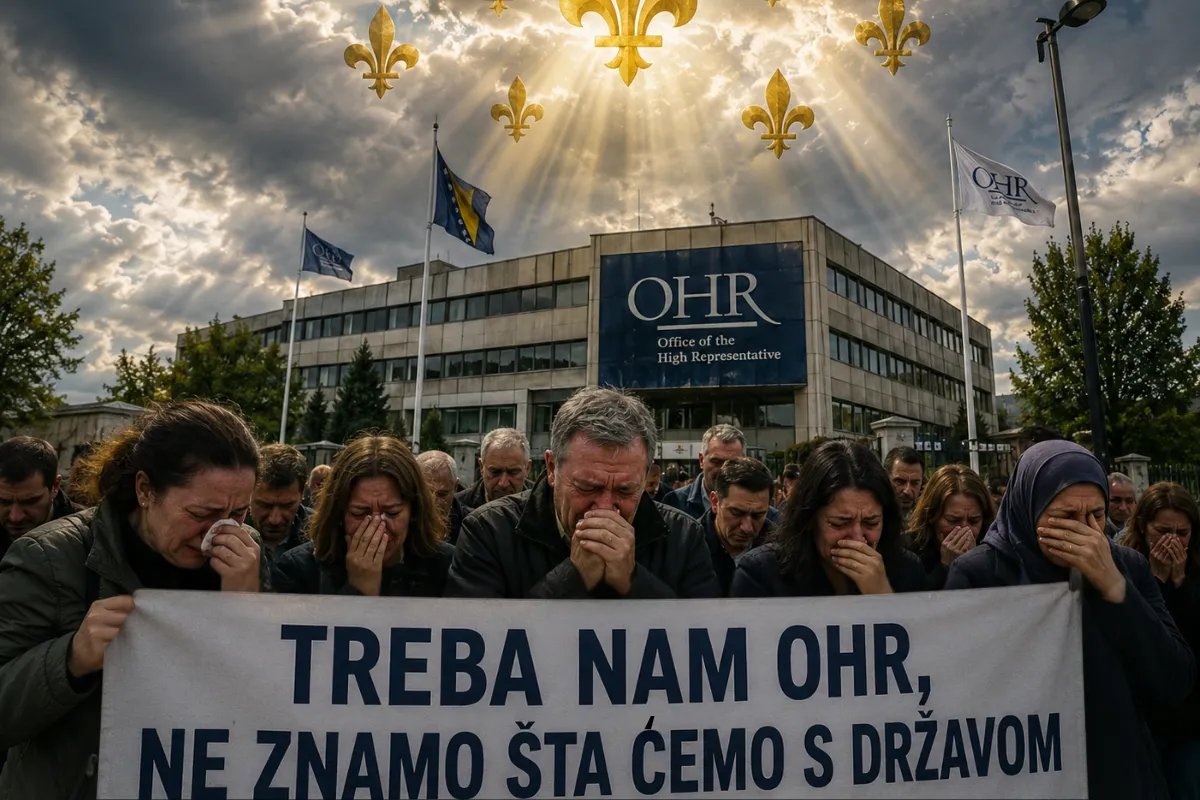
In this country, it seems, everyone has their own version of victory, even when nothing moves a single millimeter. As if Bosnia and Herzegovina has become a big political studio where results are not measured, but the loudness of the interpretation of results is. And the worst fact is that the smaller the result, the greater the interpretation.
In one version of the story, “victory” is that you even managed to be mentioned in a conversation taking place somewhere far from the public eye. In another, “victory” is that you brought a hundred people to a protest and concluded from that that you shook the political centers of power from Washington via London to Brussels, Berlin, Rome. In a third, “victory” is that you declared everyone else losers in advance, because they do not share your interpretation of reality.
And so we come to the key problem of this political claustrophobia: no one loses anymore, because no one has to prove they have won.
In the first register, the one coming from Banja Luka, the story is simple. The OHR is a problem, international interventionism is unacceptable, and “our positions are present in the process,” which in translation means it is enough for someone to mention you somewhere, and you declare it a strategic triumph. There is no longer any need for an outcome, only for presence. As if politics has been reduced to a record of entering a building, without the obligation to ever come out with a concrete result.
In the second register, the Sarajevo one, we have an almost identical matrix, only colored differently and tied to political intellect. A protest of about a hundred people becomes a “historic event” because it supposedly produced an echo in diplomatic circles. And the fact that in the country itself this event barely produced a sound is elegantly relegated to a footnote called “citizen apathy.” So, the people are to blame for not participating in a show where they should be applauding their own political symbolism.
And here opens the most dangerous point of this story: the people become decoration, not actors. When they do not participate, they are the problem. When they participate, they are proof of success. In both cases, they are not a subject but a tool.
But what connects both narratives, and what makes them almost identical in structure despite the political conflict, is a deep fascination with the same altar: the international decision-making center. Both sides, although formally clashing over who has the right to what kind of BiH, in practice share the same belief: that real decisions cannot be made here.
The difference is only in who will better tell the story that they “influenced” those who decide abroad. Because influence is the new currency of powerlessness. If you have no result, you have “influence in negotiations.” If you have no mass, you have “weight of argument.” If you have no change, you have “a process that has been initiated.”
In that logic, everything is a success except real life and the stabilization of an independent state.
And then we come to the third layer, the one that presents itself as the critical consciousness of society, but often falls into the same trap it tries to denounce. The diagnosis of apathy, alienation, “killed social spirit,” all of that sounds like serious analysis. And it is, until the moment it becomes an explanation for why symbolic acts replace reality and the need for stronger action.
Because if the people are apathetic, then it is logical that a small number of people becomes enough to declare a great political effect. If institutions are inefficient, then it is logical that politics moves to the media and press releases. If society is tired, then it is logical that interpretation becomes more important than numbers.
And so the circle closes: the real weakness of society becomes justification for a political hyperproduction of meaning.
In that circle, it is no longer important how many people stand behind you, but how far you can “carry the message.” It is not important whether something has changed, but whether someone somewhere has “registered” it. It is not important whether institutions function, but whether they are talked about.
That is a political economy without results, but with infinite inflation of interpretations.
The most absurd thing is that both sides, both those defending the status quo and those attacking it on someone else's account, essentially behave as if Bosnia and Herzegovina is an empty territory waiting to be validated from outside. Some call it “realism and protection of interests,” others “the fight for a European perspective,” but at the core, both narratives imply that internal social energy is insufficient.
That is why it is not surprising that political success is measured by whether you have entered a space where others decide. Because if the domestic space is exhausted, then the external space is the only stage on which influence can be played out.
But here arises the key illusion: entering someone else's room does not mean you have rearranged the furniture.
In all of this, perhaps the most honest thing is to say that it is not just about a “suicidal delusion of the intellect,” but a much more banal phenomenon: a political system in which it is easier to produce an interpretation than a result. Because a result requires strength, organization, numbers, and institutions. Interpretation requires only language.
And language, in this country, has long become a substitute for action.
That is why today we have a paradox in which both protests and political and diplomatic statements move in the same direction: everyone claims to have “achieved” something, but no one has to explain what exactly has changed.
And while that void is filled with words, the country remains the same, only increasingly tired and chronically crippled by people who constantly declare it either saved or lost, depending on who is speaking at the moment.
And while it is clear why politics from Banja Luka is pushing water to the mill of secessionist aspirations, the political and intellectual fear of the independence and state-building of the state they defend by forcing a protectorate is also inexplicable.
Komentari (0)
Prijavite se za komentiranje
PrijavaJos nema komentara. Budite prvi!
Minuta
Sve →Iz drugih kategorija

High Representative Not Elected: Germans, French and British Sabotaged Americans, New Attempt at End of June

ČOVIĆ WITHOUT MERCY: How Those Who Brought Ademović to Office Created a Political Hell for Him



Sunny Saturday, quite warm



Tragedy in Albanian resort: Two minors drown












