
By Armin Sijamić
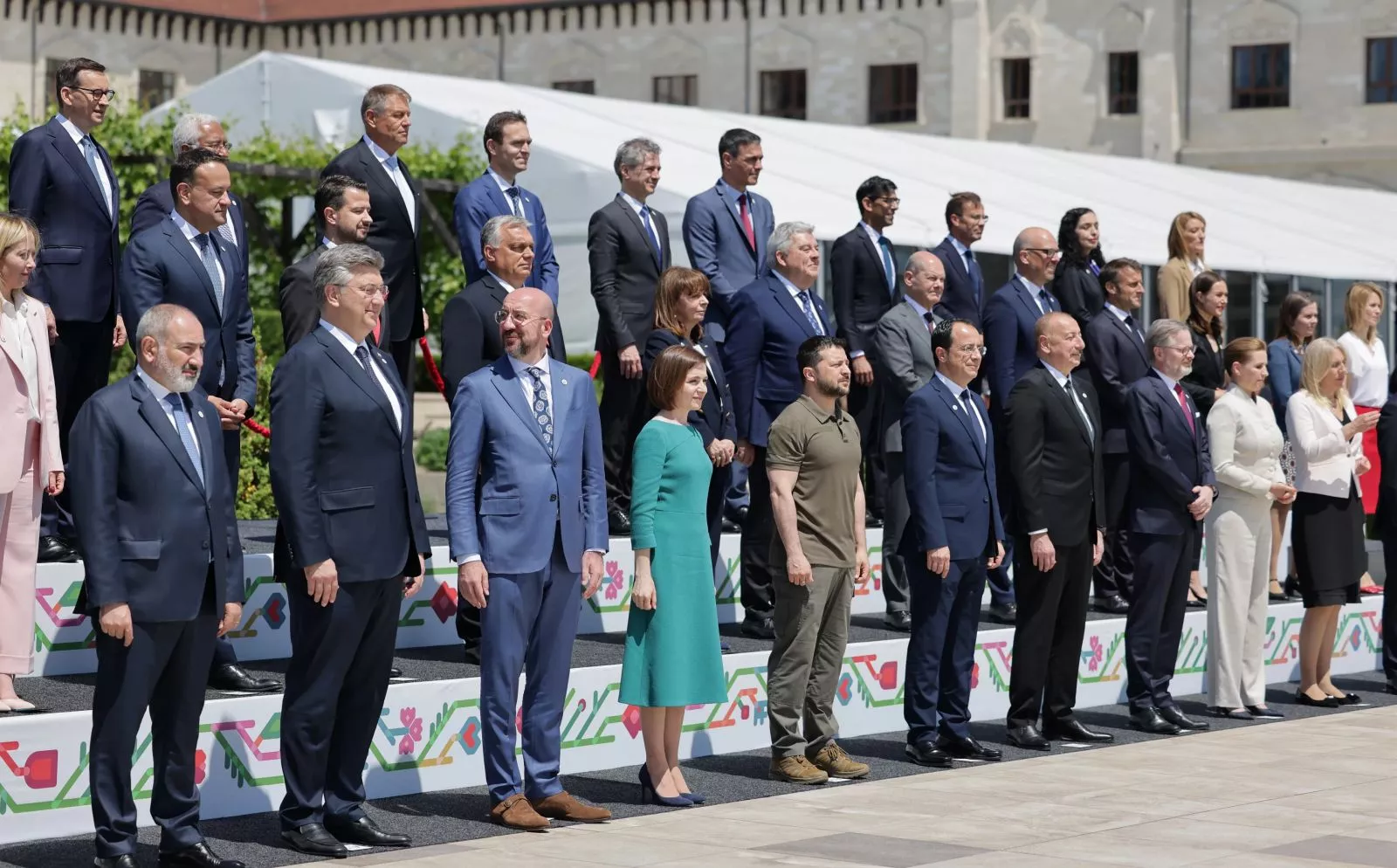
Moldova yesterday hosted presidents and prime ministers from 45 (out of 47 planned) European countries at the second summit of the European Political Community (EPC), which brings together all European countries except Russia and Belarus. The spectacular gathering concluded without a resolution, but with strong messages from Emmanuel Macron, which were, as expected, overshadowed by the crises in Ukraine, Moldova, and the Caucasus, and unexpectedly, by the one in Kosovo.
Moldova had the honour yesterday of hosting the presidents or prime ministers of almost all European countries and European Union institutions, and for one day at least, becoming a place for important discussions. Mimi Castle, about 35 kilometres from the capital Chisinau and about twenty kilometres from the Ukrainian border, was the venue for the second EPC summit, an informal forum conceived by French President Emmanuel Macron to bring together EU member states and non-member states. The first summit was held in October last year in the Czech Republic, and the next two will be hosted by Spain and the United Kingdom.
Bosnia and Herzegovina was represented in Moldova by the Chairperson of the Presidency of Bosnia and Herzegovina, Željka Cvijanović, who held a series of meetings with officials from other countries on the sidelines of the summit. In addition to her, all countries from our region sent prime ministers or presidents, including Kosovo, whose president Vjosa Osmani fiercely criticized the behaviour of Serbia, represented by President Aleksandar Vučić.
The presence of such a large number of countries at the summit is precisely what Macron wanted when he launched the EPC, believing that all European countries should cooperate and engage in dialogue on important issues, and that EU membership (or lack thereof) should not be an obstacle. The forum is conceived as a place for "strategic dialogue" where discussions take place and no joint decisions are made.
Of course, Paris's goal is more far-reaching. The summit fits into Macron's idea of Europe as an independent player on the world stage, primarily deciding on processes on its own continent. Essentially, it strengthens the position of Paris, or rather Berlin and Brussels, and reduces the influence of Washington, Beijing, and above all Moscow, which is carrying out aggression against Ukraine. It should be recalled that Macron's idea for the EPC is, in fact, a reworked idea of former French President François Mitterrand, who wanted to include Russia in European processes, which met with resistance from a number of countries.
Macron's Eastern European Policy
France's policy towards Eastern Europe, perhaps except for Romania, has not been warmly received by those it concerns in recent decades. France blames the United States for having a decisive influence on Eastern Europe. On the other hand, Eastern Europe blames France for its closeness to Moscow, even at times when Ukraine's survival hung in the balance. Macron then argued that Russia should not be "humiliated," but that its demands should be considered and it should be given the guarantees it seeks. That statement caused shock throughout Eastern Europe, which still vividly remembers the Russian boot.
In preparation for his arrival in Moldova, Macron visited Slovakia for a security forum. From Bratislava, he told Eastern Europe that they should have been listened to better in the West of the continent when they spoke about Russia, and that there should be no division between "old Europe" and "new Europe," promising that this would change in the future.
The attempt at a stronger French presence in Eastern Europe is a response to increased American presence, which has become a military issue since the aggression against Ukraine. By positioning itself in the east of the continent, the US prevents Russia from expanding its influence westward and also prevents "old Europe" from getting closer to Russia and shifting its influence eastward. Macron is now trying to keep close a number of countries that are outside the EU and are waiting for membership, which, according to the French president, will not happen until the necessary reforms are carried out within the Union. This was probably the main reason why Macron launched the EPC.
Ukraine and Security as Main Topics
The main topic of yesterday's summit was security in Europe in the context of the war in Ukraine. Ukrainian President Volodymyr Zelensky was once again in the spotlight. Unplanned, others also gained attention. The conflicts in Kosovo and the relations between Armenia and Azerbaijan, whose leaders, Nikol Pashinyan and Ilham Aliyev, met in Moldova, were also discussed at the summit. A special topic was also Moldova, which gained candidate status for EU membership, and on whose territory, in Transnistria, Russian soldiers are stationed, an hour's drive from Mimi Castle. Moldovan President Maia Sandu condemned Russia's aggression against Ukraine and Moscow's behaviour in her country at the meeting.
Some participants in the meeting assessed that Russia is a threat to European security, especially to its neighbours, and expressed their readiness to help Ukraine, as well as Moldova. Essentially, the positions of the Council of Europe from two weeks prior were reiterated, although the formal main topics of the summit in Moldova were security, energy, and connectivity. All participants of the EPC summit, except Kosovo, are members of the Council of Europe. Thus, it seems, the summit served France the most, whose president did not spare words in describing the importance of the meeting.
Zelensky once again called for his country to be admitted to NATO as soon as possible, thanked for the assistance so far, and reiterated that Ukraine needs significant help to stop Russia. He was preparing the ground for the NATO summit to be held in Lithuania next month. Essentially, the summit returned to its basic ideas - how to protect oneself from Russia. The EPC did not provide an answer to this question, especially how it would be possible to achieve this without the US.
Macron's "European Army"
Knowing that this summit, at least, would revolve around the question of "how many divisions" each country has, Macron announced from Bratislava that the EU must start arming itself, i.e., initiate its own arms production. He acknowledged the US contribution to defending Ukraine from Russian aggression, but once again called for Europe to turn to itself and rely on its own capabilities, which is a continuation of his idea of a "European army" that would exist parallel to NATO.
Macron also commented on the course of Russian aggression against Ukraine, claiming that Moscow has suffered a failure, as evidenced by Finland's entry into NATO and its loss of reputation worldwide. "The war is nowhere near over, but one thing is clear: Ukraine will not be conquered. We see that what was supposed to be a 'special operation' is a geopolitical failure," said the French president.
These statements by Macron and his policies in recent months show how much Europe has changed since Russia's aggression against Ukraine and what is being prioritized in the time to come. Reliance on military force outlines some different contours of Europe that have not been discussed for decades, and which are now coming due.
Macron wants France to be the one to lead the European response to various threats, especially those from Russia, believing that the EU is strong enough for it. However, at this moment, it is difficult to achieve, no matter how much Paris desires it. While "old Europe" was sleeping its winter sleep, "new Europe" began to build its positions, primarily with the help of official Washington, which is present in Eastern Europe and has no intention of leaving. Moreover, a number of Eastern European countries, such as Poland and Ukraine, are seeking an even greater US presence on the ground and a chance for "new Europe" and "old Europe" to swap roles in the near future.
Komentari (0)
Prijavite se za komentiranje
PrijavaJos nema komentara. Budite prvi!
Minuta
Sve →Iz drugih kategorija

High Representative Not Elected: Germans, French and British Sabotaged Americans, New Attempt at End of June

ČOVIĆ WITHOUT MERCY: How Those Who Brought Ademović to Office Created a Political Hell for Him



Sunny Saturday, quite warm



Tragedy in Albanian resort: Two minors drown












