
There is growing talk of Bosniak dissatisfaction due to the lack of leadership positions in state institutions and agencies, writes the Patria news agency.
Even recently, Bakir Izetbegović, deputy president of the SDA, told journalists that when appointing directors to various agencies, he will take into account how many Bosniaks will be in leading positions.
- We have done some analyses and we are not satisfied with the percentage of Bosniak participation. I believe it is unconstitutional and we intend to correct it. Otherwise, negotiations at the state level are led by Prime Minister Denis Zvizdić – said Izetbegović.
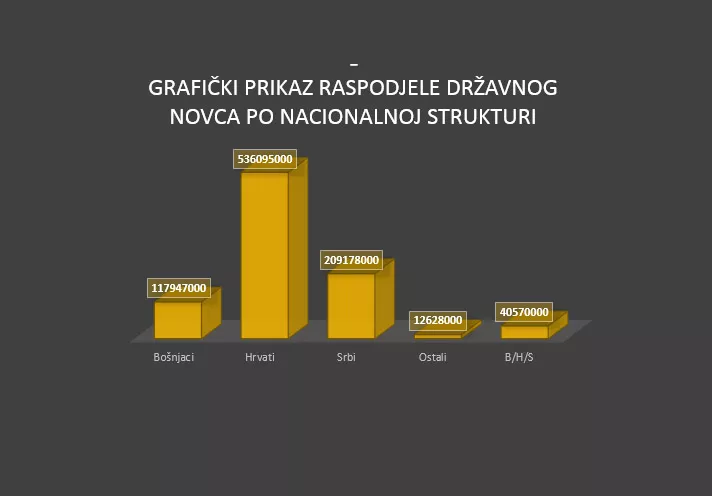
That they have grounds for thinking this way was also shown by an analysis by Šemsudin Mehmedović (SDA), a delegate in the House of Representatives of the BiH Parliamentary Assembly, because when data on budget funds available to institutions are taken as a criterion, we come to the conclusion that Bosniaks have 117,947,000 KM at their disposal, Serbs have 209,178,000 KM, and Croats have as much as 536,095,000 KM, while Others manage 12,628,000 KM. In institutions where Bosniaks, Croats and Serbs rotate (six in total), the budget is 40,570,000 KM.
When the disposal of budget funds is taken as a criterion for data analysis, it is evident that representatives of the Croatian people have more funds at their disposal than Bosniaks and Serbs combined.
When it comes to the national structure of personnel in the management of BiH institutions, of which there are 75, Bosniaks are at the head of 21 institutions, Serbs in 28, Croats in 18, in 6 institutions Bosniaks, Serbs and Croats rotate (BiH Presidency, BiH Parliamentary Assembly...), and two institutions are managed by members of the Others category.
If from the total available 535,880,000 KM we subtract 282,854,000 KM, which is the budget of the Ministry of Defense of BiH, headed by a representative of the Croatian people, we get an amount of 253,026,000 KM, which is again twice as much as the funds available to Bosniaks.
18 INSTITUTIONS
Although it is visible that Croats manage the smallest number of institutions, it is evident that they are at the head of those with the largest budgets.
These are: Ministry of Finance and Treasury of BiH (7,133,000), Ministry of Transport and Communications (11,385,000), Ministry of Justice of BiH (13,541,000), Ministry of Defense (282,854,000), Constitutional Court of BiH (5,331,000), Attorney's Office of BiH (1,031,000), General Secretariat of the Council of Ministers of BiH (3,821,000), Indirect Taxation Authority (113,070,000), Border Police of BiH (71,273,000), Audit Office of the Institutions of BiH (3,665,000), Central Election Commission (11,978,000), Agency for Statistics (4,791,000), Civil Service Appeals Board (378,000), Directorate for Economic Planning (1,121,000), Agency for Preschool, Primary and Secondary Education of BiH (1,215,000), Center for Information and Document Recognition in the Field of Higher Education in BiH (785,000), Anti-Doping Control Agency (588,000), Agency for Education and Professional Training of Personnel (4,298,000).
SECURITY SECTOR
Particular dissatisfaction among Bosniaks comes from the distribution in security agencies, and currently only one Bosniak (Mirsad Vilić) manages the Directorate for Coordination of Police Bodies.
In SIPA, the highest-ranking police officer is the assistant director for internal control, i.e., only for control, and in the Border Police, the assistant director is a Serb, but not only for a specific department (e.g., control).
The assistant director in police agencies is appointed by the director, so it is clear that Goran Zubac appoints an assistant, i.e., a Bosniak, based on his own assessment. At the same level is the assistant director for the Criminal Investigation Department, Anđelko Hrgić, but the competencies of the CID compared to internal control in SIPA are incomparable. Practically, the situation in SIPA regarding Bosniaks is unsustainable.
In the Border Police of BiH, the situation is such that the total number of employees is significantly in favor of Croats.
In the Directorate for Coordination of Police Bodies, we have a director and two deputy directors. There are no particular objections to the national structure, except that this is the only agency managed by a Bosniak, and two deputies from the Croatian and Serbian peoples have been appointed.
In the Service for Foreigners' Affairs, the national structure is in favor of Serbs and Croats, and to the detriment of Bosniaks. The mandate of the director, deputy director, and assistant director for internal control, who is from the Croatian people and is the only assistant in all BiH institutions appointed according to the law on ministerial appointments, lasts until 2016. With the appointment of Dragan Mektić to the Council of Ministers, the question of managing the institution arises; the deputy director is Izet Nizam. The proposal is that with Mektić's departure to the Council of Ministers, the position of director in this institution should rotate so that it belongs to Bosniaks, and the position of deputy director to Serbs. Representatives of the Serbian and Croatian peoples often speak about the issue of rotation.
From the above, it is evident that Bosniaks have 4 positions, Serbs 4 positions, and Croats 5 positions. When it comes to the distribution of positions, Bosniaks have only one director position, and precisely in that position, the director has two deputies, which is not the case in other institutions; in every institution where the director is not a Bosniak, there is one deputy. It is evident that members of the Croatian people have the largest number of positions, and the thesis about the alleged endangerment of representatives of that people is constantly present.
Furthermore, numerical indicators suggest that there are no significant differences; however, when considering competencies, the amount of budget funds managed by directors of institutions, the national structure of all employees, and the 1991 census, it becomes clear that the situation must be significantly changed in the shortest possible time to truly ensure the equality of peoples.
Equality is not ensured for peoples by an equal number of director positions but proportionally to the number of inhabitants, and methods for protecting vital national interests have been established. According to the current situation, Bosniaks have neither quantitative nor, especially, qualitative equality - quality refers to the competencies of the agency.
Komentari (0)
Prijavite se za komentiranje
PrijavaJos nema komentara. Budite prvi!
Minuta
Sve →Iz drugih kategorija

High Representative Not Elected: Germans, French and British Against Americans, New Attempt at End of June

ČOVIĆ WITHOUT MERCY: How Those Who Brought Ademović to Office Created a Political Hell for Him



Sunny Saturday, quite warm



Tragedy in Albanian resort: Two minors drown












