
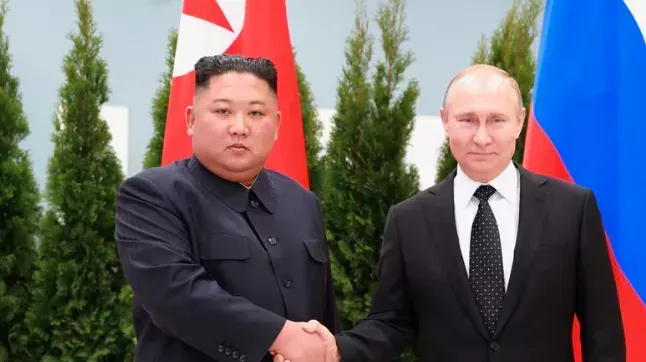
Written by Armin Sijamić
Russia's aggression against Ukraine in February last year will be remembered in Russian history as a period when Moscow changed its policy and began seeking allies where it was previously unthinkable. North Korea, which Russia kept at a distance for more than a decade, has become another card Moscow is playing in its confrontation with the United States.
The Kremlin's decision to attack Ukraine shook Russian politics. Western states and companies turned their backs on Moscow, and part of the Russian political and intellectual elite saw this as an opportunity to further develop the concept of turning towards Asia. Sixteen months after the start of the aggression against Ukraine, the turn to Asia is also a forced act, as sanctions are severing ties between Russia and the rest of the European continent, with a few exceptions.
At the end of July, Russian Defence Minister Sergei Shoigu visited North Korea, a rare visit to another country while the war in Ukraine continues and while the Russian army recovers from the Wagner group rebellion. Moreover, this is the first visit of a Russian defence minister to Pyongyang since 1991, i.e., the first since the collapse of the USSR. He came to Pyongyang for the celebration of the 70th anniversary of the armistice that ended the Korean War, fought from 1950 to 1953, which North Korea marks as its victory.
The Korean War was a clash between communists, supported by Moscow and Beijing, and a part of the Korean people backed by Washington. Shoigu, as the Russian minister, was a fitting guest for the celebration in Pyongyang, even though Russia has since abandoned communism and embraced capitalism, often less regulated than anywhere in Europe. But Shoigu did not come for that reason. The hosts could celebrate the "triumph" of communism with the Chinese, who also sent a high-level delegation.
Conditional change
"This visit will contribute to strengthening Russian-North Korean military ties and will be an important phase in the development of cooperation between the two countries," reads a statement from the Russian Ministry of Defence. Although the statement does not reveal much at first glance, this is nonetheless a significant change in Russian policy.
Those who follow processes in that part of the world have noted that Shoigu's visit to Pyongyang, where he was welcomed by his counterpart Kang Sun Nam, is an important shift in Russian policy towards its neighbour. For fifteen years, Russia has approved UN Security Council sanctions against North Korea, supporting Washington's stance that Pyongyang should be punished for its nuclear and missile programmes. Russia could have prevented the sanctions with a veto.
Shoigu's visit means that Russia in some way accepts North Korea as a nuclear power and is ready to strengthen military ties. Shoigu viewed an arms exhibition displaying ballistic missiles that are banned by UN resolutions and for which Russia has repeatedly voted.
It is hard to believe that Pyongyang, heavily reliant on China, would agree to close ties with Moscow if sanctions against a state that has been economically drained for decades remain in place. However, any kind of aid is very important for North Korea, and Russia could make it conditional.
Russia's opening towards North Korea could mean that Washington no longer has a partner in the UN Security Council that punishes Pyongyang. South Korea would pay the highest price for this. In May last year, while Russia had been fighting in Ukraine for three months and the West was imposing sanctions, Moscow did not veto UN Security Council sanctions against North Korea. At that time, Pyongyang received restrictions on the amount of oil it could buy on the world market.
Why Moscow supported US policy towards North Korea at that time is not entirely clear, but some reasons could be faith in a quick normalisation of relations with the West, a desire to show policy continuity at the UN, or an assessment that South Korea would appreciate the sanctions.
South Korea's decision to sell large quantities of weapons to Poland and to conclude an agreement with the United States on ammunition supplies angered Moscow. Russia, drawing on past experience, believes that the weapons and ammunition will end up in the hands of Ukrainians.
At the same time, the United States accused North Korea of providing aid to Russia for the war in Ukraine, which both countries deny. Whether the US accusations are accurate, time will tell, but even then, the question will remain of how much a poor neighbour, preparing for war for decades, can help Russia. As things stand, it is Russia that must provide aid to Pyongyang.
The Korean Peninsula, the Pacific, and Ukraine
Cooperation between Russia and North Korea could be a strong boost for Pyongyang, which struggles to obtain fuel, food, and technology. Russia could provide Pyongyang with the things it seeks. North Korean missile production, some of which are likely capable of hitting US soil, if supported by Russian knowledge and resources, could reach new proportions.
In recent days, Kim Jong Un has been visiting weapons factories and ordering accelerated production. Previously, he told Washington that he is ready for a nuclear war, after the US Navy arrived off the coast of South Korea with submarines carrying nuclear weapons.
The United States is announcing defence agreements with South Korea and Japan, all of which are enemies of North Korea. In a confrontation with them, North Korea has no chance, but things change if Russia and China enter the game. After all, today's division into two Korean states is the result of neither side being able to win the war. Even then, Moscow and Beijing thought differently from Washington.
Furthermore, ending the isolation of the North Korean regime would be important for Pyongyang. Let us remember how much the summit with former US President Donald Trump meant to Kim Jong Un. Shoigu's visit could be a hint that Russia and China have such plans.
The US pivot to the Pacific, essentially planned as a containment of China, could thus take an unexpected turn, with Russia and a strengthened North Korea unreservedly on China's side. The development of the situation after Russia's aggression against Ukraine shows the full scale of that conflict, which is reflected in almost all parts of the world. The new US-Russian Cold War could continue where it never really ended – on the Korean Peninsula.
Finally, it should be remembered that since the beginning of Russia's aggression against Ukraine, there have been several proposals on how to end the war. One of them is to divide Ukraine according to the principle of the division on the Korean Peninsula, where the war is still formally ongoing, and two states exist side by side, although they do not recognise each other. If that proposal is accepted, Washington and Moscow could have another case of state division, and the Korean one has already lasted seventy years with no signs of ending in the near future.
Komentari (0)
Prijavite se za komentiranje
PrijavaJos nema komentara. Budite prvi!
Minuta
Sve →Iz drugih kategorija

High Representative Not Elected: Germans, French and British Sabotaged Americans, New Attempt at End of June

ČOVIĆ WITHOUT MERCY: How Those Who Brought Ademović to Office Created a Political Hell for Him



Sunny Saturday, quite warm



Tragedy in Albanian resort: Two minors drown












