
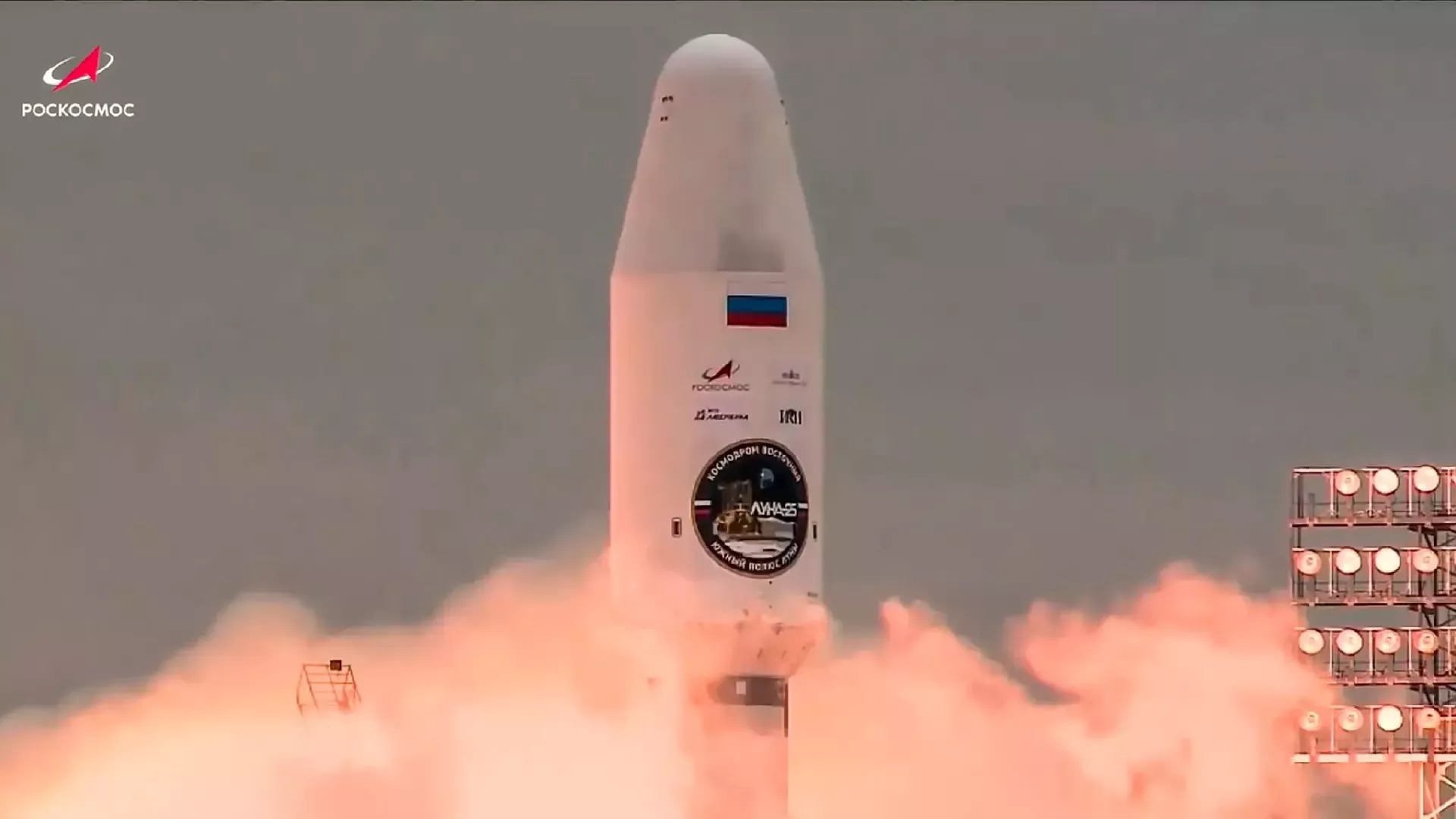
(Patria) - The Russian spacecraft Luna-25 crashed on the Moon's surface a day after an "abnormal situation" was reported and was lost, the Russian news agency Tass reported.
According to the Russian state space agency Roscosmos, communication with the spacecraft was lost.
"According to preliminary calculations, Luna-25 transferred to an unplanned orbit and collided with the Moon's surface," Roscosmos announced.
This agency, let us recall, reported an "abnormal" situation on the spacecraft yesterday after a signal was sent from Earth that was supposed to initiate its preparation for landing on the Moon's surface.
Roscosmos added in today's announcement that a special interdepartmental commission has been immediately formed to investigate the reasons that led to the loss of the uncrewed spacecraft.
Roscosmos, let us recall, reported an "abnormal situation" on its Luna-25 spacecraft.
"During the operation, an abnormal situation occurred in the automatic station, which did not allow the maneuver to be performed with the selected parameters," Roscosmos announced in a brief statement, reported by Index.hr.
The Russian spacecraft was supposed to land on the Moon's south pole on Monday, as part of a major race to explore a part of the Moon that scientists believe may contain frozen water and precious elements.
Experts are analyzing the situation, it was said, but without further details. Earlier, Roscosmos announced that it had received the first results from the Luna-25 mission and that they are being analyzed.
The agency also released photos of the Moon's Zeeman crater taken from the spacecraft. The crater is the third deepest in the Moon's southern hemisphere, it was said, with a diameter of 190 kilometers and a depth of eight kilometers.
Roscosmos previously announced that the data received so far provided information about chemical elements in the lunar soil and would also facilitate the operation of devices designed to study the Moon's surface.
The lunar probe "Luna-25" captured its initial image of the lunar landscape, revealing the Zeeman crater located at the southern pole of the Moon's far side. pic.twitter.com/UxUotwxk0o
— Space and Technology (@spacetech94) August 19, 2023
It was added that the spacecraft's equipment registered the "impact of micrometeorites".
The Russian lunar spacecraft, let us recall, entered lunar orbit four days ago, which was a major step towards Russia's ambition to become the first space power to achieve a soft landing on the south pole of Earth's only natural satellite in search of frozen water.
Four days ago, Roscosmos reported that the Luna-25 space probe entered lunar orbit at 11:57 AM Moscow time or 8:57 AM Central European time.
The Russian space probe, which is approximately the size of a small car, weighs about 1,800 kilograms and was launched last Friday from the Vostochny Cosmodrome. It was supposed to conduct research on the Moon's south pole for about a year.
In this area, scientists from NASA and other space agencies have discovered traces of frozen water in craters in recent years.
The existence of water on the Moon is important for major space powers because it would allow for longer human stays there, which in turn would enable the extraction of valuable lunar resources.
Moscow last sent a probe, Luna-24, to the Moon almost half a century ago, in early 1976, when Russia was still part of the Soviet Union, said Anatoly Zak, a scientist who monitors Russian space programs.
According to him, entering lunar orbit is absolutely crucial for the success of this project.
"Some call this the second lunar race, so it is very important for Russia to continue with this program.
Luna-25 is not just one mission, but part of a much broader Russian strategy that extends ten years into the future," Zak told Reuters, reiterating that this is happening for the first time in the post-Soviet period.
Luna-25 is part of Russia's lunar program, which envisages the construction of a space station on the Moon by 2040.
Komentari (0)
Prijavite se za komentiranje
PrijavaJos nema komentara. Budite prvi!
Minuta
Sve →Iz drugih kategorija

High Representative Not Elected: Germans, French and British Against Americans, New Attempt at End of June

ČOVIĆ WITHOUT MERCY: How Those Who Brought Ademović to Office Created a Political Hell for Him



Sunny Saturday, quite warm



Tragedy in Albanian resort: Two minors drown












