
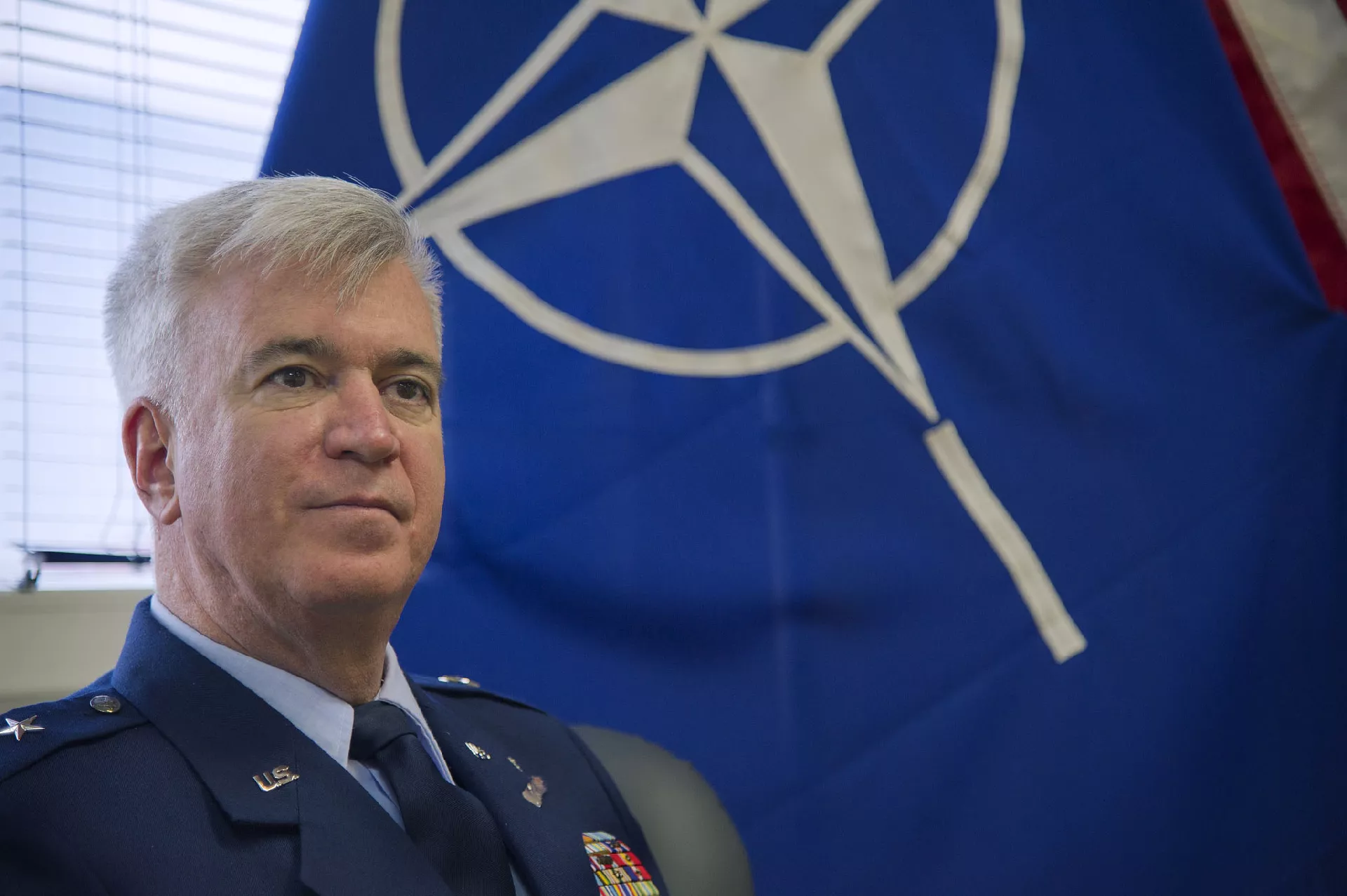
SARAJEVO, (Patria) - American Brigadier General Robert A. Huston took command of the NATO Headquarters in Sarajevo at the end of June last year. He succeeded Brigadier General Giselle Wilz, who successfully completed her two-year term in this important position.
In an interview with the Patria news agency, General Huston shares his views on the frequent war rhetoric used by certain politicians in the region, discusses Bosnia and Herzegovina's defense system, the relationship between NATO and neighboring Serbia, and how far Bosnia and Herzegovina has come on its path towards the NATO alliance.
Exactly on January 20th, it marked 21 years of NATO's mission in BiH. It has already been concluded by responsible parties in this country that defense reform is "more successful than any other reform in BiH". How is the restructuring of the Armed Forces of Bosnia and Herzegovina progressing towards meeting the criteria of the NATO Alliance?
Huston: Bosnia and Herzegovina has made significant progress in restructuring its armed forces and defense structure, and this progress must be acknowledged. The defense review agreed upon the year before last was an important step, and now the focus should be on its implementation to make that review a reality. The recent decision to procure new helicopters is a good first step in that direction. The development and modernization plan agreed upon with the defense review is a very ambitious document. I believe that Bosnia and Herzegovina, as is the case with other countries, will find it necessary to define priority requirements and direct available resources towards those priorities.
BiH also makes a significant and concrete contribution to NATO-led collective peace and security operations, especially considering your limited defense resources. You currently have 60 personnel in the mission in Afghanistan. BiH also participates in UN missions in Congo and Mali, and the EU mission in the Central African Republic. Here in the country, exercises held under the auspices of NATO and/or the EU represent and will represent a significant mechanism for training and readiness of the BiH Armed Forces. All exercises are planned to ensure that the BiH Armed Forces are ready not only to conduct peace and security operations in a multinational environment abroad but also to respond to events in the country in case of natural disasters and protect the citizens of BiH.
In this regard, it is important to utilize this and participate in NATO programs and fulfill the obligations arising from them to demonstrate capability, possibility, and credible partnership. And NATO is here to help your country in this process.
The NATO Membership Action Plan (MAP) requires reforms and transparency in all ministries, not just the Ministry of Defense. Numerous conditions must be met to lead to the country's progress in all areas. Therefore, it is said that joining NATO is a parallel process of a society entering democracy and the rule of law system. Thus, being part of NATO offers numerous advantages.
Huston: As a partnership program between NATO and a potential candidate country, the Membership Action Plan holds great value for further reforms for the benefit of all citizens of BiH. When the Membership Action Plan is activated, Bosnia and Herzegovina will develop its own Annual National Program, in consultation with NATO and based on its own priorities. These programs consist of five chapters. The first covers political and economic issues, the second military/defense, the third resource and finance issues, the fourth security issues, including intelligence, and the fifth deals with legal issues. NATO provides advice and assistance, and there is continuous exchange of information between NATO and the potential candidate country. It is important to emphasize that all these reforms increase overall transparency and accountability.
In short, all the processes a country goes through on the path to NATO revolve around security, stability, and prosperity. Euro-Atlantic integration is a tried and tested roadmap for achieving these. The reform process that a country must go through will improve the overall functioning of the state, in all areas from justice, police, armed forces to the economy. Improvements in these areas will contribute to the security, stability, and prosperity of all citizens of BiH.
The process of registering immovable military property has moved from a standstill, which is one of the conditions for activating MAP. So far, the size of the Armed Forces, the problem of their manning, equipping, and standardization, as well as their complete political control, are still cited as problems. Where do we stand today with these tasks?
Huston: As I have already pointed out, the NATO Headquarters Sarajevo welcomed the adoption of the Defense Review and its integral part, the Development and Modernization Plan, in November 2016, upon the recommendation of the Ministry of Defense. This is a key step in the partnership between BiH and NATO and the development of the operational capabilities of the BiH Armed Forces. It reaffirms and builds upon the defense reform consensus from 2005, and it is a clear sign that BiH remains committed to defense reform and fulfilling its obligations within NATO's Partnership for Peace program.
The Defense Review addresses the size of the BiH Armed Forces, as well as their manning, equipping, and standardization. We remain committed to providing assistance to BiH and to the implementation of the Defense Review and the Development and Modernization Plan, which will lead to further strengthening and standardization of BiH's defense sector.
BiH has a good structure to ensure democratic, civilian control and oversight of the defense sector, including parliamentary bodies. Unfortunately, we have seen attempts to misuse the BiH Armed Forces for political purposes. This burdens the defense system and distracts the BiH Armed Forces from the actual work on defense reform.
We heard from one member of the BiH Presidency that BiH's accession to NATO is a priority over joining the European Union. As usual, the key problem for BiH's accession to NATO turns out to be the political consensus of all parties in our country.
Huston: Both NATO and EU integration processes bring concrete benefits to a potential candidate country. Experience from the region and beyond shows that in the process of Euro-Atlantic integration, countries first become members of NATO, and then the EU. I am talking about countries that want membership in both NATO and the EU. BiH wants this and participates in reform programs as part of the path to becoming a credible candidate for membership in NATO and the EU. These are long-term commitments, but we can see, both in the region and beyond, that they bring concrete benefits that cannot be ignored.
As for NATO, we are focused on progress in our partnership with Bosnia and Herzegovina and providing assistance for the agreed-upon, necessary reforms. Therefore, we encourage Bosnia and Herzegovina's leadership to take the necessary steps to activate the Membership Action Plan as soon as possible.
There is constant talk in the region about the relationship between Serbia and NATO. Then we hear statements that this cooperation is excellent, and from RS they say: We will join NATO when Serbia does. Does it seem to you that double games are being played here with NATO and Russia?
Huston: NATO and Serbia have been continuously building cooperation and dialogue since Serbia joined the Partnership for Peace program in 2006, at the same time as BiH and Montenegro. While NATO fully respects Serbia's policy of military neutrality, there is practical cooperation in a number of areas, including the destruction of dangerous ammunition, training of peacekeepers, NATO Trust Fund activities in Serbia, the Planning and Review Process (PARP) for building capabilities and interoperability, and the broader Individual Partnership Action Plan (IPAP) agreed upon in 2016.
In this context, the NATO integration path can only bring benefits to Bosnia and Herzegovina and all its citizens. In the regional context, peace and stability throughout the Balkans are in everyone's interest, and Bosnia and Herzegovina is at the very center of the entire region, both geographically and culturally. The better the political cooperation, the better we will understand each other and increase our cooperation for mutual benefit.
We don't know if it is seen the same way from the outside as by the citizens of BiH, but threats of war from some political leaders are constant. There are newspapers in Serbia that continuously declare war on Bosnia and Herzegovina. How sure are we that there will be no military conflicts here, and what would be the role of NATO, which is the guarantor of peace in BiH, in that case?
Huston: I hear the political rhetoric, but also what ordinary people have to say. I think citizens in BiH and the region want peace and security as a foundation for economic prosperity and want to have the right to live their lives without fear or intimidation of any kind. The entire international community, including NATO, remains committed to peace in BiH, and all our joint efforts on BiH's path to Euro-Atlantic integration, including strong cooperation with relevant local institutions, have the same goal: to increase the security, stability, and prosperity of BiH and the entire Western Balkans. What is truly visible to me, as an outsider, is that the people who live in this country want their children and grandchildren to live in a secure and prosperous BiH. I hope they will find leaders who will lead them forward, not look to the past.
Komentari (0)
Prijavite se za komentiranje
PrijavaJos nema komentara. Budite prvi!
Minuta
Sve →Iz drugih kategorija

High Representative Not Elected: Germans, French and British Sabotaged Americans, New Attempt at End of June

ČOVIĆ WITHOUT MERCY: How Those Who Brought Ademović to Office Created a Political Hell for Him



Sunny Saturday, quite warm



Tragedy in Albanian resort: Two minors drown












