
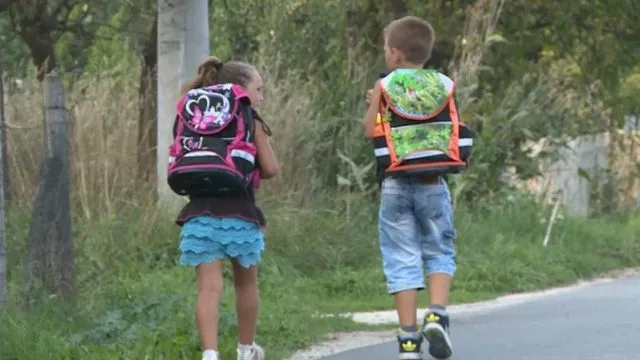
SARAJEVO, (Patria) - Children of Bosniak nationality from Vrbanjci will attend instructional classes in the premises of the Islamic Community's Majlis for the seventh consecutive year in the nearby hamlet of Hanifići, because the educational authorities of Republika Srpska are not respecting the decisions of the highest courts of their entity regarding the national subject group.
Two daughters – one in the ninth grade and the other in the sixth grade – will, along with other children, be sent by returnee Nedžad Smajlović this autumn not to the classrooms of the school in Vrbanjci near Kotor Varoš, but to the desks of a "substitute school" located in the premises of the Majlis. Instructional classes in the national subject group will be organized there for them, and instead of teachers from their home school [in Republika Srpska], they will be taught by teachers from the "Prvi mart" Primary School from Jelah, following the curriculum of the Zenica-Doboj Canton [in the Federation of BiH].
At the end of last calendar year, when the Supreme Court of Republika Srpska upheld the lawsuit filed by Bosniak students and their parents from Vrbanjci, finding discrimination against students, violation of the right to education, and unequal treatment compared to other children in that entity, parents and children hoped that the legal battle was over, BIRN BiH reports.
The ruling ordered the "Sveti Sava" Primary School in Kotor Varoš, to which the Vrbanjci Branch School belongs, as well as the Republika Srpska entity, to introduce and include the national subject group according to the Bosnian curriculum from the Zenica-Doboj Canton in that school. However, the case has returned to court. Instead of implementing the ruling, the Republika Srpska entity and the "Sveti Sava" Primary School in Kotor Varoš appealed to the Constitutional Court of Bosnia and Herzegovina.
"And it all has become an endless story now," says Smajlović.
He doesn't think that "everything is now in the background, but in the hundredth plan."
"I cannot allow someone to abuse my right to something. It's the same if someone in the Federation of BiH wants to learn Serbian or Croatian and is denied that. If we are a democratic society, then we must look at it that way, not have someone impose something on me," states Smajlović, adding that he doesn't know how classes will be organized at all due to the poor epidemiological situation caused by the spread of the coronavirus, let alone anything about the national subject group program.
He also adds that he would be glad if children of different nationalities went to school together, as they socialize anyway. However, he continues, in primary school, the children are not together; instead, some belong to the school in Kotor Varoš, and others to the school in Jelah, "instead of socializing there and not turning their backs on each other."
The school claims there are not enough students
The national subject group, in addition to languages and literature, includes history and geography, or nature and society in the lower grades of primary school, and religious education. As early as 18 years ago, the education ministers of the two BiH entities signed a Provisional Agreement on Meeting the Special Needs and Rights of Returnee Children. They agreed that children would learn general subjects based on the curriculum of Republika Srpska if they were in that entity, or based on the curriculum by cantons if they were in the Federation of BiH.
For the national subject group, parents of students were given the right to choose the entity or cantonal curriculum. The priority was to be the engagement of returnee teachers to teach the national subject group. The Implementation Plan of the Provisional Agreement also stated that schools with 18 or more students in a class, or the minimum number prescribed by law for mixed classes, are obliged to organize regular classes for the national subject group, while schools with fewer than 18 students in a class are obliged to organize classes according to the decision of the competent ministry. It also states that classes for the national subject group will be organized in school premises.
It is precisely this Provisional Agreement that the "Sveti Sava" Primary School in Kotor Varoš refers to in its response to the Balkan Investigative Reporting Network of Bosnia and Herzegovina (BIRN BiH) regarding why the entity Supreme Court's ruling was not implemented and the national subject group introduced.
"We could not apply the aforementioned ruling because, out of the total number of plaintiffs – children to whom the ruling applies – only 16 primary school-aged students remained, and they are not in the same class. The ruling mentions the Provisional Agreement on Meeting the Needs of Returnee Children, which precisely states that there must be 18 students in a class for the conditions to be met for introducing the national subject group," replied Slađana Šubara, director of the school in Kotor Varoš.
No response was received from the Ministry of Education and Culture of Republika Srpska to the question of why the ruling was not implemented in practice by the time of this report.
When the long-standing court case began, it involved 128 children. It all started at the Basic Court in Kotor Varoš, continued at the District Court in Banja Luka, then at the Supreme Court of Republika Srpska, then at the Constitutional Court of Bosnia and Herzegovina, and last autumn it was returned to the Supreme Court of Republika Srpska. With the appeals from the school and the Republika Srpska entity, the case returned to the Constitutional Court of BiH at the beginning of the year. For both appeals, the Court's website states that the "cases are ongoing."
According to lawyer Nedim Ademović, "the ruling of the Supreme Court of Republika Srpska is binding, very clear, and precise."
"It should have been implemented immediately, meaning by the next school year. The Supreme Court of Republika Srpska gave very direct and unambiguous directives to public authorities. Filing an appeal to the Constitutional Court of BiH against this ruling, regardless of whether it is admissible or not, does not postpone the execution of the ruling of the Supreme Court of Republika Srpska. Therefore, the non-implementation of the ruling of the Supreme Court of Republika Srpska is pure obstruction. In my opinion, the plaintiffs from Vrbanjci should file an appeal for non-execution of the ruling of the Supreme Court of Republika Srpska," states Ademović.
In the meantime, regardless of the appeals, lawyer Haris Kaniža, one of the legal representatives of the children and their parents, has twice submitted proposals to the Ministry of Education and Culture of Republika Srpska and the sued school to resolve the procedure amicably. As he told BIRN BiH, "he has not received an official response to date."
"Republika Srpska and the "Sveti Sava" Primary School in Kotor Varoš have filed an appeal with the Constitutional Court of Bosnia and Herzegovina, despite the fact that the Supreme Court of Republika Srpska made its ruling precisely according to the instructions of the Constitutional Court of BiH, so it can be concluded that filing an appeal cannot be a reason for not implementing the ruling," points out Kaniža.
Commenting on the school director's response about the necessity of having at least 18 students in a class for the national subject group to be introduced, he says that "this remark was also made during the legally concluded proceedings."
"And the Supreme Court did not accept it, so any further reliance on this fact is arbitrary and incorrect. It is important to emphasize that the operative part of the Supreme Court's ruling does not only mention the students who filed the lawsuit but also other students, which is why their remark is unfounded," adds Kaniža.
Since the ruling has not yet been implemented, along with his colleagues from the legal team, a month ago he decided to submit a proposal to the Basic Court in Kotor Varoš for the compulsory execution of the aforementioned legally binding ruling in accordance with the provisions of the Law on Enforcement Procedure, with an order to impose fines and penalties on responsible persons until the ruling is fully implemented. The court has not yet made a decision.
Protection mechanisms are not functioning
In the opinion of Faris Vehabović, judge of the European Court of Human Rights, in this case, "politics takes precedence over law, and proportionally, so does the lack of democracy."
He reminds that there are a large number of cases pending before the European Court of Human Rights against BiH. And all of them, he notes, relate to the non-execution of final and enforceable court rulings.
"There are legal remedies that can be used in such cases, from the Constitutional Court to the European Court, but if you have a well-established system in the country that obstructs the judiciary, then everything is uncertain, and therefore it is high time for prosecutors to start doing their job as prescribed by law and initiate proceedings against those responsible," adds Vehabović.
Ademović considers the non-implementation of the ruling of the highest judicial instances in an entity and country as an "absence of a functional legal state."
He continues, "the implementation of ethno-nationalism is being sought, which is contrary to plurality, multiculturalism, and secularism."
"Ethno-nationalism, as a widespread matrix in BiH, is a tool for the totalitarian hegemony of an ethnicity, on the one hand, and for slowing down or amortizing the process of awakening civic consciousness in people, on the other. In this context, the education system is particularly valuable for ethno-nationalists because new generations are produced on this matrix and ideology," states Ademović.
Representatives of the international community are also closely following the entire case. The Embassy of the United States of America (USA) in Bosnia and Herzegovina has called on the Ministry of Education and Culture of Republika Srpska to implement the decision of the Supreme Court of Republika Srpska in the upcoming school year.
"The United States supports access to quality education without discrimination and forced assimilation for all students, regardless of their ethnicity, gender, or ability. This is a human rights issue that we also highlighted in our human rights report, along with other issues such as 'two schools under one roof'," the U.S. Embassy's Public Affairs Office stated in its response to BIRN BiH.
Ambassador Kathleen Kavalec, Head of the OSCE Mission in Bosnia and Herzegovina, believes that the "case could and should have been resolved long ago, even outside of court."
"Relevant human rights standards are quite clear and have been pointed out on multiple occasions. We call on the authorities to keep this in mind in the future. The priority of politicians should be to find long-term solutions to existing problems in education, i.e., to develop inclusive quality education, not further divisions. Bosnia and Herzegovina cannot become a prosperous country if it fails to ensure inclusive, quality education for all children, without any form of discrimination," states Kavalec.
Despite having filed a motion for compulsory execution, lawyer Kaniža hopes that everything will eventually be resolved amicably, as he is convinced that "the ruling will be fully implemented because there are legally provided mechanisms for its implementation and respect."
"If the silence from the other side continues, then we must state that the non-implementation of final court decisions is a criminal offense, and we will be prepared to file criminal charges against the responsible persons in the sued school and the competent entity ministry," announces Kaniža.
As long as court decisions remain in drawers, the "Prvi mart" Primary School in Jelah will this autumn continue to teach children from both entities – for those attending classes in its facilities, and for the children in the premises of the Islamic Community's Majlis in Kotor Varoš, in the hamlet of Vrbanjci.
Komentari (0)
Prijavite se za komentiranje
PrijavaJos nema komentara. Budite prvi!
Minuta
Sve →Iz drugih kategorija

High Representative Not Elected: Germans, French and British Sabotaged Americans, New Attempt at End of June

ČOVIĆ WITHOUT MERCY: How Those Who Brought Ademović to Office Created a Political Hell for Him



Sunny Saturday, quite warm



Tragedy in Albanian resort: Two minors drown












