
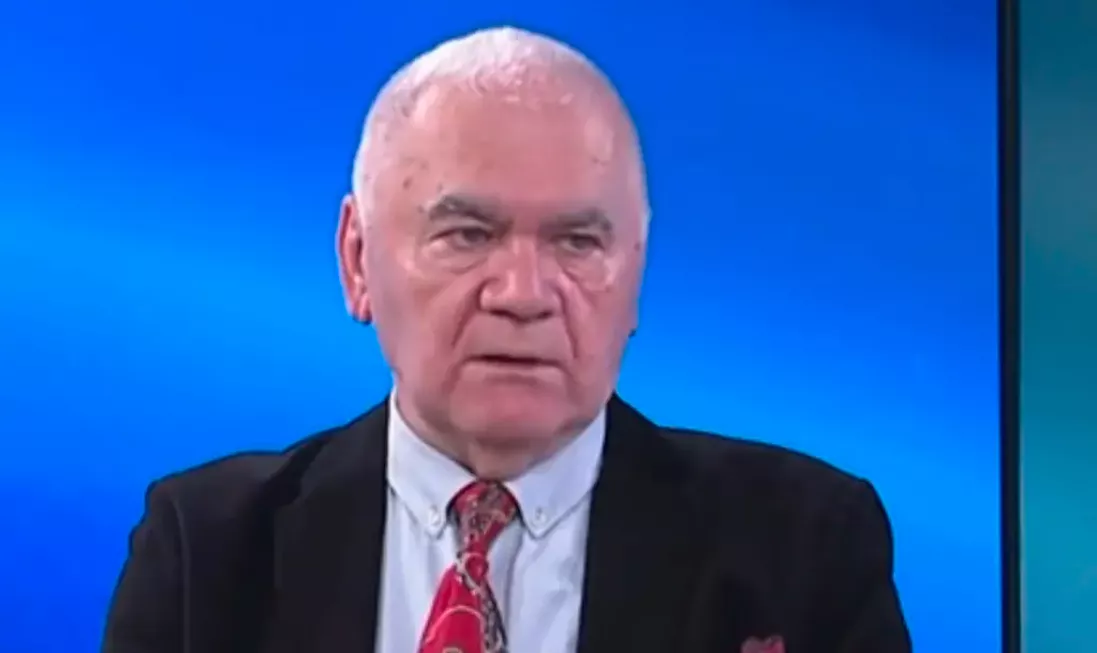
SARAJevo, (Patria) - Following fierce attacks on the Association of Independent Intellectuals Krug 99 after its last session, the President of the Association Adil Kulenović published an authentic text of his introductory address at the Krug 99 session on the topic "Contemporary Croatian Politics and the Renewal of the Karađorđevo Agreement.
Krug 99 states that they are publishing the text also due to obscure defamation and threats against Krug 99.
We are publishing the statement without intervention:
"Almost four years ago, in December 2018, the Croatian Parliament adopted the Declaration on the Status of the Croatian People in BiH, which, as time has shown, was a clearly defined political strategy of the Republic of Croatia to renew and further pursue the key goals of the Tuđman – Milošević agreement from March 1991 in Karađorđevo, regarding the resolution of the then Yugoslav crisis, the essence of which was the division of BiH.
The escalation of such a policy and open hostility towards the state subjectivity, political independence, and sovereignty of BiH, which is symbolically personified today by Zoran Milanović, the President of the Republic of Croatia, is a product of the long and already transparent activities of state institutions, diplomacy, security, and political structures of the Republic of Croatia, both domestically and internationally, as well as through the engagement of separatist, collaborationist political allies and structures within BiH itself. Permanent pressure aimed at blocking the democratic transformation of BiH by insisting on the so-called 'legitimate political representation of peoples' in a multi-ethnic community and civil society has already escalated into an open call for a military arrangement of the Republic of Croatia in the state of BiH, and the institute of dual citizenship of citizens of one ethnic group has become an instrument of divided loyalty of citizens and a loss of interest in the reform processes necessary for BiH's European integration.
The ideology, political methods, and goals of the militant 'Russian world,' through the political instrumentalization of ethnic groups in other countries to annex parts of other countries' territories, have their followers in the Balkans. The takeover and domination of the sovereignty of neighboring nations/states is not only a Russian practice and that of its key ally in the Balkans – the 'Serbian world' – but also the blatant intentions and shaping of the so-called – 'Croatian world.' Although they have been in conflict for centuries over unresolved mutual national aspirations, they are in fact in an open, strategic alliance and coordinated action, with interests and goals towards BiH.
It is now completely clear why the initiative of Krug 99 (from January 2019) for a dialogue between the democratic public of Croatia and the civic, state-building public of Bosnia and Herzegovina on the Memorandum of Understanding, defined in response to the aforementioned Declaration of the Croatian Parliament, was not accepted almost four years ago:
Rejection of the Republic of Croatia, as a signatory to the General Peace Agreement by which it committed to full respect for the sovereignty, integrity, and political subjectivity of Bosnia and Herzegovina, and thus as a party involved in the war in BiH, to derive any paternalistic rights towards BiH and reaffirm the war aims of the so-called HRHB. Nor the imposition of rights to subordinate the Constitution and laws of the Republic of Croatia to the Constitution and laws of BiH as a "legal" and political basis for interference in the internal organization and building of a democratic order in BiH.
Nor that the constituent Croatian people in BiH be treated as part of the Croatian nation-state, and as political citizens of the Republic of Croatia. Nor that laws of the Republic of Croatia establish and operate supranational institutions such as the Office for Croats outside of BiH, which places one of the constituent peoples of BiH in the position of diaspora and national minority, or as newcomers in their age-old homeland of BiH.
By persistently producing the endangerment of Bosniak Croats, the answer to the question of political responsibility for the catastrophic policy of "humanitarian relocation," "ethnically pure areas," the result of which is a reduction in the Croatian population by more than half of the pre-war number, and a constant tendency for further reduction, is being concealed. All of this continues to generate divided state loyalty among that segment of authentic citizens of BiH, which, through the practice of dual political and institutional citizenship, has severe consequences for internal peace, stability, for the restoration and building of trust between people and nations, for Euro-Atlantic integration and democratic development, for the just resolution of borders, property, BiH's justified interests in maritime rights, the use of natural resources, the construction of transport infrastructure. The promotion of systemic discrimination in education and the civilizationally inappropriate apathy of "two schools under one roof" is an additional reason for their further and harmful emigration for the social, cultural, economic, and political being of BiH.
Rejection of the democratic and electoral order of BiH being treated as any special case outside the European legal acquis, of the majority ethnic electoral legitimacy in BiH being legalized against the principle of parliamentary majority legitimacy in forming government, of ethno-territorial unitarism and separatism being legalized against a functional state and the imposition of the model of consociational democracy rejected in the modern world.
A model that would ultimately permanently establish the parallelism of power in a divided and segregated society, a ruined state. It is a deception to offer BiH a concept of a segregated society that did not exist in the past, nor succeeded even during the war despite the then and current production of ethnic hostilities. Rationalization of government, refederalization of the state, and a third unitary entity, certainly not. The Constitution of BiH directly applies the European Convention on Human Rights and is above any law and right in BiH.
Rejection of the status of the Croatian people in BiH being viewed separately from the comparable status of the other two peoples, national minorities, and citizens of BiH. There is no institutional endangerment of the Croatian people in BiH. On the contrary, beyond the consociational rule, which is advocated by the creators of the Declaration, there is no proportional representation in BiH's institutions of power at all levels, but rather a parity model is used which negates models of proportional representation and is not influenced by the Croatian minority.
The Houses of Peoples, as well as clubs at the cantonal level of government, are composed parity-wise, and decisions are made by consensus, without the possibility of outvoting. This is also the case in the Presidency of BiH, the Federation of BiH, the Council of Ministers of BiH, as nowhere else in Europe. The Government of the FBiH has a proportional number of ministers from all three peoples and mechanisms that can stop any decision declared as being in the vital interest. Parity also exists in judicial bodies, security, financial, tax, and other agencies. However, the separation of state and political institutions on an ethnic basis under the guise of legitimate representation is not only contrary to fundamental European values and electoral standards, but the imposition of internal ethno-territorial democratization alone would be the end of any state and democratic society, including BiH.
Due to the simmering and open coalition of ethnic policies which are in their essence an expression of the great-power policies of neighboring states against BiH, the Declaration does not point to the position of Croats in the RS, nor to the exclusive position of ethnic Serbs due to the existence of entity voting in the House of Representatives of the Parliamentary Assembly of BiH.
Rejection, in part and in whole, of all instructions and statements from the Declaration concerning BiH's electoral legislation and the results of the last elections as a gross interference in matters that by their nature fall under the internal jurisdiction of states and are contrary to the Charter and declarations of the United Nations, as well as a unilateral interpretation of the constituent status of peoples and citizens in BiH in the imposed Stalinist, undemocratic interpretation of so-called "constituentness."
Due to our demand that the Croatian Parliament and public accept the judgments of the International Criminal Tribunal for the former Yugoslavia, and especially the findings regarding the international armed conflict on the territory of Bosnia and Herzegovina and the established joint criminal enterprise, including, among others, state and military leaders of the Republic of Croatia, and to establish measures and procedures to eliminate the political and legal consequences of the criminal acts of ethno-territorial division and the forced grouping and displacement of the population.
And to contribute to the restoration of civil society, reconciliation and trust, the development of democratic institutions and standards from the European legal acquis in Bosnia and Herzegovina.
Definitive stance that the Croatian political public must know that the state-building Bosnian political nation is not a relic of the distant past, but a nation strengthened by genocide, interstate armed conflict, and joint criminal enterprise, and politically aware of its statehood, largely politically emancipated from the position of an ethno-religious group, convinced of belonging to the values of European and democratic civilization. Expressions of such state-building consciousness were partly demonstrated through the results of the last elections in which Željko Komšić was elected as a member of the BiH Presidency from the Croatian people, as well as numerous other candidates from candidate lists that are not exclusively mono-ethnically defined.
And finally, we reject the unfounded arrogance, historical falsifications about the past war and genocide by those actors on the political, scientific, propaganda, and media scene of the Republic of Croatia, and especially their incorrect and offensive attitude towards the old historical and authentic Bosnian state and social being.
The historical pendulum is on the side of those, in both countries, who will build trust and mutual understanding, and against those who will produce and incite hatred and conflict. Especially between states, people, and nations that had no real reasons for conflict and transient policies of domination of one over the other."
Adil Kulenović, introductory, September 18, 2022.
Komentari (0)
Prijavite se za komentiranje
PrijavaJos nema komentara. Budite prvi!
Minuta
Sve →Iz drugih kategorija

High Representative Not Elected: Germans, French and British Sabotaged Americans, New Attempt at End of June

ČOVIĆ WITHOUT MERCY: How Those Who Brought Ademović to Office Created a Political Hell for Him



Sunny Saturday, quite warm



Tragedy in Albanian resort: Two minors drown












