
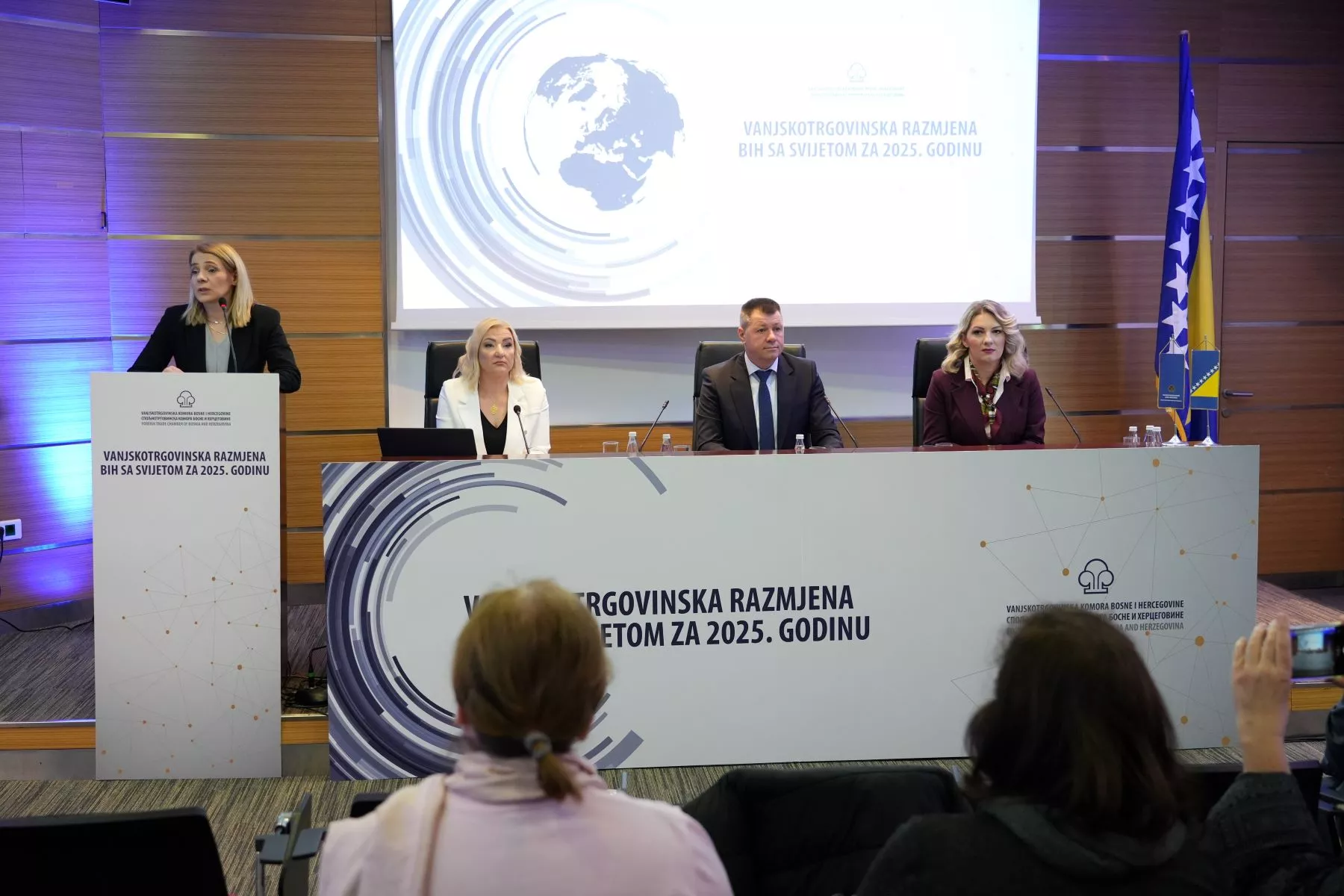
(Patria) - In 2025, the total volume of Bosnia and Herzegovina's foreign trade with the world increased by 2.12 billion KM, confirming a higher intensity of international trade, as well as growth in economic activities and integration with foreign markets.
The value of exports in 2025 amounted to 17.42 billion KM, representing an increase of 882 million KM compared to the same period last year. Export growth is a positive signal and indicates the gradual recovery of foreign markets, primarily BiH's main trading partners.
The value of imports amounted to 30.43 billion KM, which is 1.21 billion KM more than the previous year. The trade deficit increased by 359 million KM and amounted to 13 billion.
This was highlighted at a press conference in Sarajevo, where the President of the Foreign Trade Chamber (VTK) of BiH, Ahmet Egrlić, and representatives of the Macroeconomic System Sector, Belma Alihodžić and Amila Močević, presented the basic indicators of our country's foreign trade with the world in 2025.
Data on our country's foreign trade with the world were also presented to representatives of the diplomatic corps in BiH, BiH institutions, and companies.
- During the past year, almost 1,000 of our companies participated in fair visits, B2B meetings, conferences, and training sessions that we organized. The trade structure remains stable, the metal industry retains the largest share, while the wood industry achieves a surplus and makes a significant contribution to the foreign trade balance.
It is particularly important to emphasize the strong connection with the markets of the European Union and the CEFTA region, where BiH companies are integrated into regional and European value chains. Export growth in certain markets, along with the simultaneous need for further diversification and strengthening of competitiveness, indicates the potential of the domestic economy to further improve its position in the international market in the coming period - said Egrlić.
The European Union remains key for BiH exports, with Croatia being the leading individual partner, while the most dynamic growth was recorded within CEFTA, confirming that regional markets are becoming an increasingly important space for placing BiH products and building long-term economic ties.
- The most significant trading partner for our country remains the EU, with more than 73% of total exports and 66% of total imports. Moderate import growth of 2.68% and stronger export growth of 5.57% confirm stable and intensive foreign trade, with exports to the EU increasing by 669 million KM.
The coverage of imports by exports with the EU is 62.7%, which indicates a stable, but still deficit, relationship, with the EU retaining its position as a key partner and the main driver of BiH exports - said Alihodžić.
Total exports to CEFTA region countries amounted to 2.97 billion KM, an increase of 135 million KM compared to the previous year, while imports from the CEFTA region were 4.74 billion KM, an increase of 229 million KM.
The largest volume of trade is with Serbia, where goods worth 1.88 billion KM were exported, while the value of imports was 4.10 billion KM.
- Exports to the CEFTA market amounted to 404.52 million KM, an increase of 64.5 million KM compared to the previous year. Imports amounted to 603.16 million KM and are higher by 21.99 million KM. More than 70% of total trade with EFTA is with Switzerland, where exports reached 344.37 million KM, while imports amounted to 547.66 million KM.
Bosnia and Herzegovina achieved export growth to so-called third markets of 3.60%, with a total of 1.37 billion KM worth of goods exported, while imports amounted to 4.85 billion KM, an increase of 9.48%. Of these markets, exports only grew to Turkey, while imports grew the most from China - said Alihodžić.
Looking at commodity trade in economic sectors, an increase in both exports and imports is evident in almost all sectors, which directly resulted in a larger volume of total trade. The structure of export growth shows that BiH is progressing fastest in the sectors of energy, electrical industry, and automotive industry.
- The total export growth is largely the result of a strong increase in electricity exports, which grew by 30% and confirmed the key role of the energy sector in BiH's export structure.
Significant contributions were also made by sectors with higher added value, primarily the export growth of automotive parts increased by 13% and insulated wires by 7%, confirming the stable integration of domestic companies into European supply chains.
Metal structures show moderate growth of 5%, while furniture exports slightly decreased by 2%, indicating market challenges, but also the continued presence of BiH manufacturers in the EU - said Močević.
She added that oil and petroleum oils continue to be the most significant import products, with a value of 2.24 billion KM in 2025, despite a 7% decrease.
- Car imports increased by 9%, and medicines by 8%. The growth in electricity imports is particularly pronounced at 101%, to 628.96 million KM, indicating an energy imbalance and the need to strengthen domestic capacities.
Copper wire, with imports of 471.8 million KM and growth of 4%, retains a significant role as it is largely used for further processing and export, confirming the integration of domestic industry into international value chains - explained Močević.
The agro-industrial and food sector continues to record the largest deficit in commodity trade, which in 2025 amounts to 4.24 billion KM, resulting from imports of 5.55 billion KM and exports of 1.32 billion KM.
- Although the deficit appears large, it is understandable given BiH's dependence on the import of raw materials and products that are not produced domestically. Agro-industry exports resulted in increased placement of fats and oils, dairy products, and cereal-based products.
Imports are led by meat and meat products, vinegar, alcohols and beverages, tobacco, coffee, tea, cereal-based products, and the dairy industry. The agro-industry has room for further growth, but domestic market support is also needed for acceleration - added Močević.
The wood industry, as highlighted, traditionally achieves a surplus in commodity trade thanks to export growth and controlled imports. In 2025, exports amounted to 2.60 billion KM, while imports were 1.45 billion KM, resulting in a surplus of 1.15 billion KM.
In the same period, the chemical and pharmaceutical industry achieved exports of 2.14 billion KM, a slight decrease of 11 million KM or 1%, while imports increased to 4.66 billion KM, representing a growth of 5%.
The textile industry recorded a decrease in exports to 1.61 billion KM and a reduction of 47.3 million KM, while imports amounted to 2.32 billion KM and recorded a decrease of 31.3 million KM.
Mineral fuels and electricity show stable import growth, with oil product imports in 2025 amounting to 2.24 billion KM, while electricity imports have sharply increased to 628.96 million KM, or 101%.
In 2026, it is expected that BiH's foreign trade will maintain a similar pace as before, without significant fluctuations. On the other hand, wage growth, increased inflow of remittances from abroad, and slightly elevated inflation could result in increased domestic consumption, which could increase imports in the next quarter.
As for exports, moderate growth is predicted, but without major jumps. For greater growth in total exports, it is necessary to increase the export of products with higher added value, especially in the food, textile, automotive, and IT sectors, and to diversify exports to so-called third markets, particularly to the USA, Turkey, and Saudi Arabia.
Komentari (0)
Prijavite se za komentiranje
PrijavaJos nema komentara. Budite prvi!
Minuta
Sve →Iz drugih kategorija

High Representative Not Elected: Germans, French and British Against Americans, New Attempt at End of June

ČOVIĆ WITHOUT MERCY: How Those Who Brought Ademović to Office Created a Political Hell for Him



Sunny Saturday, quite warm



Tragedy in Albanian resort: Two minors drown












